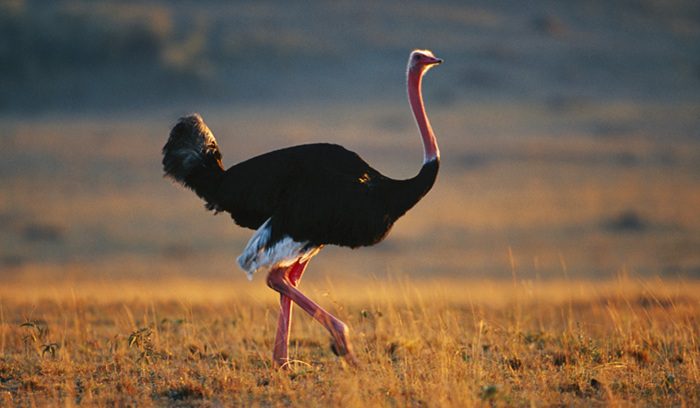
For the first time in roughly 100 years, wild ostriches are walking across the sands of Saudi Arabia. A coordinated rewilding program has reintroduced the North African ostrich — once hunted to local extinction — to protected desert habitat in the Kingdom, marking one of the most significant wildlife recoveries in the Arabian Peninsula’s modern history.
At a glance
- Ostrich rewilding: Saudi Arabia’s Royal Commission for AlUla and the Saudi Wildlife Authority have led the reintroduction of North African ostriches to protected reserves, including the vast Mahazat as-Sayd Protected Area.
- Protected habitat: Mahazat as-Sayd covers more than 2,200 square kilometers of fenced desert — one of the largest protected areas of its kind in the world — giving reintroduced animals room to establish wild populations.
- Extinction driver: Ostriches disappeared from the Arabian Peninsula in the early 20th century C.E., lost to overhunting and habitat pressure during a period when traditional wildlife management practices had broken down across the region.
Why ostriches matter to desert ecosystems
Ostriches are not just a dramatic sight on the horizon. They play a functional role in desert ecosystems — spreading seeds across vast distances, disturbing soil in ways that support plant diversity, and serving as prey that sustains larger predators.
Their return signals something broader: that degraded desert habitats can recover when given protection and time. Saudi Arabia’s rewilding push is part of a wider Vision 2030 environmental strategy that has also seen the reintroduction of Arabian oryx, sand gazelle, and Arabian sand gazelle to reserves across the country.
The North African ostrich (Struthio camelus camelus) is the subspecies historically native to the Arabian Peninsula. It is still classified as vulnerable by the International Union for Conservation of Nature, which makes every successful reintroduction meaningful beyond the borders of any single country.
Centuries of coexistence, then loss
Ostriches have a long history in the Arabian Peninsula. Ancient rock art across the region depicts them alongside hunters and herders — evidence of a deep relationship between people and these birds stretching back thousands of years.
That relationship was not always extractive. Indigenous Bedouin communities historically managed desert wildlife through traditional stewardship practices that limited overhunting. The collapse of those practices in the early 20th century C.E., combined with the spread of firearms and motor vehicles, drove ostriches — and many other species — to regional extinction within a few decades.
Restoring them now requires not just releasing birds but rebuilding the ecological conditions that allow them to survive. That means protected land, managed water sources, monitoring teams, and sustained political will.
What comes next
Conservationists are watching closely to see whether released populations breed successfully in the wild — the true measure of a rewilding program’s success. Early signs from Saudi Arabia’s reserves have been encouraging, with reports of natural breeding among reintroduced oryx and gazelle populations suggesting the habitat can support self-sustaining wildlife communities.
The ostrich program still faces real challenges. Maintaining the scale of protection needed across thousands of square kilometers is expensive and logistically complex. And while fenced reserves are a critical first step, some ecologists argue that true recovery requires wildlife to eventually move through unfenced, working landscapes — a much harder goal to achieve.
Still, a century after ostriches vanished from Arabian skies, they are back. That fact alone carries weight.
For context on how protected area design is shaping wildlife recovery globally, see this overview from the International Union for Conservation of Nature. The Royal Commission for AlUla publishes updates on Saudi Arabia’s broader rewilding initiative. For subspecies status, the IUCN Red List entry for the North African ostrich provides current population data. And for a broader view of Arabian Peninsula conservation, National Geographic has documented the region’s remarkable recovery efforts in recent years.
Read more
For more on this story, see: Ostriches return to Saudi desert for first time in 100 years
For more from Good News for Humankind, see:
- Ghana creates a new marine protected area at Cape Three Points
- Alzheimer’s risk cut in half by drug in landmark prevention trial
- The Good News for Humankind archive on wildlife conservation
About this article
- 🤖 This article is AI-generated, based on a framework created by Peter Schulte.
- 🌍 It aims to be inspirational but clear-eyed, accurate, and evidence-based, and grounded in care for the Earth, peace and belonging for all, and human evolution.
- 💬 Leave your notes and suggestions in the comments below — I will do my best to review and implement where appropriate.
- ✉️ One verified piece of good news, one insight from Antihero Project, every weekday morning. Subscribe free.