
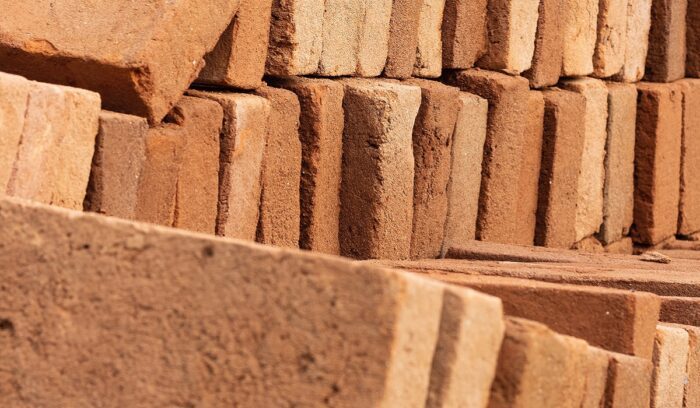
At a site in the Jordan Valley, sometime around 8000 B.C.E., people shaped wet clay into rough oblongs, pressed them flat, and left them in the sun to harden. It sounds almost too simple. But that act — repeated, refined, and passed on — set in motion one of the longest-running revolutions in human history.
Key findings
- Sun-dried mud bricks: Archaeological excavations at ancient Jericho, in the modern-day West Bank, have yielded some of the oldest known shaped bricks, made from clay mixed with organic material and dried in the open air.
- Early construction materials: Before shaped bricks, permanent shelters relied on stone, timber, or packed earth — materials harder to shape, transport, and stack with precision.
- Jericho settlement: Jericho is among the world’s oldest continuously inhabited sites; its residents were among the earliest known to transition from nomadic camps to walled, permanent settlements — a shift bricks helped make possible.
What a sun-dried brick actually was
The earliest bricks were not baked. They were shaped by hand — often pressed into simple molds — from a mixture of clay soil, water, and straw or other plant fiber. The straw wasn’t decoration; it acted as a binding agent, distributing stress through the material and reducing cracking as the clay dried.
Left in the sun for days, the result was a block that held its shape, could be stacked, and could be produced by almost anyone with access to riverside clay. No kiln required. No specialist knowledge beyond what neighbors could teach each other.
That accessibility was the point. Mud brick construction spread rapidly across the ancient Near East because it required only materials the land already offered in abundance. A community near a river could build more shelter faster, more durably, and with less physical effort than was possible with stone.
From Jericho to the ancient world
Jericho was not an isolated experiment. Across the ancient Near East — in what are now Iraq, Syria, and Turkey — early farming communities were making similar discoveries around the same period. The emergence of settled agriculture and the invention of shaped bricks appear to have developed in close proximity, each enabling the other.
As communities grew, so did the ambition of their construction. Mesopotamian builders eventually discovered that mixing clay with straw and firing it in a kiln produced a harder, more water-resistant brick — one that could support taller walls and stand up to rain in ways that sun-dried bricks could not. The walls of ancient Babylon were built from exactly these kiln-fired bricks.
Brick technology spread west and north over millennia. It arrived in the Indus Valley, where the cities of Mohenjo-daro and Harappa used standardized fired bricks laid with remarkable precision — including plumbing systems that required consistent brick dimensions to function. It reached China, Egypt, and eventually the Mediterranean.
In each case, local builders adapted the core idea to their climate, their soil, and their aesthetic traditions. The brick was not a single invention exported from one place. It was a shared discovery, refined independently and then traded, borrowed, and improved across cultures.
Lasting impact
It is difficult to overstate how much the brick changed what human settlement could look like.
Before shaped bricks, permanent buildings were constrained by the shapes that stone and timber naturally offered. A brick wall could be any length, any height, curved or straight, with openings wherever a builder chose to leave them. Bricks standardized construction in a way that made it teachable, scalable, and repeatable.
That standardization had social consequences. Buildings became more permanent. Permanent buildings meant fixed communities. Fixed communities meant record-keeping, division of labor, trade networks, and governance. The temples, granaries, and administrative centers of early Mesopotamian cities were built from brick. So were the walls that defined cities as distinct from the surrounding land — a concept that would shape human political organization for thousands of years.
The Romans later pushed brick technology further, developing mortar from lime, water, and sand, then discovering that adding crushed stone and pottery fragments to mortar produced a moldable, durable substance we now call concrete. That chain of innovation — from a clay block dried in the Jordan Valley sun to the Pantheon’s poured concrete dome — runs without a significant break across roughly ten millennia.
Today, bricks remain one of the most widely used construction materials on Earth. Roughly 1.4 trillion bricks are produced each year. The fundamental concept has not changed since Jericho.
Blindspots and limits
The archaeological record for this period is fragmentary, and “oldest known” is not the same as “oldest.” Earlier brick use may yet be found at sites not yet excavated or not yet recognized as such. The date of ~8000 B.C.E. reflects current best evidence but should be held loosely — some sources cite 7000 B.C.E., and the range between those figures likely reflects different sites, different definitions of what counts as a shaped brick, and different dating methods.
It is also worth noting that sun-dried mud construction — including rammed earth walls and molded mud blocks that blur the line between “brick” and “not brick” — predates Jericho at various sites. The transition from shaped mud to recognizable standardized brick was gradual, not a single invention moment, and many communities contributed to it without leaving records we can read.
Kiln-fired bricks, while more durable, came with real costs: fuel consumption for kilns contributed to deforestation in parts of the ancient Near East, a consequence that brick-making industries continue to wrestle with in parts of South Asia today.
Read more
For more on this story, see: Owlcation — Who Invented Bricks, Mortar and Concrete?
For more from Good News for Humankind, see:
- Damascus emerges as one of the world’s oldest continuously inhabited cities
- Early humans reach Borneo, leaving some of the world’s oldest cave art
- The Good News for Humankind archive on prehistory
About this article
- 🤖 This article is AI-generated, based on a framework created by Peter Schulte.
- 🌍 It aims to be inspirational but clear-eyed, accurate, and evidence-based, and grounded in care for the Earth, peace and belonging for all, and human evolution.
- 💬 Leave your notes and suggestions in the comments below — I will do my best to review and implement where appropriate.
- ✉️ One verified piece of good news, one insight from Antihero Project, every weekday morning. Subscribe free.


