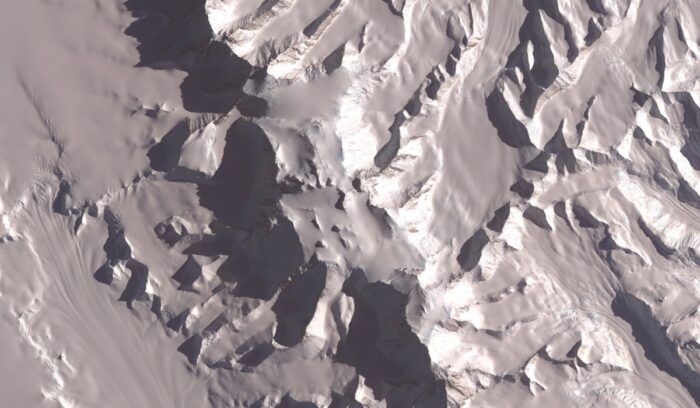
Antarctica had been mapped from the air and named on charts for nearly a decade before anyone set foot on its highest point. In December 1966 C.E., a team of ten American scientists and mountaineers changed that — trudging through polar cold to plant footprints on a summit that no human being had ever reached.
Key findings
- Mount Vinson first ascent: The American Antarctic Mountaineering Expedition (AAME) 1966/67, led by Nicholas Clinch, completed the first ascent of Mount Vinson on 18 December 1966 C.E., with all ten expedition members reaching the summit across three consecutive days.
- Antarctic exploration history: Mount Vinson, standing at 4,892 meters (16,050 feet) above sea level, had only been spotted from the air in January 1958 C.E. by U.S. Navy aircraft — less than a decade before climbers stood on its peak.
- Seven Summits designation: Mount Vinson is the highest peak on the Antarctic continent and is counted among the Seven Summits, the highest mountain on each of the world’s seven continents — a list that draws climbers from across the globe.
A mountain that almost no one could reach
Mount Vinson sits roughly 1,200 kilometers (750 miles) from the South Pole, inside the Sentinel Range of the Ellsworth Mountains, overlooking the Ronne Ice Shelf. Getting there in the 1960s C.E. was not simply a matter of booking a flight — it required the backing of the U.S. Navy, the National Science Foundation, and the American Alpine Club.
Two separate climbing groups had been lobbying for the expedition since 1963 C.E. One was organized by Charles Hollister and Samuel Silverstein in New York; the other was led by Peter Schoening out of Seattle, Washington. The National Science Foundation pushed the two groups to merge, and in spring 1966 C.E., the AAC recruited Nicholas Clinch to lead the combined team.
The result was the AAME 1966/67 — ten climbers and scientists drawn from universities including Columbia, the University of Minnesota, and the University of Washington, with sponsorship from the AAC and the National Geographic Society.
The climb itself
The Navy flew the expedition from Christchurch, New Zealand, to McMurdo Sound, Antarctica, and then by ski-equipped C-130 Hercules aircraft into the Sentinel Range in December 1966 C.E. The first group of four climbers reached the summit on 18 December. Three more followed on 19 December, and the final three on 20 December. Every member of the expedition made the top.
The climb offered relatively little technical difficulty by elite mountaineering standards. The real obstacles were environmental: average temperatures of around −30°C (−20°F), the constant risk of high winds and snowfall, and the sheer remoteness of a mountain that lies at the edge of one of the most isolated places on Earth.
That remoteness also meant there were no local climbing communities or Indigenous mountain traditions to draw on — unlike many of the world’s other great peaks, where local guides and knowledge systems had shaped the history of high-altitude climbing for generations. This was, in a meaningful sense, a mountain that humanity was approaching from the outside for the very first time.
Lasting impact
The 1966 C.E. first ascent opened a new chapter in Antarctic exploration and helped establish Mount Vinson as a premier goal for serious mountaineers. By February 2010 C.E., more than 1,400 climbers had attempted the summit. The mountain became an anchor point for the Seven Summits challenge — the goal of climbing the highest peak on every continent — which has since drawn thousands of climbers into Antarctica and helped sustain a small but significant ecosystem of polar adventure and science.
The expedition’s legacy is also written into the landscape itself. In August 2006 C.E., the U.S. Advisory Committee on Antarctic Names approved the naming of subsidiary peaks south of Mount Vinson after each of the AAME 1966/67 members — Clinch, Corbet, Fukushima, Hollister, Marts, Silverstein, Schoening, and Wahlstrom — a permanent record of the team’s achievement carved into Antarctic geography.
The precise height of Mount Vinson was not fully confirmed until GPS surveys conducted by the Omega Foundation between 1998 and 2007 C.E. established the current figure of 4,892 meters (16,050 feet). The surveys were led by Australian mountaineer Damien Gildea, working alongside Chilean climbers Rodrigo Fica and Camilo Rada — a reminder that the story of understanding this mountain has always been international, even when the first team to climb it was not.
Blindspots and limits
The first ascent of Mount Vinson was a genuine milestone, but its story belongs to a narrow slice of humanity — well-funded, institutionally connected, predominantly male, and operating under the geopolitical umbrella of Cold War-era U.S. Antarctic presence. The mountain lies within an area subject to an unrecognized Chilean territorial claim under the Antarctic Treaty System, a reminder that Antarctica’s political status remains genuinely contested. The Wikipedia source also notes that the claim about who was “first” to set foot on the summit within the four-person lead group on 18 December 1966 C.E. is not clearly established in the available record.
Read more
For more on this story, see: Wikipedia — Vinson Massif
For more from Good News for Humankind, see:
- Uganda brings rhinos back to Kidepo Valley
- Indigenous land rights recognized for 160 million hectares ahead of COP30
- The Good News for Humankind archive on the modern era
About this article
- 🤖 This article is AI-generated, based on a framework created by Peter Schulte.
- 🌍 It aims to be inspirational but clear-eyed, accurate, and evidence-based, and grounded in care for the Earth, peace and belonging for all, and human evolution.
- 💬 Leave your notes and suggestions in the comments below — I will do my best to review and implement where appropriate.
- ✉️ One verified piece of good news, one insight from Antihero Project, every weekday morning. Subscribe free.