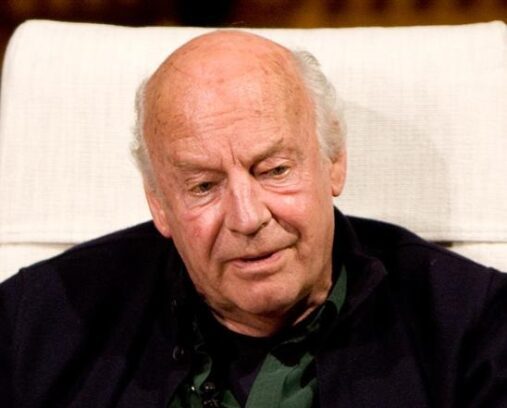
In 1986 C.E., a Uruguayan writer working in exile finished a project that had consumed nearly a decade of his life — a three-volume retelling of the entire human history of the Americas, from Indigenous creation to the Cold War, told not in chapters but in hundreds of brief, luminous scenes. With the publication of Century of the Wind, Eduardo Galeano closed the Memory of Fire trilogy, one of the most ambitious works of literary non-fiction the Americas had ever produced.
What the trilogy achieved
- Memory of Fire trilogy: The three volumes — Genesis (1982 C.E.), Faces and Masks (1984 C.E.), and Century of the Wind (1986 C.E.) — together span roughly five centuries of American history, from pre-Columbian civilizations to the mid-twentieth century, told through hundreds of micro-narratives drawn from primary sources.
- Narrative structure: Galeano’s method was formally radical: each entry, rarely longer than a page, cites its source in a footnote, blurring the boundary between fiction and documented history and placing poetry in direct service of the historical record.
- Literary reception: The trilogy was described by critics as “the most powerful literary indictment of colonialism in the Americas” and earned Galeano recognition as a defining voice of Latin American letters — alongside a reputation that crossed well beyond academic or leftist circles.
A book born from exile
Galeano did not write *Memory of Fire* from the comfort of a university post. He wrote it as a man in flight.
In 1973 C.E., a military coup overthrew Uruguay’s civilian government. Galeano was imprisoned and then forced to leave the country he would later describe as an intimate land condemned to amnesia. He moved to Argentina, where he founded the cultural magazine Crisis — until the Videla regime’s 1976 C.E. coup put his name on a death squad list and forced him to flee again, this time to Spain.
It was in Spain that the trilogy took shape. The act of writing it was inseparable from what it was about: the silencing of voices, the erasure of memory, the insistence that the suppressed record could be recovered and made to speak again. Galeano finished the first volume, Genesis, in 1982 C.E. He returned to Montevideo in early 1985 C.E., after Uruguay’s democratization, and completed the trilogy the following year.
Whose history it told
The trilogy’s scope was extraordinary. Genesis opens with Indigenous creation stories and moves through the Spanish and Portuguese conquests. Faces and Masks covers the colonial period and the wars of independence. Century of the Wind carries the story through revolutions, coups, and resistance movements into the twentieth century.
What distinguished the work was not only its range but its perspective. The trilogy was built from the viewpoint of the conquered, the enslaved, and the dispossessed — the peoples whose stories were typically footnotes, or absent entirely, from official histories. Indigenous communities, African-descended populations, rural laborers, women, and dissidents all move through these pages as subjects rather than backdrop.
Galeano sourced each entry meticulously. The footnotes gave the work a documentary spine even as the prose sang. He was not inventing — he was recovering, reframing, and refusing to let the archive serve only those who had always controlled it.
The form was the argument
The micro-narrative structure of Memory of Fire was itself a political and aesthetic statement. By refusing the long march of conventional historiography — the grand arc, the heroic protagonist, the smooth progress narrative — Galeano insisted that history was made of fragments, voices, and moments that did not resolve neatly.
Each entry could be read alone. Together, they accumulated into something that felt less like a textbook and more like a collective memory being reassembled in real time. Scholars of Latin American literature noted that this structure drew on deep traditions of oral storytelling across Indigenous and Afro-Latin communities, traditions that survived in exactly the spaces official histories tried to erase.
The trilogy sat alongside Galeano’s earlier Open Veins of Latin America (1971 C.E.), which had been banned in Uruguay, Chile, and Argentina under military rule. But where Open Veins was driven by political economy, Memory of Fire was driven by image and voice. Galeano himself later acknowledged that his writing had evolved — that he had moved toward greater brevity and immediacy. The trilogy represented that evolution at its fullest.
Lasting impact
The completion of the Memory of Fire trilogy arrived at a specific historical moment: the return of democracy across much of Latin America after decades of military rule. In that context, a work dedicated to recovering suppressed memory was not merely literary — it was civic.
The trilogy has been translated into dozens of languages and remains in print across the world. It influenced a generation of writers, historians, and educators working to decolonize curricula and recover marginalized perspectives. Publishers like Norton, who brought the trilogy to English-speaking readers through translations by Cedric Belfrage and Mark Fried, helped carry the work to audiences far beyond Latin America.
Galeano’s method — sourced micro-narratives that center the dispossessed — has become a recognizable mode in literary non-fiction and hybrid history writing. Writers working in this vein today often cite him directly. His insistence that history belonged to the people it happened to, not only to those who wrote it down, shaped debates about historical memory and truth-telling that are still very much alive.
The trilogy also demonstrated something important about literature’s relationship to political trauma: that the most durable response to erasure is not argument alone, but beauty alongside argument. A story told well enough cannot easily be untold.
Blindspots and limits
The trilogy’s point of view is a strength and a constraint simultaneously. Galeano wrote as an advocate, and some historians have noted that Memory of Fire can flatten complexity in service of its moral architecture — rendering certain historical actors as straightforwardly heroic or villainous in ways that oversimplify the record. The work’s later volumes, covering the twentieth century, occasionally veer closer to political polemic than to the careful evidentiary restraint of its best pages.
Galeano himself, toward the end of his life, expressed ambivalence about parts of his earlier writing — not disavowing the politics, but questioning the craft. He remained committed to the core project while acknowledging that no single voice, however capacious, could hold all the Americas’ stories at once.
Read more
For more on this story, see: Eduardo Galeano — Wikipedia
For more from Good News for Humankind, see:
- Indigenous land rights and the fight to protect 160 million hectares
- Marie-Louise Eta becomes the first female head coach in men’s top-flight European football
- The Good News for Humankind archive on Uruguay
About this article
- 🤖 This article is AI-generated, based on a framework created by Peter Schulte.
- 🌍 It aims to be inspirational but clear-eyed, accurate, and evidence-based, and grounded in care for the Earth, peace and belonging for all, and human evolution.
- 💬 Leave your notes and suggestions in the comments below — I will do my best to review and implement where appropriate.
- ✉️ One verified piece of good news, one insight from Antihero Project, every weekday morning. Subscribe free.