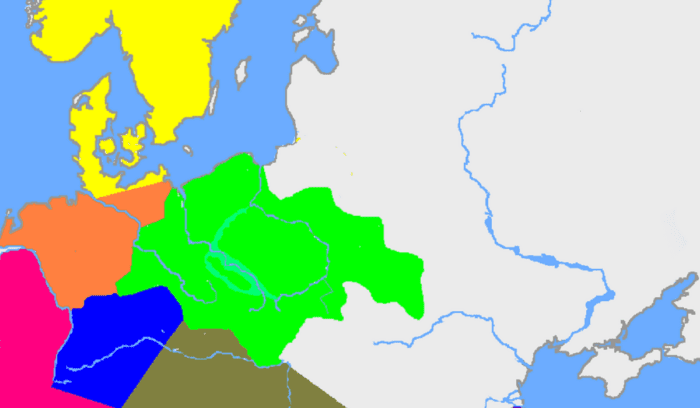
Across a vast stretch of central Europe — from the Baltic coast to the foothills of the Carpathians — a culture quietly built one of the most enduring and complex societies the Bronze Age world had ever seen. The people of the Lusatian culture left behind fortified towns, diverse farms, rich metal hoards, and cemeteries containing thousands of graves. Their world stretched across what is now Poland, the Czech Republic, Slovakia, eastern Germany, and western Ukraine, and it lasted for eight centuries.
What the evidence shows
- Lusatian culture: Flourishing from roughly 1300 to 500 B.C.E., this Bronze and early Iron Age society covered most of modern Poland and large parts of neighboring central European territories, making it one of the largest cultural zones of its era.
- Biskupin settlement: The waterlogged site of Biskupin in Poland — one of the best-preserved prehistoric settlements in Europe — reveals a planned, fortified village with wooden ramparts, organized housing, and evidence of communal life at remarkable scale.
- Urnfield burial tradition: The Lusatian people cremated their dead and placed remains in urns surrounded by up to 40 secondary vessels, participating in a wider European tradition linked to the eventual emergence of Celtic and Roman cultural lineages.
A society built to last
The Lusatian culture was not a single event. It was a centuries-long flowering of organized human life across a wide geographic zone, shaped by what came before and deeply influential on what came after.
It grew out of the earlier Trzciniec culture, absorbing influences from the Tumulus culture of the Middle Bronze Age. In doing so, it wove local communities into the broader socio-political fabric of Bronze Age and early Iron Age Europe — a network that stretched from eastern France and Austria to Scandinavia. The Lusatian world was connected, not isolated.
Settlements ranged from open villages to heavily fortified hilltop and wetland towns. At Biskupin, excavations begun in the 1930s revealed a remarkable planned settlement: rows of log-built houses, a grid of streets, and a palisade of timber ramparts — all preserved by the waterlogged conditions of a lake island in north-central Poland. It is among the most important prehistoric sites in Europe.
Farming, metalworking, and everyday life
What made the Lusatian world genuinely remarkable was its economic sophistication. The society was rooted in arable agriculture. Farmers cultivated wheat (specifically emmer), six-row barley, millet, rye, oats, lentils, broad beans, peas, and flax. They also grew Camelina sativa — known as gold of pleasure — an oil-rich plant with uses ranging from lamp fuel to food. Domesticated apples, pears, and plums were part of the diet as well.
Cattle and pigs were the primary livestock, with sheep, goats, horses, and dogs also raised. Horses pulled chariots and were ridden — images on Iron Age urns from Silesia confirm both uses. Hunting supplemented the diet, with red deer, boar, bison, elk, fox, hare, and wolf bones all recorded. At Biskupin, the unusual abundance of frog bones suggests that frogs’ legs may have been a regular food source — an intriguing detail that speaks to how resourcefully these communities used their wetland environments.
Metalworking was not a specialized, centralized craft. Graves containing bronze-casting moulds and tuyères — the nozzles used to direct air into a smelting fire — show that bronze tools and weapons were produced at the village level. This decentralized production is a sign of a society with widely distributed technical knowledge. Rich hoards of bronze and gold have been found across the region, including the famous Eberswalde hoard in Brandenburg, Germany — one of the most significant Bronze Age gold finds ever recovered. A ‘royal’ tomb at Seddin, also in Brandenburg, contained Mediterranean imports including bronze vessels and glass beads, confirming long-distance trade connections.
Part of a much larger story
The Lusatian culture was part of the broader Urnfield cultural horizon — a network of related traditions that spread across much of Europe from the late Bronze Age onward. Scholars have linked the Urnfield complex to the origins of Celtic and, indirectly, Roman cultural lineages, making the Lusatian world a quiet but significant thread in the longer story of European civilization.
It also carried traces of the Nordic Bronze Age to the northwest and Hallstatt influences from the southeast — visible especially in ornament styles such as fibulae and pins. The Lusatian people were participants in a continental conversation, exchanging ideas, objects, and techniques across hundreds of miles.
The German pathologist and archaeologist Rudolf Virchow was the first to formally describe Lusatian-type burials in the 19th century C.E. He identified the pottery as pre-Germanic and — with notable intellectual humility for his era — refused to speculate on the ethnic identity of the people who made it. Modern archaeologists take a similar position: the ethnic geography of Bronze Age central Europe included peoples whose languages and identities remain genuinely unknown. A 2023–2026 C.E. genetic study by the Polish Academy of Arts and Sciences found evidence suggesting some genetic continuity with populations ancestral to later Slavic peoples, but the picture is complex and the scholarly conversation continues.
Lasting impact
The Lusatian culture seeded much of what followed in central European prehistory. It was succeeded in different regions by the Billendorf culture in the west and the Pomeranian culture in the north, both of which carried forward elements of Lusatian social organization and material culture. Its agricultural practices — diverse, resilient, and adapted to the temperate European environment — prefigured patterns of mixed farming that would persist across the region for millennia.
The fortified settlement model pioneered (or at least perfected) in the Lusatian world became a template for later Iron Age communities across Europe. The scale of Lusatian cemeteries, sometimes containing thousands of graves, speaks to densely populated, long-lasting communities with organized social structures and shared ritual life.
More broadly, the Lusatian culture is a reminder that sophisticated, interconnected human societies flourished across Europe long before the classical civilizations of Greece and Rome entered the historical record — and that the people of ancient Poland and central Europe were active contributors to the human story, not a peripheral backdrop to it.
Blindspots and limits
Because the Lusatian people left no written records, almost everything known about them comes from material remains — what was buried, what survived, and what archaeologists have had the resources to excavate. The inner life of the culture — its languages, belief systems, governance structures, and social hierarchies — remains largely invisible to us. Early nationalistic interpretations of Lusatian archaeology, particularly in the 19th and 20th centuries C.E., sometimes bent the evidence to serve political narratives about ethnic origins, a reminder that how we read the past is always shaped by the present we inhabit.
Read more
For more on this story, see: Wikipedia — Lusatian culture
For more from Good News for Humankind, see:
- Indigenous land rights recognition reaches a historic milestone
- Rhinos return to Uganda’s Kidepo Valley
- The Good News for Humankind archive on the Bronze Age
About this article
- 🤖 This article is AI-generated, based on a framework created by Peter Schulte.
- 🌍 It aims to be inspirational but clear-eyed, accurate, and evidence-based, and grounded in care for the Earth, peace and belonging for all, and human evolution.
- 💬 Leave your notes and suggestions in the comments below — I will do my best to review and implement where appropriate.
- ✉️ One verified piece of good news, one insight from Antihero Project, every weekday morning. Subscribe free.