Around 5000 B.C.E., farming communities from one of Europe’s most widespread early agricultural networks put down roots along a stretch of the Danube that would one day become the capital of Slovakia. They were among the first people anywhere to turn this particular bend in the river into a permanent home — and they did it roughly 7,000 years before anyone called the place Bratislava.
What the evidence shows
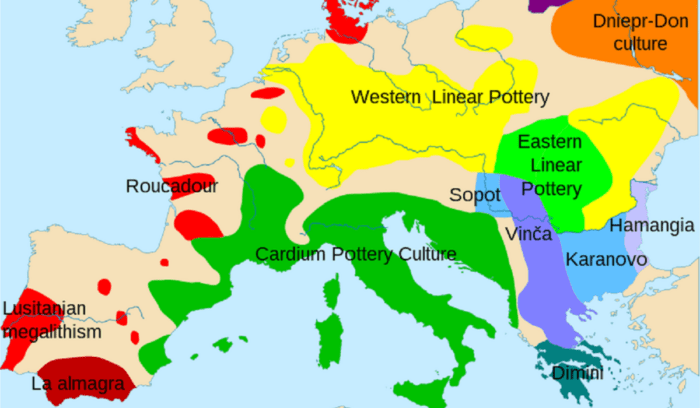
- Linear Pottery Culture: Also known by its German name Linearbandkeramik (LBK), this culture spread across Central Europe from roughly 5500 to 4500 B.C.E., carrying agriculture westward from the Balkans in one of prehistory’s most rapid human expansions.
- Neolithic settlement: Archaeological evidence at the Bratislava site identifies this as the first known permanent settlement in the area, placing it squarely in the Neolithic era — the period when humans were shifting from nomadic foraging to village life and cultivated land.
- Danube corridor: The Danube River valley served as a natural highway for the spread of early farming communities; Bratislava’s position at the confluence of the Danube and Morava rivers made it a natural stopping point for westward-moving agricultural populations.
Who the Linear Pottery people were
The Linear Pottery Culture takes its name from the distinctive incised decorations on its pottery — simple, flowing geometric lines that archaeologists now recognize across hundreds of sites from Hungary to France. These were not wandering bands. They were farmers.
LBK communities built longhouses — sometimes more than 30 meters from end to end — that housed extended families and their animals. They grew emmer wheat and einkorn, kept cattle and pigs, and organized their villages with a consistency that archaeologists find striking across vast distances. The same basic house form, the same ceramic style, the same agricultural toolkit appears from the Pannonian Plain all the way to the Paris Basin.
Genetic and isotopic studies in recent decades have revealed that LBK farmers descended largely from Anatolian agricultural communities who had migrated into Europe over thousands of years. They mixed with local Mesolithic hunter-gatherer populations to varying degrees. The people who arrived at the future site of Bratislava around 5000 B.C.E. were, in other words, the product of a long, slow, multigenerational migration — a human chain stretching back to the ancient Near East.
Why this location mattered
The site that would become Bratislava sits at a geographically unusual junction. The Little Carpathian foothills rise to the north and east; the Danube curves through the lowlands below. Two rivers converge here. Three countries now share borders within a few kilometers of the old city center.
For Neolithic farmers, this kind of geography was not incidental — it was the point. Fertile loess soils, access to water, natural defensive high ground, and proximity to river-based travel routes made this one of the most attractive settlement locations in the entire Middle Danube region. The Danubian corridor that the LBK people followed westward ran almost directly through this spot.
Communities that settled here could farm the rich floodplain terraces, trade along the river, and watch the landscape in multiple directions. That combination of advantages explains why human settlement at Bratislava did not end with the LBK. The Celts arrived around 200 B.C.E. The Romans fortified the riverbank. The Slavs came next. Eleven Hungarian kings were later crowned here. The same geography that attracted Neolithic farmers shaped every chapter that followed.
Lasting impact
The decision — if “decision” is even the right word for the gradual process of a community choosing to stay — to settle the Bratislava bend of the Danube set in motion one of the longest unbroken chains of human habitation in Central Europe.
Agriculture itself was the larger revolution. The Neolithic transition that LBK communities carried across Europe fundamentally altered the human relationship with land, time, and social organization. Farming made surplus possible. Surplus made storage possible. Storage made complex community life possible. Villages became towns. Towns became cities. The same shift playing out at Bratislava around 5000 B.C.E. was happening simultaneously across a broad arc from the Levant to the Atlantic coast.
The LBK also left a genetic legacy. Population genomics research has traced ancestry from early European farmers — including LBK communities — forward into present-day European populations. The people who built longhouses at the foot of the Little Carpathians are, in a real biological sense, among the ancestors of people living in Central Europe today.
At a more local scale, the Bronze Age, Iron Age, and Celtic cultures that followed at Bratislava each built on what came before. The Celts who founded the Bratislava oppidum around 200 B.C.E. were settling land with a millennium-long agricultural memory. The Romans who arrived centuries later found a region already shaped by human use. Settlement, in this sense, compounds.
Blindspots and limits
The archaeological record for LBK communities at Bratislava is real but incomplete. Much of what scholars know about this settlement comes from regional site patterns and material culture comparisons rather than deep excavation of the Bratislava site itself, which centuries of subsequent habitation have complicated. The “around 5000 B.C.E.” date reflects the broader LBK chronology in this region; tighter dating awaits more extensive study.
It is also worth being clear about what “first known permanent settlement” means and does not mean. It means first in the surviving archaeological record — not necessarily first in absolute terms. Earlier transient or seasonal use of this landscape by Mesolithic foragers is entirely plausible and would leave a much fainter trace. The shift from foraging to farming was rarely a clean break; in many places it was a long, overlapping process involving people who moved between both strategies for generations.
Read more
For more on this story, see: Wikipedia — Bratislava: History
For more from Good News for Humankind, see:
- Indigenous communities secure 160 million hectares in landmark land rights push
- Rhinos return to Uganda’s Kidepo Valley after decades away
- The Good News for Humankind archive on prehistory
About this article
- 🤖 This article is AI-generated, based on a framework created by Peter Schulte.
- 🌍 It aims to be inspirational but clear-eyed, accurate, and evidence-based, and grounded in care for the Earth, peace and belonging for all, and human evolution.
- 💬 Leave your notes and suggestions in the comments below — I will do my best to review and implement where appropriate.
- ✉️ One verified piece of good news, one insight from Antihero Project, every weekday morning. Subscribe free.