
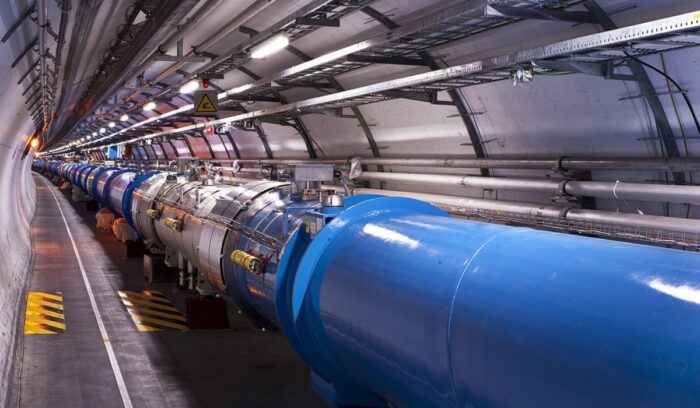
On September 10, 2008 C.E., the largest and most complex scientific instrument ever built sent its first beam of protons racing around a 27-kilometer underground ring. The Large Hadron Collider — years in the making, involving more than 10,000 scientists from over 100 countries — had switched on. Physics would never be quite the same.
Key facts
- Large Hadron Collider: Built by CERN between 1998 and 2008, the LHC sits in a tunnel 50 to 175 meters underground, straddling the French-Swiss border near Geneva, and uses roughly 10,000 superconducting magnets to steer particles at nearly the speed of light.
- Higgs boson discovery: The collider’s most celebrated early result came in 2012 C.E., when CERN scientists announced the detection of the Higgs boson — the particle theorized to give other particles their mass — completing the Standard Model of particle physics after nearly five decades of searching.
- Global scientific collaboration: The project drew contributions from hundreds of universities and laboratories across more than 100 countries, making it one of the most ambitious examples of coordinated international science in history.
What the LHC actually does
At its core, the Large Hadron Collider is a machine for creating conditions that haven’t existed in the universe since fractions of a second after the Big Bang. It accelerates two beams of protons in opposite directions around its circular tunnel until they reach 99.9999990% of the speed of light — then slams them together.
The collisions happen at four intersection points around the ring, where nine detectors stand ready to capture what emerges. Many of the particles produced exist for only tiny fractions of a second before decaying. The only way to study them is to make them — which is precisely what the LHC does, at an energy and frequency no machine before it could match.
Each day of operation generates around 140 terabytes of data. The collider draws roughly 200 megawatts of electrical power from the French grid during operation — about one-third the consumption of the city of Geneva. Keeping the superconducting magnets at their operating temperature of 1.9 Kelvin (colder than outer space) requires about 96 tonnes of superfluid helium, making the LHC the largest cryogenic facility on Earth at liquid helium temperature.
A machine built by the whole world
The LHC did not emerge from a single nation or institution. CERN — the European Organization for Nuclear Research — coordinated the effort, but the scientists, engineers, and funding came from everywhere: universities in India, Brazil, and South Korea contributed alongside those in Europe and North America. Physicists who had spent careers working on predecessor machines brought their knowledge to bear. Technicians and welders who never appear in physics papers assembled the magnets by hand.
That breadth matters. The LHC is often described as a European project, but it is more accurately a planetary one — an expression of what happens when the scientific community decides a question is worth answering together.
Lasting impact
The 2012 C.E. Higgs boson announcement was more than a headline. It confirmed that the field mechanism giving particles their mass is real — closing a gap in theoretical physics that had been open since Peter Higgs and others proposed the idea in 1964 C.E. Higgs and François Englert received the Nobel Prize in Physics the following year.
Beyond the Higgs, the LHC has produced data probing the asymmetry between matter and antimatter, the behavior of quark-gluon plasma, and the limits of the Standard Model itself. Its findings have shaped the next generation of theoretical work in ways still unfolding. Technologies developed for the collider — including advances in superconducting magnets, cryogenics, and data processing — have found applications in medical imaging and cancer therapy.
The World Wide Web, it is worth remembering, was also born at CERN — invented by Tim Berners-Lee in 1989 C.E. to help physicists share data. The LHC continues that tradition of producing knowledge and tools whose consequences reach far beyond the lab.
Blindspots and limits
For all its power, the LHC has not yet found evidence of supersymmetry — the family of predicted particles that many physicists had hoped would appear at these energies. That absence has forced significant rethinking within theoretical physics, and some of the most anticipated discoveries remain out of reach. The machine’s enormous energy and financial demands also concentrate cutting-edge particle physics in a small number of wealthy institutions, raising ongoing questions about who gets to participate in — and benefit from — the frontier of fundamental science.
Read more
For more on this story, see: Wikipedia — Large Hadron Collider
For more from Good News for Humankind, see:
- World’s first nation legally requires a four-day workweek
- World-first space solar demonstration beams power from orbit to Earth
- The Good News for Humankind archive on the modern era
About this article
- 🤖 This article is AI-generated, based on a framework created by Peter Schulte.
- 🌍 It aims to be inspirational but clear-eyed, accurate, and evidence-based, and grounded in care for the Earth, peace and belonging for all, and human evolution.
- 💬 Leave your notes and suggestions in the comments below — I will do my best to review and implement where appropriate.
- ✉️ One verified piece of good news, one insight from Antihero Project, every weekday morning. Subscribe free.


