
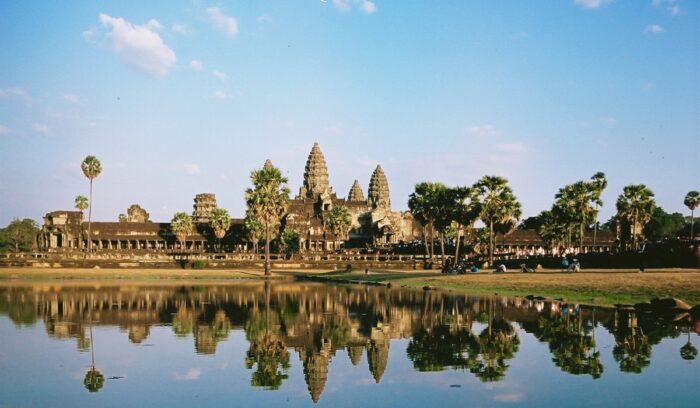
In 802 C.E., a Khmer prince climbed a sacred mountain in what is now northern Cambodia and declared himself a god-king and universal ruler. That single ceremony — part Hindu ritual, part political masterstroke — set in motion one of the most powerful and sophisticated civilizations Southeast Asia has ever seen.
Key facts
- Khmer Empire: Founded conventionally in 802 C.E. when Jayavarman II conducted a consecration ritual on Mount Mahendraparvata — now called Phnom Kulen — proclaiming himself chakravartin (universal ruler) and devaraja (god-king), and declaring independence from a place inscriptions call “Java.”
- Jayavarman II: The founding king had spent time at the Sailendran court in Java before returning to Cambodia, where he unified competing kingdoms and established his capital at Indrapura before eventually moving his court inland — a journey that laid the geographic and political groundwork for Angkor.
- Angkor water network: Satellite imaging has revealed that Angkor’s elaborate hydraulic infrastructure, at its peak between the 11th and 13th centuries, was the most extensive pre-industrial urban complex in the world — an engineering achievement that sustained a population of hundreds of thousands.
A kingdom built on water and ritual
The Khmer Empire grew from the older civilization of Chenla, itself a successor to earlier Cambodian polities. When Jayavarman II performed his great ritual on Phnom Kulen in 802 C.E., he was not starting from nothing. He was weaving together existing traditions — Hindu cosmology, Javanese court culture, and indigenous Khmer political structures — into something new and durable.
The ceremony mattered because it gave his rule a sacred dimension. By claiming the title of devaraja, Jayavarman II positioned himself not merely as a political ruler but as a divine presence on earth. That fusion of religion and governance would shape the empire for more than six centuries.
His successors extended the territory steadily. Indravarman I, who reigned from 877 to 889 C.E., expanded the kingdom without major wars and initiated ambitious construction projects, funded by agricultural surpluses and trade. The temple of Angkor, later designated a UNESCO World Heritage Site, began to take shape in this era. Crucially, Indravarman I’s temple Bakong shows striking architectural similarities to the Borobudur complex in Java — evidence of active exchange between Kambuja and the Sailendran court, not just one-way cultural borrowing.
Angkor and the hydraulic city
The empire’s capital, Angkor, was not simply a city of temples. It was an extraordinarily sophisticated hydraulic system — a network of reservoirs, canals, and moats that captured monsoon rains and redistributed water across the dry season. This system, revealed in full only through modern aerial and satellite archaeology, supported an urban population that may have reached one million people at the empire’s height.
Yasovarman I, who reigned from 889 to 915 C.E., created the East Baray — a reservoir measuring more than seven kilometers long and nearly two kilometers wide. That single structure held enough water to irrigate the rice fields that fed the capital. The Khmer didn’t conquer their environment; they worked with its rhythms.
This relationship with water also helps explain the empire’s extraordinary longevity. For more than 600 years, the hydraulic cities of Kambuja produced surpluses that funded art, architecture, and diplomacy on a scale few civilizations anywhere in the world could match.
Knowledge across borders
The Khmer Empire did not rise in isolation. Sanskrit was the empire’s prestige language, and Hindu and Buddhist traditions — transmitted through trade networks connecting South Asia, Southeast Asia, and China — shaped its art, governance, and cosmology. Scholars of Southeast Asian history have long noted that the Angkor period represents not a derivative culture but a creative synthesis: Khmer architects and scholars absorbed influences from Java, India, and China and produced something distinctly their own.
Stone inscriptions — the only written records of the Angkor period to survive — record not just royal deeds but donations to temples, the names of priests and administrators, and the workings of a complex bureaucracy. These inscriptions, many still being translated and analyzed, continue to reshape our understanding of how the empire actually functioned day to day.
The temple of Banteay Srei, built during the reign of Jayavarman V in the late 10th century C.E., is widely considered among the finest examples of Khmer art ever created. Its intricate sandstone carvings, executed at a scale almost impossibly fine for the medium, reflect the work of generations of craftspeople whose names history has not preserved.
Lasting impact
The Khmer Empire’s most visible legacy is Angkor Wat — built in the 12th century C.E. under Suryavarman II and now the largest religious monument on earth. But the empire’s influence extends well beyond stone. The Khmer language, Cambodian legal traditions, agricultural practices, and artistic conventions all carry the Angkor period’s imprint.
Beyond Cambodia, the empire’s expansion across mainland Southeast Asia — reaching what is now Thailand, Laos, and southern Vietnam — spread hydraulic engineering techniques, administrative models, and cultural forms that shaped the civilizations that followed. The Ayutthaya Kingdom that eventually absorbed Angkor in 1431 C.E. was itself deeply marked by Khmer precedents.
Modern Cambodia traces its national identity in large part to the Angkor period. The silhouette of Angkor Wat appears on the Cambodian national flag — the only national flag in the world to feature a building. That continuity, from a mountain ceremony in 802 C.E. to a modern nation-state, is a thread spanning more than 1,200 years.
Blindspots and limits
The Khmer Empire’s grandeur came with real costs. Its expansion was achieved partly through military conquest and the absorption of neighboring peoples, and the labor demands of its monumental construction projects fell on the rural and enslaved populations who built them. The stone inscriptions that are our primary historical source were commissioned by elites — priests, kings, and nobles — which means the experiences of the majority of Kambuja’s inhabitants remain largely invisible to historians. The reasons for Angkor’s eventual decline remain genuinely debated: climate stress, hydraulic infrastructure failure, southward migration, and political fragmentation have all been proposed, and no single explanation has achieved scholarly consensus.
Read more
For more on this story, see: Wikipedia — Khmer Empire
For more from Good News for Humankind, see:
- Hausa Bakwai kingdoms begin to take shape in northern Nigeria
- Angkor Wat construction begins under King Suryavarman II in Cambodia
- The Good News for Humankind archive on Cambodia
About this article
- 🤖 This article is AI-generated, based on a framework created by Peter Schulte.
- 🌍 It aims to be inspirational but clear-eyed, accurate, and evidence-based, and grounded in care for the Earth, peace and belonging for all, and human evolution.
- 💬 Leave your notes and suggestions in the comments below — I will do my best to review and implement where appropriate.
- ✉️ One verified piece of good news, one insight from Antihero Project, every weekday morning. Subscribe free.


