
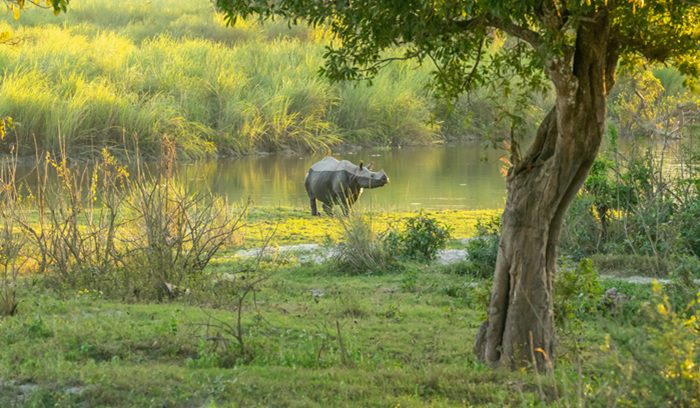
For the first time in recorded history, Kaziranga National Park in Assam completed a full year without a single rhino poaching incident — a milestone that conservationists across South Asia are calling extraordinary. The park, which shelters roughly two-thirds of the world’s remaining greater one-horned rhinoceroses, has long been the front line of a decades-long battle against one of the world’s most lucrative wildlife black markets.
At a glance
- India rhino poaching: Kaziranga recorded zero poaching incidents across all of 2025 C.E., the first such clean year in the park’s modern conservation history.
- Rhino population: Kaziranga is home to more than 2,600 greater one-horned rhinos (Rhinoceros unicornis), representing approximately 70% of the global population of the species.
- Anti-poaching measures: The milestone follows years of expanded ranger deployment, real-time surveillance technology, and deepened cooperation between the Assam Forest Department and local communities.
Why Kaziranga matters
The greater one-horned rhino nearly vanished in the early 20th century. By some estimates, fewer than 200 animals survived across the Indian subcontinent by 1900 C.E., driven to the edge by hunting and habitat loss. Kaziranga’s designation as a protected reserve — and later a UNESCO World Heritage Site — gave the species a place to recover.
That recovery has been remarkable. The park’s rhino count has grown from around 366 animals in 1966 C.E. to more than 2,600 today. But the species has never been out of danger. Rhino horn commands prices on the black market comparable to gold, driven largely by demand in parts of East and Southeast Asia where it is falsely believed to carry medicinal value. Poachers have killed dozens of rhinos in Kaziranga in some years.
The zero-poaching result in 2025 C.E. did not happen by accident. It reflects a sustained investment in wildlife protection infrastructure that few parks in the world can match.
The people behind the record
Kaziranga’s ranger force operates under difficult and sometimes dangerous conditions. The park spans more than 430 square miles of floodplain, grassland, and forest — terrain that shifts dramatically each monsoon season. Rangers work in shifts around the clock, and anti-poaching patrols regularly result in armed confrontations.
Assam’s forest department has in recent years integrated drone surveillance, camera trap networks, and informant systems into its operations. These tools give rangers earlier warnings of intrusion and allow faster response times across the park’s vast interior.
Equally important is the role of communities living on Kaziranga’s edges. Local residents from Assam’s Mising and Karbi communities have increasingly become partners in conservation rather than bystanders — some serving as informants or participants in eco-tourism economies that give them a direct stake in the rhinos’ survival. This kind of community-linked conservation has parallels elsewhere, including in Uganda’s rhino reintroduction program at Kidepo Valley, where local engagement has been central to success.
An honest look at what remains hard
One zero-poaching year, however historic, does not mean the threat is gone. Illegal wildlife trade networks remain active across South and Southeast Asia, and demand for rhino horn has not disappeared. Climate change is also reshaping Kaziranga’s ecosystem: the annual Brahmaputra floods that once drove animals onto elevated ground now sometimes arrive with greater unpredictability and violence, complicating both wildlife management and ranger logistics.
And rhino populations elsewhere remain fragile. The species’ recovery is concentrated in a small number of parks, meaning that a single disease outbreak or a collapse in protection at any one site could set back decades of progress. Conservation scientists continue to argue for greater genetic diversity and broader geographic distribution of the surviving population.
A signal, not an endpoint
What the 2025 C.E. record does offer is proof that intensive, sustained, community-supported protection works. At a moment when biodiversity headlines are often bleak, Kaziranga’s achievement is a demonstration that human effort — rangers walking difficult terrain, officials resisting corruption, communities choosing wildlife over short-term gain — can hold the line.
The greater one-horned rhino once stood at the edge of extinction. Today it represents one of the great wildlife recovery stories of the modern era. The question now is whether the conditions that produced this milestone can be maintained — and whether the model can travel to other species and other places facing similar pressures.
Read more
For more on this story, see: India’s rhino stronghold records zero poaching cases in 2025
For more from Good News for Humankind, see:
- Uganda brings rhinos back to Kidepo Valley
- Ghana expands marine protection at Cape Three Points
- The Good News for Humankind archive on wildlife conservation
About this article
- 🤖 This article is AI-generated, based on a framework created by Peter Schulte.
- 🌍 It aims to be inspirational but clear-eyed, accurate, and evidence-based, and grounded in care for the Earth, peace and belonging for all, and human evolution.
- 💬 Leave your notes and suggestions in the comments below — I will do my best to review and implement where appropriate.
- ✉️ One verified piece of good news, one insight from Antihero Project, every weekday morning. Subscribe free.