
Forty-two thousand years ago, on a small island at the edge of the inhabited world, someone ground a sea snail shell into a curve and dropped it into deep water. The hooks found at Jerimalai limestone shelter in East Timor are the oldest confirmed fishing hooks ever discovered — and the fish bones beside them prove these were not shoreline catches. The people here were working the open ocean.
Key findings
- Open-ocean fishing hooks: Shell hooks carved from Trochus sea snails were recovered from Jerimalai, a limestone rock shelter on the eastern tip of Timor, and dated to approximately 42,000 B.C.E.
- Deep-water fish bones: Bones of tuna and giant trevally — both pelagic species that live in fast, open water far from shore — were found alongside the hooks, confirming the hooks were used beyond coastal shallows.
- Maritime capability: The combination of manufactured hooks, open-ocean targets, and island location implies that these people had boats, navigational knowledge, and sophisticated ecological understanding tens of thousands of years before the earliest known civilizations.
A limestone shelter that rewrote fishing history
The Jerimalai site was excavated by a team led by Sue O’Connor of the Australian National University. Their findings, published in the journal Science in 2011 C.E., pushed back the known origins of fishing technology by tens of thousands of years.
The hooks were shaped from Trochus shells — small, spiral mollusks common across the Indo-Pacific. Each hook was deliberately ground into a precise curve. These were not accidental forms. They were manufactured tools produced through a multi-step process: selecting the right shell, understanding its structural properties, grinding without snapping, and shaping a finished object visualized before it existed.
That last part matters. The ability to plan a sequence of steps toward an unseen result is one of the markers researchers use to identify fully modern human cognition. The people of Jerimalai were thinking ahead.
What open-ocean fishing actually requires
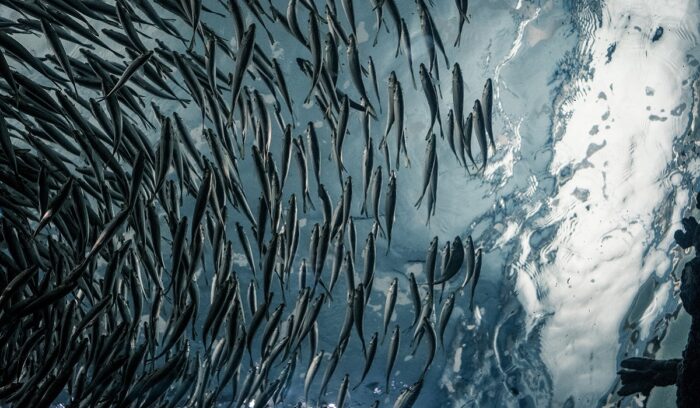
Tuna and giant trevally don’t live near shore. Both are pelagic species — they inhabit the fast, deep water of the open sea, and catching them requires going out to meet them.
That means a boat capable of handling open-water conditions. It means reading the sea well enough to know where fish will be by season, how deep they run, and when they surface. It means coordinating with other people, since hauling a large pelagic fish is not a solo task. And it means trusting the craft and the crew enough to venture far from land.
The Smithsonian Human Origins program identifies systematic fishing as one of the more sophisticated behavioral markers of modern human cognition. What the Jerimalai evidence shows isn’t just that these people fished — it’s that they fished out there, in conditions that demanded accumulated knowledge, social coordination, and the kind of trust that only develops in communities with shared culture.
A brain-building food source
The nutritional consequences of reliable access to open-ocean fish are worth taking seriously. Tuna and trevally are dense in omega-3 fatty acids, which are directly linked to brain development and function in modern nutritional science.
A population with consistent access to high-quality marine protein would have had real biological advantages — more stable cognitive energy, better infant brain development, and a food source less vulnerable to drought or terrestrial disruption than land-based hunting. Some researchers argue that marine food sources played a role in the cognitive and cultural flourishing of the Upper Paleolithic. Whether that connection was causal or correlational remains genuinely debated. But the nutrients were real, and so were the people eating them.
Opening the ocean as a highway
East Timor sits in the Wallacea region — a chain of islands separated by deep-water channels that no land bridge ever crossed. Any human who reached it did so by boat. The same watercraft and navigational knowledge that enabled open-ocean fishing also enabled movement between islands.
The colonization of Australia — one of the most consequential migrations in human prehistory — required crossing open water, almost certainly from the direction of Wallacea. The fish hooks at Jerimalai don’t just speak to food. They speak to the maritime capability that made an entire continent reachable.
Every seafaring tradition that followed — the Polynesian navigators who crossed the Pacific without instruments, the ancient traders who eventually linked the Indian Ocean world — owes something to the accumulated knowledge of people like those at Jerimalai. The skills built around open-ocean fishing shaped social structures: coordinating a crew, sharing knowledge of migration routes, building the trust required to go far from shore together. These are the foundations of complex societies.
That legacy continues. The creation of marine protected areas like those off the coast of Ghana reflects an unbroken human relationship with the ocean — one that requires the same deep ecological knowledge the Jerimalai fishers carried. And the recognition of Indigenous peoples’ rights over ancestral lands and waters, advanced at forums like COP30, carries an echo of that generational, place-based understanding. Communities who have fished the same waters for generations hold knowledge that no laboratory has yet fully mapped.
The people of this region — ancestors of populations across Island Southeast Asia and the Pacific — were among the first to treat the ocean not as a barrier but as a resource to be understood and worked with skill. That reframing still matters.
For more on marine conservation efforts building on humanity’s long ocean relationship, see the story of Ghana’s marine protected area at Cape Three Points. And for the continuing effort to recognize the rights of Indigenous peoples over the waters and lands they have known for millennia, see the reporting on Indigenous land rights at COP30.
Lasting impact
The hook from a Trochus shell is easy to underestimate. It fits in your palm. But the thread attached to it runs forward through 42,000 years of maritime culture, deep-sea trade, Pacific colonization, and ocean science.
Reliable access to pelagic fish may have supported the cognitive and demographic expansion of human populations in Island Southeast Asia during the Upper Paleolithic. The navigational and boat-building knowledge developed around open-ocean fishing enabled the first crossings of Wallace’s Line — the deep-water boundary that separates Asian from Australian fauna, and that no land animal crossed without human help.
In a very real sense, a continent was reached because someone first learned to catch a tuna.
Blindspots and limits
The Jerimalai evidence is compelling, but absence of earlier hooks elsewhere doesn’t mean earlier fishing didn’t happen — only that organic materials degrade, and shell is fragile across tens of millennia. There may be older fishing traditions we will never find. The record also gives us a date and a location but not the names, languages, or full social structures of the people who lived at Jerimalai. Their ingenuity is visible; their full humanity remains largely beyond our reach.
Read more
For more from Good News for Humankind, see:
- Ghana creates a marine protected area at Cape Three Points
- Indigenous land rights recognized across 160 million hectares at COP30
- The Good News for Humankind archive on prehistoric milestones
About this article
- 🤖 This article is AI-generated, based on a framework created by Peter Schulte.
- 🌍 It aims to be inspirational but clear-eyed, accurate, and evidence-based, and grounded in care for the Earth, peace and belonging for all, and human evolution.
- 💬 Leave your notes and suggestions in the comments below — I will do my best to review and implement where appropriate.
- ✉️ One verified piece of good news, one insight from Antihero Project, every weekday morning. Subscribe free.
More Good News
-
COP30 pledges recognition of 160 million hectares of Indigenous land rights
At the COP30 World Leaders Summit in Belém, Brazil in November 2025, 15 governments pledged to formally recognize Indigenous land rights over 160 million hectares by 2030 — an area the size of Iran — through the Intergovernmental Land Tenure Commitment. Brazil committed at least 59 million hectares. More than 35 donors renewed a $1.8 billion Forest and Land Tenure Pledge. The Tropical Forest Forever Facility secured nearly $7 billion, with 20% directed to Indigenous peoples. It was the largest Indigenous participation in COP history.
-
Ghana creates its first marine protected area to rescue depleted fish stocks
Ghana has declared its first marine protected area near Cape Three Points on the Gulf of Guinea, marking a historic step to reverse decades of overfishing. The protected zone aims to restore fish populations that have collapsed under pressure from industrial trawling and illegal fishing. The decision supports 2.7 million Ghanaians whose livelihoods depend on healthy coastal fisheries and aligns Ghana with the global goal of protecting 30 percent of the world’s oceans by 2030.
-

U.S. researchers cut Alzheimer’s risk by half in first-ever prevention trial
For the first time, researchers have evidence that removing amyloid plaques from the brain before symptoms appear can cut Alzheimer’s risk by roughly half. A clinical trial published in The Lancet Neurology, led by Washington University School of Medicine in St. Louis, found that long-term treatment with the antibody drug gantenerumab significantly delayed dementia onset in people with a rare genetic form of the disease. The findings provide the clearest signal yet that intervening years before symptoms emerge can change the course of Alzheimer’s disease.
