
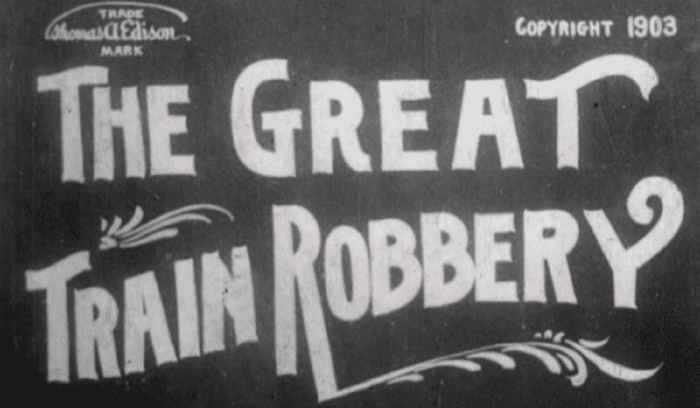
In late 1903 C.E., a 12-minute film about four bandits robbing a train changed everything. It told a story with a beginning, a middle, and an end — and audiences across America had never seen anything like it.
Key facts
- First narrative film: The Great Train Robbery (1903 C.E.), produced by Thomas Edison and directed by Edwin S. Porter, is recognized as the first movie to tell a coherent story from start to finish, rather than simply recording a scene or event.
- Crosscutting technique: Porter introduced parallel editing — cutting between two simultaneous scenes — a technique still foundational to filmmaking today and one that gave audiences their first sense of cinematic suspense.
- Nickelodeon boom: The film’s popularity drove the opening of the first permanent movie theaters, called nickelodeons, where audiences paid a nickel to watch it — directly seeding the commercial film industry.
What Porter actually made
Before The Great Train Robbery, films existed — but they were curiosities. They showed waves crashing, trains arriving, workers leaving a factory. They documented. They did not narrate.
Porter changed that. Working as an employee of the Edison Manufacturing Company, he took his crew to ten different locations: Edison’s New York studio, Essex County Park in New Jersey, and stretches of the Lackawanna Railroad. The film he assembled from those locations introduced something audiences had not experienced before — the feeling of being pulled through a story.
The plot is simple: four outlaws rob a train and its passengers, make their escape on horseback, and are eventually hunted down and killed by a posse. But in 1903 C.E., that arc — crime, chase, consequence — was genuinely new on screen.
The cast was small and resourceful. Gilbert M. “Broncho Billy” Anderson played at least four different roles: one of the bandits, the fireman bludgeoned with a piece of coal, a slain train passenger, and the man forced to dance as bullets hit the ground at his feet. That last image — the outlaw shooting at a man’s feet — became a lasting Western cliché, appearing in films for the next century.
The editing innovations that shaped cinema
Porter did not just tell a story. He invented tools to tell it better.
Most films of the era kept the camera fixed in one position, like a theater audience watching a stage. Porter moved his. In one scene, he panned the camera to follow characters running across a creek and into the trees — a simple gesture that made the frame feel alive.
More significantly, he introduced crosscutting: the technique of cutting between two scenes happening at the same time in different places. Audiences could now watch a rescue posse forming while the bandits were still escaping. Time and space on screen became flexible. That flexibility is still the grammar of every thriller, drama, and action film made today.
There was also the film’s most famous moment: the outlaw leader, played by Justus D. Barnes, turns directly toward the camera and fires his pistol at the audience. Whether this scene appeared at the beginning or end of the film was left to the projectionist’s discretion. Either way, it terrified and thrilled audiences in equal measure — and proved that cinema could do something theater could not: collapse the distance between the story and the person watching it.
Lasting impact
The film played nationwide in 1904 C.E. and became the centerpiece of the first nickelodeons in 1905 C.E. These small, storefront theaters — charging five cents a seat — were the direct ancestors of the modern movie theater. Within a decade, cities across the United States had hundreds of them.
The commercial logic The Great Train Robbery set in motion was enormous. If people would pay to watch a story on a screen, there was a business here. That business became Hollywood, and then a global industry that now generates hundreds of billions of dollars a year and reaches virtually every person on Earth.
The Western genre it helped define — the chase, the outlaw, the posse, the open frontier — became one of the most exported American cultural forms of the 20th century, shaping how people around the world imagined justice, freedom, and the frontier long before they ever visited the United States.
Film historians at the American Film Institute and the Library of Congress — which added The Great Train Robbery to the National Film Registry in 1990 C.E. — have consistently recognized it as a foundational work, not just for American cinema but for the art of storytelling on screen worldwide.
It is also worth noting that the nickelodeon era, which this film ignited, created one of the first mass entertainment spaces in American history that was relatively accessible across class lines. Working-class audiences, recent immigrants, and people who could not afford theater tickets could enter a nickelodeon for a nickel. Early cinema scholars have documented how these spaces became cultural mixing points — chaotic and commercial, but genuinely public in a way that mattered.
Blindspots and limits
The film was produced within Edison’s commercial empire, and the credit structure of early cinema was murky — Porter directed and filmed it, but the institutional credit went largely to Edison, a pattern that would recur throughout the industry’s early decades. The contributions of the cast, crew, and location workers are almost entirely undocumented.
The nickelodeon boom that followed was also not equally open to everyone. In many parts of the United States, these theaters were segregated by race, and the Western genre the film helped launch often erased or caricatured Indigenous peoples and communities of color — a legacy that mainstream film history took most of the 20th century to seriously examine.
Read more
For more on this story, see: ThoughtCo — The Great Train Robbery
For more from Good News for Humankind, see:
- Germany unveils the world’s first hydrogen passenger train
- Indonesia shuts down its last coal-fired power plant, ending an era
- The Good News for Humankind archive on arts and culture
About this article
- 🤖 This article is AI-generated, based on a framework created by Peter Schulte.
- 🌍 It aims to be inspirational but clear-eyed, accurate, and evidence-based, and grounded in care for the Earth, peace and belonging for all, and human evolution.
- 💬 Leave your notes and suggestions in the comments below — I will do my best to review and implement where appropriate.
- ✉️ One verified piece of good news, one insight from Antihero Project, every weekday morning. Subscribe free.


