
When French lawmakers voted on a new building law in early 2015 C.E., they quietly set a standard that few countries had attempted: every new commercial building in France would need to put its roof to work — either as a garden or a power source.
What the law requires
- France green roof law: New commercial buildings across France must partially cover their rooftops with living vegetation or solar panels — a requirement written directly into national building code.
- Green roof benefits: Vegetated rooftops insulate buildings, retain rainwater, reduce urban air pollution, and provide habitat for birds and other urban wildlife.
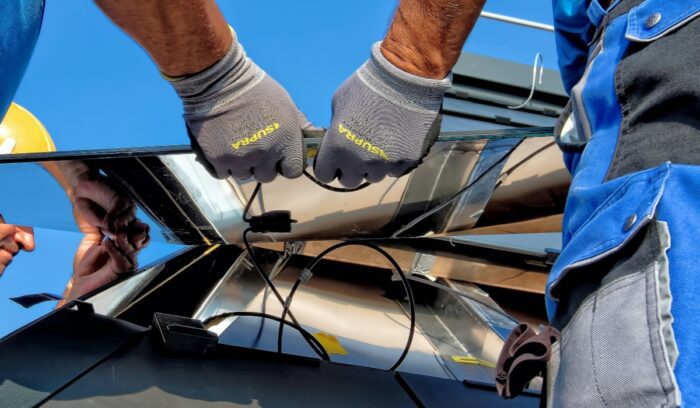
- Solar panel option: Businesses that prefer clean energy generation over living roofs may install solar panels instead, giving the law practical flexibility for different building types.
Why rooftops matter for cities
Cities get hot — and not just because of the weather. The urban heat island effect, documented extensively by the U.S. Environmental Protection Agency, causes large cities to run 1.8°F to 5.4°F warmer than surrounding areas during the day, and as much as 22°F warmer at night. Roads, rooftops, and paved surfaces absorb and radiate heat in ways that natural ground cover does not.
Green roofs interrupt that cycle. A layer of soil and vegetation reflects sunlight, absorbs rainwater, and creates a natural thermal barrier. Studies by researchers publishing in Scientific Reports have shown that green roofs can cut building energy use meaningfully — particularly for heating and cooling — while also reducing stormwater runoff that overwhelms drainage systems during heavy rain.
For urban residents, the benefits go beyond engineering. Green rooftops create pockets of nature in neighborhoods where open land is scarce. Birds nest there. Bees forage there. In dense cities, that ecological toehold matters.
How the law came to be
The legislation passed by the French Parliament in 2015 C.E. was a compromise. Environmental groups had originally pushed for full green roof coverage on all new buildings — a more sweeping standard. What emerged was narrower: partial coverage, commercial zones only, with the solar panel alternative built in as a practical concession to businesses.
That narrowing disappointed some advocates. But the law still represented a meaningful shift: it made ecological rooftop design a legal baseline rather than a voluntary gesture.
The timing also carried symbolic weight. The United Nations climate summit, COP21, was scheduled to arrive in Paris at the end of 2015 C.E. France’s domestic building policy sent a signal about where the host country’s priorities stood — at least architecturally.
France’s energy context
France has historically relied on nuclear power more heavily than almost any other country — nuclear generation made up roughly 83 percent of total electricity production in 2012 C.E. That dependence had left France behind Germany, Italy, and Spain in solar development. As of mid-2014 C.E., France had installed just over five gigawatts of photovoltaic capacity, compared to nearly 40 gigawatts in Germany.
The green roof law, by creating a built-in solar incentive for commercial construction, offered one mechanism for closing that gap incrementally — building by building, rooftop by rooftop.
Lasting impact
France’s 2015 C.E. law became a reference point for urban greening policy internationally. Several European cities had already pioneered green roofs voluntarily — Toronto, Canada had passed its own green roof bylaw in 2009 C.E. — but France’s national mandate gave the concept new political legitimacy at scale.
By requiring ecological design at the point of construction — before buildings are locked into their form for decades — the law works with the grain of urban development rather than against it. A rooftop greened from the start costs far less than retrofitting an existing structure.
The broader model has influenced subsequent policy conversations across Europe and beyond, as cities grapple with heat, flooding, biodiversity loss, and energy demand simultaneously. The French law demonstrated that a single national building standard could address all four at once.
Blindspots and limits
The law applies only to new commercial buildings, leaving France’s vast existing building stock — including millions of residential rooftops — entirely untouched. Partial coverage is also a modest requirement; the ecological benefits of green roofs scale significantly with how much of the roof surface is planted. Critics noted at the time that the law’s ambition was trimmed considerably from what environmental groups had proposed, and that without stronger incentives for retrofits and residential buildings, its impact would remain limited in the near term.


