On a January morning in 1724 C.E., a Spanish military column marched out of Buenos Aires and changed the map of South America. Led by Bruno Mauricio de Zabala, the force arrived at a small Portuguese fort on the northern bank of the Río de la Plata and issued an ultimatum. The Portuguese left. The Spanish stayed. The founding of Montevideo — one of Latin America’s most enduring cities — had begun.
Key facts
- Founding of Montevideo: On 22 January 1724 C.E., Spanish forces under Zabala expelled a Portuguese garrison that had occupied the site since November 1723 C.E., beginning permanent Spanish settlement on the site that would become Uruguay’s capital.
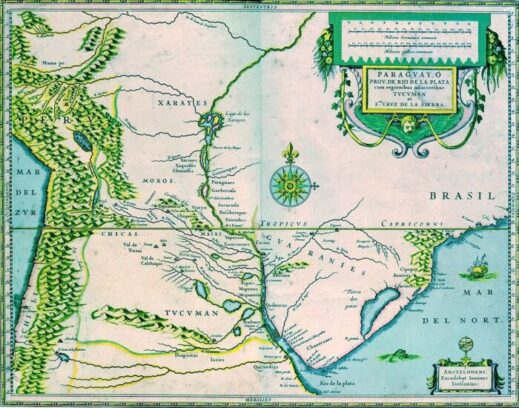
- Spanish-Portuguese rivalry: The expulsion was not simply a military skirmish — it was a deliberate strategic move in a long contest over the Platine region, the fertile estuary where the Paraná and Uruguay rivers meet the Atlantic.
- Early population: A census conducted in 1724 C.E. counted more than 100 families of Galician and Canary Islands origin, more than 1,000 Indigenous people — mostly Guaraní — as well as enslaved people of Bantu origin, painting a picture of a founding population that was already diverse and deeply unequal.
A fort becomes a city
The Portuguese had moved first. In November 1723 C.E., Field Marshal Manuel de Freitas da Fonseca built a fort on the heights overlooking Montevideo Bay, giving Portugal a foothold on the eastern bank of the Río de la Plata. Spain had long controlled Buenos Aires on the western bank, but this Portuguese advance threatened to shift the balance of power in the entire region.
Zabala, the Spanish governor of Buenos Aires, moved quickly. Within weeks, he organized an expedition and forced the Portuguese to abandon the site. The Spanish then began to populate it — first with six families relocated from Buenos Aires, then with settlers arriving from the Canary Islands, people known as Guanches or Canarians, who became a defining cultural thread in early Montevideo.
That same year, a formal census was conducted and the settlement was given the name San Felipe y Santiago de Montevideo, later shortened to the name the world now knows. The word “Monte” almost certainly refers to the Cerro de Montevideo, the distinctive hill rising across the bay. The rest of the name remains etymologically contested — a small, fitting mystery for a city whose origins are themselves layered and debated.
When was Montevideo actually founded?
This is genuinely complicated. There is no single founding document for Montevideo. Zabala’s own diary cites 24 December 1726 C.E. as the formal foundation date, a date corroborated by witnesses. Full administrative independence from Buenos Aires did not come until 1 January 1730 C.E. Historians have long debated which date matters most.
What is clear is that 1724 C.E. marks the decisive turning point: the moment the Portuguese were expelled, Spanish settlers moved in, and a census made the city legible on paper. Whether that constitutes “founding” depends on how you define the word. Cities rarely have a single birth date. Montevideo grew into itself across a decade.
Who was already there
The Spanish and Portuguese contest over Montevideo was conducted on land that was not empty. The 1724 C.E. census recorded more than 1,000 Indigenous people in the area, mostly Guaraní, whose presence in the Río de la Plata region stretched back thousands of years. Their labor, knowledge of the land, and proximity to the settlement shaped early Montevideo in ways that colonial records largely left unacknowledged.
Enslaved people of Bantu origin were also recorded in that first census — trafficked across the Atlantic to serve the colonial economy from its earliest days. The Afro-Uruguayan community that descends from these and later arrivals has contributed profoundly to Uruguayan culture, including the creation of candombe, a drum-based tradition recognized by UNESCO as Intangible Cultural Heritage of Humanity. Their contribution to the city’s identity is inseparable from the conditions of their arrival.
Lasting impact
Montevideo grew rapidly into one of South America’s most important port cities. By 1776 C.E., Spain had designated it the main naval base for the South Atlantic, with authority extending to the Argentine coast, Fernando Po, and the Falklands. The city’s deep natural harbor gave it an enduring commercial advantage over Buenos Aires, and the two cities became rivals for dominance in maritime trade throughout the colonial period.
That rivalry helped shape the political imagination of the region. After independence, Montevideo became the capital of Uruguay — a nation that emerged in 1828 C.E. partly as a buffer state between the competing ambitions of Argentina and Brazil, with its capital city already carrying centuries of cosmopolitan experience.
Today, Montevideo is home to nearly 1.3 million people — about 37% of Uruguay’s entire population. It serves as the seat of Mercosur and ALADI, Latin America’s leading trade blocs, a role that has drawn comparisons to Brussels. The 2019 Mercer Quality of Life report ranked it first in Latin America, a position the city had held consistently since 2005 C.E. It hosted every match of the first FIFA World Cup in 1930 C.E., and its art deco architecture, candombe drumming, and rambla — the long seaside promenade — define a city that absorbed many worlds and made something distinctly its own.
Blindspots and limits
The founding of Montevideo was also the dispossession of the Guaraní and other Indigenous peoples of the Banda Oriental, whose lands were absorbed into a colonial project that gave them no political standing. The enslaved Bantu men and women counted in the 1724 C.E. census had no voice in the city’s founding story — they were property in a ledger, not participants in a civic moment. Colonial-era records were written by and for the colonizers, and the fuller history of the city’s early population remains incompletely documented. Celebrating the city’s founding means reckoning honestly with what that founding cost, and for whom.
Read more
For more on this story, see: Wikipedia — Montevideo: Early history
For more from Good News for Humankind, see:
- Indigenous land rights take center stage at COP30
- Renewables now make up at least 49% of global power capacity
- The Good News for Humankind archive on Uruguay
About this article
- 🤖 This article is AI-generated, based on a framework created by Peter Schulte.
- 🌍 It aims to be inspirational but clear-eyed, accurate, and evidence-based, and grounded in care for the Earth, peace and belonging for all, and human evolution.
- 💬 Leave your notes and suggestions in the comments below — I will do my best to review and implement where appropriate.
- ✉️ One verified piece of good news, one insight from Antihero Project, every weekday morning. Subscribe free.