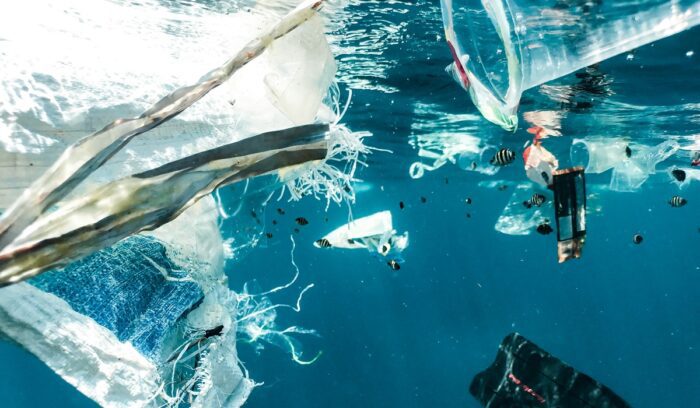
A tech start-up in Ecuador has deployed a floating barrier and conveyor belt system to intercept plastic waste in the San Pedro River before it makes its way to the Pacific Ocean. The Azure system, built by Ichthion, can collect up to 80 tonnes of plastic per day — and the company is pairing that extraction work with data gathering designed to stop plastic from entering rivers in the first place.
At a glance
- River plastic collection: The Azure system uses a floating boom angled to direct debris into one corner of the riverbank, where a mobile conveyor belt loads it into a shore-side container for sorting and recycling.
- Waste data tracking: Ichthion logs everything it collects to identify pollution sources — whether industrial dumping or gaps in municipal garbage systems — then works with local governments and communities to address the root cause.
- Ocean-bound plastic: Research shows up to 80% of plastic that reaches the open ocean arrives via rivers, making interception at the river stage one of the most direct ways to reduce marine pollution.
How the Azure system works
The Azure barrier stretches across the river and extends 60 centimeters into the water, deep enough to catch surface debris but shallow enough to let fish and other organisms pass freely below. The natural current does most of the work, pushing floating waste toward the riverbank where a manual operator guides it onto the conveyor belt.
The conveyor is mobile, meaning a single unit can serve multiple barrier sites across a river network. The system only runs during brief collection windows each day, keeping operating costs low — a deliberate design choice by Ichthion founder Inty Grønneberg, who built the Azure system with affordability in mind for communities in the Global South.
At the San Pedro River site, the most collected in a single day has been 1.5 tonnes of plastic and synthetic fabrics — roughly the weight of an adult female hippopotamus. The majority of what the team pulls out is plastic bottles from local communities, along with significant quantities of water hyacinth, an invasive species that depletes oxygen in rivers and releases methane as it decomposes.
Prevention through data
Grønneberg is direct about the limits of extraction alone. “If you only look at what you extract, it won’t stop,” he told BBC Future Planet. “Extraction is important, but prevention based on data is more important.”
The team catalogs each collection to trace where the waste originated. That intelligence lets Ichthion approach municipalities, businesses, and communities with specific, actionable information rather than general appeals. The company is also training an AI system to automate plastic identification and exploring the use of drone imagery to detect debris upstream before it reaches the barrier.
Hiring locally is built into the model. Community members operate the Azure system and participate in clean-up days and awareness campaigns, which Ichthion co-founder Yessica Benavides says is essential for generating lasting change.
Ecuador’s plastic crisis — and its wider context
Ecuador faces a severe waste management challenge. The country deals with overflowing landfills and open dumps, and between 2018 and 2022 it imported more than 48,000 tonnes of plastic waste from 42 countries — primarily the U.S. — according to the local advocacy group Zero Garbage Alliance. A 2024 C.E. free trade deal with China includes a clause permitting China to export difficult-to-process waste, including plastics, to Ecuador.
Ichthion is not alone in this space. The Bubble Barrier, developed in the Netherlands, pumps air through a perforated tube on the riverbed to lift submerged debris to the surface without blocking ship traffic. Its 60-meter installation in Amsterdam collects around 80 kilograms of plastic per month. The operating costs, however — tens of thousands of dollars per year to run the air compressor — can make it financially out of reach for many lower-income countries.
Jordyn Wolfand, an assistant professor of civil and environmental engineering at the University of Portland, evaluated more than 40 river plastic clean-up systems and found that effectiveness depends less on any single design than on how well a technology fits the specific conditions of its site. Placement matters too: systems installed farther upstream, closer to pollution sources, tend to perform better.
The honest limits of clean-up
Not everyone is unconditionally enthusiastic about river interception technologies. Win Cowger, a research scientist at the Moore Institute for Plastic Pollution Research in California, has raised concerns about large-scale deployment of physical barriers potentially disrupting the downstream flow of sediments and organic matter that coastal ecosystems depend on. He also cautions that clean-up efforts can serve as cover for plastic producers to avoid reducing output.
Grønneberg says Ichthion designed the Azure system in close consultation with scientists to minimize ecosystem disruption — the barrier does not touch the riverbed — and notes that the invasive water hyacinth it regularly collects is itself an ecological problem. He also states that Ichthion has not received funding from plastic-producing companies.
Both Cowger and Grønneberg ultimately land in the same place. Reducing plastic production, backed by policy, remains the most powerful lever. “The solution is to avoid consumption,” says Grønneberg. “That’s fundamental.” The Azure system and efforts like it are a meaningful part of a larger picture — but they work best when paired with the harder work of changing what gets made and how waste gets managed.
Read more
For more on this story, see: BBC Future Planet
For more from Good News for Humankind, see:
- U.K. cancer death rates down to their lowest level on record
- Alzheimer’s risk cut in half by drug in landmark prevention trial
- The Good News for Humankind archive on Ecuador
About this article
- 🤖 This article is AI-generated, based on a framework created by Peter Schulte.
- 🌍 It aims to be inspirational but clear-eyed, accurate, and evidence-based, and grounded in care for the Earth, peace and belonging for all, and human evolution.
- 💬 Leave your notes and suggestions in the comments below — I will do my best to review and implement where appropriate.
- ✉️ One verified piece of good news, one insight from Antihero Project, every weekday morning. Subscribe free.