
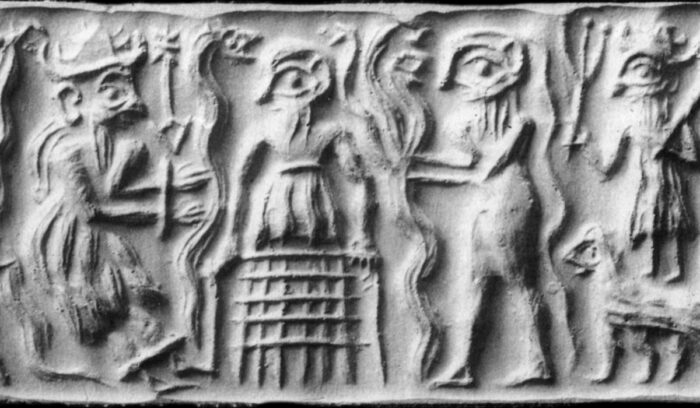
Somewhere in the ancient cities of Bad-tibira and Uruk, a figure named Dumuzid entered the historical record — not as a footnote, but as a king. The Sumerian King List, one of the oldest administrative documents in human history, names Dumuzid as both an antediluvian ruler of Bad-tibira and an early king of Uruk. Whether he was a historical person, a mythological figure, or some fusion of the two, his appearance in that list marks a remarkable moment: humanity beginning to name, record, and remember its leaders.
What the record shows
- Sumerian King List: Dumuzid appears as the fifth antediluvian king of Bad-tibira and also as an early king of Uruk, placing him among the earliest named rulers in any written tradition.
- Dumuzid the Shepherd: His Sumerian title, sipad, identifies him as a shepherd-king — a role that made him the divine provider of milk and livestock in a society where those resources were precious and seasonal.
- Mesopotamian mythology: Far beyond politics, Dumuzid became the consort of the goddess Inanna, a central figure in Sumerian literature, and the origin point for the dying-and-rising god tradition that echoed across the ancient Near East and into Greek mythology as Adonis.
Why naming a ruler matters
The act of listing kings — giving them names, sequences, and cities — was itself a technology. It meant that communities were not just surviving; they were organizing memory, legitimacy, and power across generations.
Uruk, where Dumuzid ruled according to the King List, was arguably the world’s first true city. By around 3100 B.C.E., it may have housed up to 50,000 people — an unprecedented concentration of human life. Managing that scale required something new: formal authority, recognized succession, and the written record to sustain both. Dumuzid’s name, preserved in cuneiform on clay tablets, is part of that invention.
The British Museum holds versions of the Sumerian King List that trace an unbroken chain of rulers from before a mythological flood down through historical dynasties. Scholars debate where legend ends and history begins, but the list itself reveals something true: Sumerians understood governance as a continuous, serious project that demanded record-keeping.
A king who became a god — and a season
What makes Dumuzid unusual is that he did not stay in the administrative record. He migrated into the deepest currents of ancient religion and literature.
In the poem Inanna’s Descent into the Underworld, Dumuzid is condemned to spend half the year in the realm of the dead, while his sister Geshtinanna takes his place for the other half. Ancient Mesopotamian peoples understood this as the explanation for the scorching summers that killed vegetation across the region. His death caused the dry season. His return brought the rains and new growth.
This is one of the earliest attempts by any human society to explain the cycle of seasons through narrative — to locate the rhythm of the natural world inside a story about loss, loyalty, and return. That story proved durable. The cult of Tammuz, as he was later known in Babylonian and Akkadian traditions, spread across the Levant, appeared by name in the Hebrew Bible in Ezekiel 8:14, and eventually shaped the Greek myth of Adonis.
Women across Mesopotamia led public mourning rituals during the midsummer month that bore his name. These were not minor observances — they were citywide expressions of grief, community identity, and hope for renewal. Shared ritual at that scale is another marker of civilization.
Lasting impact
The significance of Dumuzid runs in two directions. As an entry in the King List, he represents the beginning of a tradition that all modern governance still echoes: the idea that power should be named, recorded, and transferred in an orderly way. Legitimacy through succession, documented in writing, is foundational to every state that has existed since.
As a mythological figure, Dumuzid seeded a template for the dying-and-rising god that appeared across dozens of cultures over thousands of years. Osiris in Egypt, Adonis in Greece, Baal in Canaan — scholars trace family resemblances across all of them. The emotional architecture of those stories — the god who dies, the world that suffers, the god who returns — became one of humanity’s most persistent ways of making sense of loss and hope.
The World History Encyclopedia notes that Dumuzid’s influence on later religious traditions extends well beyond the ancient Near East, making him one of the most widely transmitted mythological figures in human history, even if few people today would recognize his Sumerian name.
Blindspots and limits
The Sumerian King List is not a reliable historical document in the modern sense — it freely mixes mythological figures with what may be actual rulers, assigns implausibly long reigns to early kings, and was likely written partly to legitimize later dynasties by constructing a grand lineage. Whether Dumuzid was ever a real person, a purely mythological figure, or a local cult deity who was later inserted into the political record is genuinely uncertain, and scholars remain divided.
The women who led mourning rituals for Tammuz across centuries of Mesopotamian life — practicing what was arguably one of the ancient world’s most widespread religious observances — are almost entirely unnamed in surviving sources. Their central role in transmitting this tradition is acknowledged but rarely examined in detail.