
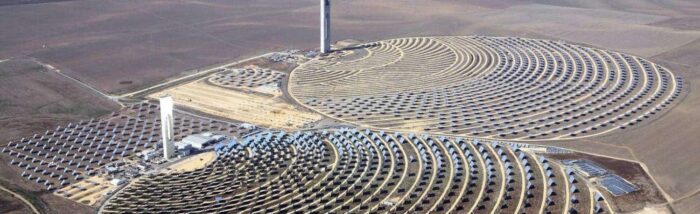
In the middle of one of the hottest, sunniest deserts on Earth, Dubai is turning its greatest natural abundance into something the world has rarely seen at this scale. The Mohammed bin Rashid Al Maktoum Solar Park is adding an 800-megawatt concentrated solar power facility — the largest of its kind ever attempted — and in doing so, staking a claim to a future that looks very different from the oil economy that built this city.
Key facts
- Concentrated solar power: Unlike conventional photovoltaic panels, CSP uses mirrors to focus sunlight onto a central tower, heating a fluid that drives a turbine — and crucially, can store heat to generate electricity hours after the sun goes down.
- Solar park capacity: The 800MW CSP addition is part of the broader Mohammed bin Rashid Al Maktoum Solar Park, which is planned to reach 5,000MW of total capacity by 2030 C.E., powering roughly a third of Dubai’s electricity needs.
- Clean energy target: Dubai’s integrated energy strategy aims to source 75% of its electricity from clean energy by 2050 C.E. — a striking target for a city whose modern infrastructure was built almost entirely on fossil fuel wealth.
Why concentrated solar, and why now
Most solar installations you hear about use photovoltaic panels — the flat, silicon-based technology now covering rooftops across the world. CSP works differently. Arrays of mirrors, called heliostats, track the sun and focus its energy onto a single point, heating a molten salt or synthetic fluid to extreme temperatures.
That stored heat can continue generating electricity well into the evening. For a grid that needs to meet air-conditioning demand long after sunset, that is not a small advantage — it is the whole ballgame.
Dubai’s decision to anchor its solar expansion in CSP technology reflects a broader calculation: that the region’s intense, reliable sunshine is an asset the world will want for decades. The International Renewable Energy Agency has identified CSP with thermal storage as one of the most promising tools for round-the-clock clean electricity, particularly in sun-belt nations.
A city betting against its own history
It is hard to overstate how symbolically significant this is. Dubai’s skyline, its air conditioning, its desalination plants — all of it was powered by fossil fuels extracted from the same regional geology that shapes the terrain around this solar park.
That a Gulf city is now building the world’s largest CSP plant is not irony so much as pragmatism. Dubai imports most of its oil and gas. Renewables offer energy independence alongside climate benefits. And a region with some of the highest solar irradiance anywhere on Earth has an obvious comparative advantage in the technology.
The project is being developed by DEWA, the Dubai Electricity and Water Authority, with Shanghai Electric as the primary contractor for Phase 4 — a partnership that reflects how thoroughly the clean energy supply chain has become a global, cross-civilizational enterprise, with Chinese manufacturing, European engineering expertise, and Gulf capital all working in concert.
What this means for the region and beyond
When complete, the CSP component alone is expected to offset roughly 1.6 million tons of carbon dioxide annually. For a country where per-capita emissions rank among the highest in the world, that number is meaningful — though it does not, on its own, resolve the structural tension between fossil fuel export economies and the clean energy transition.
More broadly, projects at this scale drive down costs. Every gigawatt of CSP built adds to the global manufacturing base, refines the engineering, and makes the next project cheaper. The International Energy Agency has tracked this pattern across wind and photovoltaic solar for two decades — CSP is following the same curve, just later.
Developing nations across North Africa, the Middle East, and South Asia are watching closely. If Dubai can demonstrate that CSP with storage is economically viable at scale, it opens a pathway for sun-rich countries that currently depend on expensive imported fuel to generate power.
Lasting impact
Projects of this size rarely stay contained to one city. The Mohammed bin Rashid Al Maktoum Solar Park is already influencing how regional governments think about energy infrastructure. Saudi Arabia, Morocco, and Chile have all moved forward with major CSP projects in the years following Dubai’s announcements, and international financing institutions have pointed to the Dubai model as evidence that large-scale renewables in the Global South are bankable investments.
The thermal storage dimension matters especially. As the world races to integrate more variable renewable energy — wind and photovoltaic solar, whose output fluctuates with weather — the ability to store the sun’s energy as heat and dispatch it on demand becomes more valuable, not less. Dubai’s investment is, in a real sense, an investment in grid stability technology for the whole planet.
Blindspots and limits
This project does not resolve the fundamental tension in Dubai’s economy: the same region driving this renewable expansion continues to profit from fossil fuel extraction and export. Water use is also a real concern — CSP plants can require significant cooling, a genuine constraint in an arid environment, and the environmental footprint of large-scale heliostat fields on desert ecosystems deserves continued scrutiny. The 2030 C.E. and 2050 C.E. targets are ambitious, and meeting them will require sustained political will and substantial additional investment beyond what is currently committed.
Read more
For more on this story, see: Gizmodo
For more from Good News for Humankind, see:
- The world is on track to triple renewable energy capacity by 2030
- Frank Shuman’s solar thermal power plant proves the sun can run the world
- The Good News for Humankind archive on renewable energy
- Clean energy milestones: the breakthroughs powering a fossil-free future
About this article
- 🤖 This article is AI-generated, based on a framework created by Peter Schulte.
- 🌍 It aims to be inspirational but clear-eyed, accurate, and evidence-based, and grounded in care for the Earth, peace and belonging for all, and human evolution.
- 💬 Leave your notes and suggestions in the comments below — I will do my best to review and implement where appropriate.
- ✉️ One verified piece of good news, one insight from Antihero Project, every weekday morning. Subscribe free.


