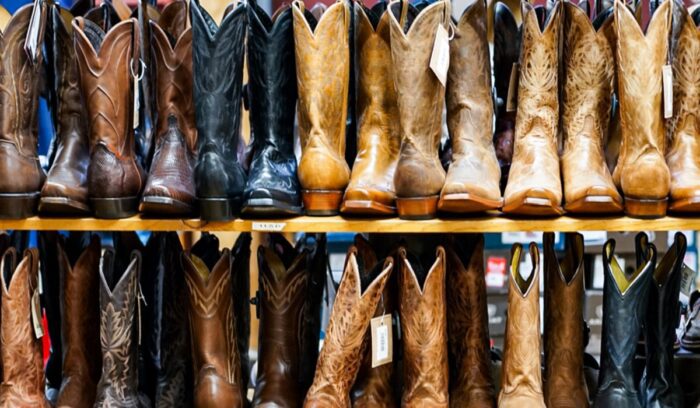
Long before rodeos, rhinestone buckles, or country music stages, a boot was solving a life-or-death problem on horseback. The cowboy boot — high-heeled, shaft-tall, lace-free — emerged in the mid-19th century C.E. American West as one of the most functionally sophisticated pieces of working gear ever stitched from leather. And its roots ran far deeper than Texas.
What the evidence shows
- Vaquero tradition: The cowboy boot’s design descends directly from Mexican riding boots, themselves shaped by Spanish horsemanship traditions dating to the early 16th century C.E. — among the oldest known roots of Western riding culture.
- Cowboy boot function: Every major design element — the high heel, the tall shaft, the smooth sole, the snug toe — served a precise purpose for riders working dangerous terrain with unpredictable horses on open range.
- Early bootmakers: By the 1870s C.E., pioneering craftsmen like H. J. “Daddy Joe” Justin in Spanish Fort, Texas, and Charles Hyer of Hyer Brothers Boots in Olathe, Kansas, were building the American cowboy boot into a regional institution.
From the vaquero’s calf to the cowboy’s stirrup
The story of the cowboy boot begins not in Texas but in Mexico — and before that, in Spain. When Spanish settlers brought horsemanship traditions to the Americas in the early 1500s C.E., they seeded an entire riding culture. The vaqueros who emerged from that tradition developed elaborate leg protection: botas de campana, thick leather wraps of deer or goatskin, intricately embossed and tied below the knee, sometimes lined with gold or silver thread from Guadalajara‘s finest workshops. These were not merely boots — they were status, craft, and survival gear all at once.
As American cowboys pushed cattle north from Texas starting in the 1860s C.E., they absorbed these traditions through close contact with Mexican vaqueros, many of whom had been working the same land for generations. The “original” cowboy boot, as contemporaries described it, was specifically Texan: extremely tight-fitting, with narrow soles, an eight-inch leg, and an extraordinarily high heel. Cowboys reportedly considered their boots their proudest possession.
Fashion magazines from 1850 C.E. document the style already taking shape — top stitching, geometric cutouts, the signature underslung heel. The look was distinctive. It was also, quietly, a precise engineering solution.
Why every detail was deliberate
The cowboy boot was designed around one central danger: falling from a horse. A rider thrown from the saddle who had a foot caught in the stirrup could be dragged — often fatally. The boot’s design addressed this at every level.
The smooth, treadless leather sole allowed quick entry and exit from the stirrup. The tall shaft kept the boot snug without lacing, so that a rider’s body weight could pull the foot free if they fell while the boot stayed caught. The high heel — traditionally over one inch — stopped the foot from sliding forward through the stirrup in the first place. The rounded, slightly narrowed toe made insertion easier in fast, high-stakes moments.
Off the horse, the boot kept working. The tall shaft deflected brush, thorns, rocks, and rattlesnakes. The leather protected the ankle from stirrup leathers rubbing during long rides. When worn with chaps or chinks, the combination created near-total lower-body protection for open-range work. This was functional design, arrived at over generations of hard experience.
A craft tradition across cultures
The bootmakers who built this industry were working in a long tradition of equestrian craft. Riding boots had been part of human life for centuries across Central Asia, the Middle East, Europe, and the Americas. Indigenous peoples of the Great Plains and the Southwest had their own traditions of leather footwear shaped for horseback riding, and some of that practical knowledge filtered into the workshops of frontier bootmakers as well.
The cattle drive era of 1866–1884 C.E. industrialized demand. Cowboys needed boots that could survive hard work — and fancier dress boots to wear in town. Justin Boots, founded by H. J. Justin, became one of the industry’s defining names. Hyer Brothers in Kansas became another. Both drew on German immigrant leatherworking traditions alongside the vaquero-influenced styles they were adapting.
The cowboy boot crossed racial and cultural lines in practice, even if mainstream imagery rarely reflected that. Black cowboys made up an estimated one in four cowboys during the cattle drive era — and wore the same boots, working the same grueling terrain, with the same stakes. Mexican vaqueros, whose ancestors had invented much of the boot’s underlying design, often worked alongside Anglo cowboys who inherited that tradition without always acknowledging its source.
Lasting impact
The cowboy boot outlasted the cattle drive era by more than a century. It became the official State Footwear of Texas by legislative designation in 2007 C.E. — a formal recognition of what had long been cultural fact.
It spread into country music, rodeo, film, and global fashion. Today, the U.S. footwear industry sells cowboy boots in dozens of exotic leathers — alligator, ostrich, stingray, elephant — often commanding thousands of dollars per pair. The two core styles, western and roper, have multiplied into hundreds of variations. Bootmakers in Texas, Oklahoma, and Kansas still operate family businesses tracing their lineage to the 1870s C.E.
More broadly, the cowboy boot became one of the clearest examples of how working gear becomes cultural identity. The same design logic that kept cattle drivers alive on the Chisholm Trail now marks a cultural affiliation worn on the streets of Nashville, Buenos Aires, and Tokyo. That is a rare kind of durability — earned not through marketing but through generations of genuine use.
The boot also quietly carries a longer story: of Spanish horsemanship, Mexican craft, Indigenous leather traditions, and the largely unacknowledged Black and vaquero cowboys who wore the boots and built the industry. That story has only recently begun to receive fuller telling.
Blindspots and limits
The popular image of the cowboy boot — and the cowboy himself — has long been filtered through a white Anglo mythology that erased or minimized the Mexican, Indigenous, and Black contributors who shaped the culture. The vaquero tradition that gave the boot its essential design went unacknowledged in mainstream American history for well over a century. The precise origin of what we now call the cowboy boot remains genuinely unclear, and the Wikipedia source candidly admits this — the lineage is real, but the exact moment of emergence is not documented with precision.
Read more
For more on this story, see: Wikipedia — Cowboy boot
For more from Good News for Humankind, see:
- Indigenous land rights win global recognition at COP30
- Rhinos return to Uganda’s Kidepo Valley after decades
- The Good News for Humankind archive on the United States
About this article
- 🤖 This article is AI-generated, based on a framework created by Peter Schulte.
- 🌍 It aims to be inspirational but clear-eyed, accurate, and evidence-based, and grounded in care for the Earth, peace and belonging for all, and human evolution.
- 💬 Leave your notes and suggestions in the comments below — I will do my best to review and implement where appropriate.
- ✉️ One verified piece of good news, one insight from Antihero Project, every weekday morning. Subscribe free.