
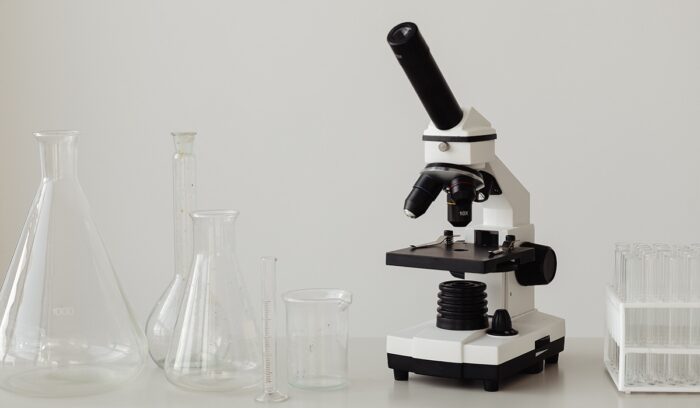
In a spectacle maker’s workshop in Middelburg, in what is now the Netherlands, a father and son assembled something the world had never seen: a tube lined with two lenses that could magnify objects far beyond what any single glass could achieve. That device — crude, imprecise, and revolutionary — would one day let humanity see the invisible world that governs nearly all life on Earth.
What the evidence shows
- Compound microscope: Zacharias and Hans Janssen are credited with assembling one of the earliest compound microscopes around 1595 C.E., using two lenses in a sliding tube to achieve magnifications of roughly three to nine times the object’s actual size.
- Spectacle making tradition: The Janssens worked as lens grinders and eyeglass makers in Middelburg, a trade hub in the Dutch Republic — a profession that gave them both the materials and the optical intuition to experiment with stacked lenses.
- Historical attribution: The earliest written accounts crediting the Janssens came decades after the fact, from testimony by Zacharias’s son and a Dutch diplomat, which means some historians treat the attribution as plausible but not definitively proven.
A city of lenses and curiosity
Middelburg in the late sixteenth century C.E. was no quiet backwater. It was a commercial and intellectual crossroads of the Dutch Republic, a society investing heavily in trade, navigation, and natural inquiry. Lens grinding was a serious craft there, not a curiosity.
The Dutch Republic of this era was also home to some of the most rigorous early scientific culture in Europe. The same environment that produced the Janssens would later nurture Antonie van Leeuwenhoek, who in the 1670s C.E. built far more powerful single-lens microscopes and became the first person to observe bacteria and other microorganisms directly.
It is worth remembering that optical knowledge did not arise in Europe in isolation. Arab scholars — including Ibn al-Haytham in the eleventh century C.E. — had developed foundational theories of optics and refraction that traveled through translation into European scientific practice. The Janssens built on a long chain of transmitted knowledge.
How two lenses changed everything
The principle behind the compound microscope is elegant: one lens, the objective, magnifies the object; a second lens, the eyepiece, magnifies that magnified image again. The result is a multiplication of magnifying power that no single lens can match.
The Janssens’ earliest instrument was limited — it distorted images at the edges and couldn’t achieve the magnifications that later instruments would reach. But the concept was sound. Within decades, other makers refined the design, and by the mid-seventeenth century C.E., Robert Hooke in England had used an improved compound microscope to observe and name the “cell” — the fundamental unit of all living things.
That single word, coined because cork cells reminded Hooke of monks’ rooms, became the cornerstone of biology.
Lasting impact
It is nearly impossible to overstate how much the compound microscope reshaped human understanding. Without it, there is no germ theory of disease — no understanding that bacteria and viruses cause illness, no antibiotics, no vaccines developed with knowledge of pathogens at the cellular level. The germ theory of disease, which transformed medicine in the nineteenth century C.E., was built on observations made possible by instruments descended from the Janssens’ workshop.
Cell biology, genetics, histology, microbiology, immunology — each of these fields depends on the ability to see what is too small for the naked eye. Modern medicine’s capacity to diagnose cancer from a tissue sample, to identify a novel pathogen, or to watch a neuron fire all trace back, in a direct line of technological inheritance, to that sliding tube of lenses assembled in Middelburg.
The microscope also changed philosophy. It confronted humanity with the humbling reality that an entire world of living things had existed all along, completely invisible and completely consequential. It was a reminder — still relevant — that reality is almost always larger and stranger than our unaided senses suggest.
Modern descendants of the compound microscope now include electron microscopes capable of imaging individual atoms, confocal microscopes that build three-dimensional models of living tissue, and super-resolution fluorescence microscopes that earned their inventors the Nobel Prize in Chemistry in 2014 C.E.
Blindspots and limits
The historical record around the Janssens is genuinely uncertain. No instrument they made has been definitively authenticated, and the key written accounts were recorded long after the fact. Some historians argue that Hans Lippershey — better known for the telescope — or Italian lens makers may have developed similar devices around the same time, and that the Janssens’ priority has been shaped as much by national pride as by evidence. The story of who “invented” the microscope is probably less a single moment and more a convergence of parallel experiments across several workshops in northern Europe, none of which knew exactly what they were starting.
Read more
For more on this story, see: History of the Microscope
For more from Good News for Humankind, see:
- Van Leeuwenhoek’s microscope reveals a hidden living world for the first time
- Ibn al-Haytham’s Book of Optics reshapes how humanity understands vision
- The Good News for Humankind archive on the early modern era
About this article
- 🤖 This article is AI-generated, based on a framework created by Peter Schulte.
- 🌍 It aims to be inspirational but clear-eyed, accurate, and evidence-based, and grounded in care for the Earth, peace and belonging for all, and human evolution.
- 💬 Leave your notes and suggestions in the comments below — I will do my best to review and implement where appropriate.
- ✉️ One verified piece of good news, one insight from Antihero Project, every weekday morning. Subscribe free.


