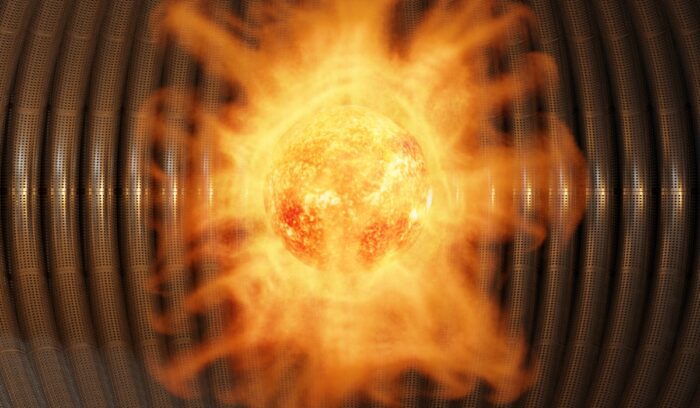
Scientists in China have achieved something that would have seemed like science fiction just a generation ago: sustaining superheated fusion plasma for more than 17 minutes inside an experimental reactor. The milestone, set by the Experimental Advanced Superconducting Tokamak — known as EAST — at the Institute of Plasma Physics in Hefei, marks the longest plasma confinement time ever recorded at that temperature, and pushes humanity meaningfully closer to the dream of near-limitless clean energy.
At a glance
- China fusion plasma record: The EAST tokamak held plasma at approximately 100 million degrees Celsius — roughly seven times hotter than the sun’s core — for 1,066 seconds, shattering the previous record of 403 seconds set by the same facility in 2023 C.E.
- Plasma confinement: Sustained confinement is one of fusion’s hardest engineering problems; the plasma must be held stable long enough for the reaction to produce more energy than it consumes, a threshold scientists call “ignition.”
- Clean energy potential: Fusion reactions produce no carbon emissions and no long-lived radioactive waste, using hydrogen isotopes found in seawater as fuel — a resource that is effectively inexhaustible.
Why duration matters so much
Getting plasma hot enough to fuse atoms is one challenge. Keeping it there is another entirely.
Fusion plasma is an unstable, turbulent soup of charged particles that wants to escape its magnetic cage at every moment. Even small disruptions can collapse the reaction. The fact that Chinese researchers at the Chinese Academy of Sciences held plasma steady for more than 17 minutes — more than twice their own previous record — signals that the engineering of magnetic confinement is maturing rapidly.
The EAST device is often called China’s “artificial sun,” though that nickname understates how extreme the conditions inside actually are. At 100 million degrees Celsius, matter behaves in ways that exist nowhere else on Earth. Containing it requires superconducting magnets generating fields powerful enough to levitate a freight train, all operating near absolute zero a few meters from the plasma itself.
A global race with a shared finish line
China is not alone in this work. The international ITER project in France — a 35-nation collaboration including the U.S., E.U., Japan, South Korea, and India — is currently under construction and aims to demonstrate fusion’s energy potential at scale in the 2030s C.E. Private companies like Commonwealth Fusion Systems and Helion Energy are pursuing their own approaches, betting that compact designs using newer magnet technology can get there faster.
EAST’s record feeds directly into that global knowledge base. The plasma physics data gathered during sustained runs helps researchers everywhere refine their models of how fusion plasma behaves over time — information that is essential for designing commercial reactors.
South Korean researchers also set a related record in 2024 C.E., holding plasma at 100 million degrees for 48 seconds in a different configuration. Each nation’s advances build on the others, with findings typically shared in peer-reviewed journals and international conferences, even amid broader geopolitical tensions.
How far away is fusion power, really?
Honest answers require caution. The 17-minute record is a record for duration, not for net energy output. EAST is a research device, not a power plant, and it consumes far more energy than the plasma currently produces. The gap between sustaining plasma and delivering electricity to a grid involves enormous engineering challenges that remain unsolved.
Still, the trajectory of progress has accelerated noticeably in the past decade. Advances in high-temperature superconducting magnets, plasma control algorithms, and computer modeling have compressed timelines that once stretched indefinitely into the future. The International Atomic Energy Agency now tracks more than 100 active fusion projects worldwide — a number that would have been unimaginable in the 1990s C.E.
Whether commercial fusion arrives by 2040 C.E. or 2060 C.E. remains genuinely uncertain. But records like this one make the question feel less hypothetical than it did before.
Read more
For more on this story, see: China fusion plasma record — Good News for Humankind
For more from Good News for Humankind, see:
- U.K. cancer death rates fall to their lowest level on record
- Ghana establishes a new marine protected area at Cape Three Points
- The Good News for Humankind archive on clean energy
About this article
- 🤖 This article is AI-generated, based on a framework created by Peter Schulte.
- 🌍 It aims to be inspirational but clear-eyed, accurate, and evidence-based, and grounded in care for the Earth, peace and belonging for all, and human evolution.
- 💬 Leave your notes and suggestions in the comments below — I will do my best to review and implement where appropriate.
- ✉️ One verified piece of good news, one insight from Antihero Project, every weekday morning. Subscribe free.