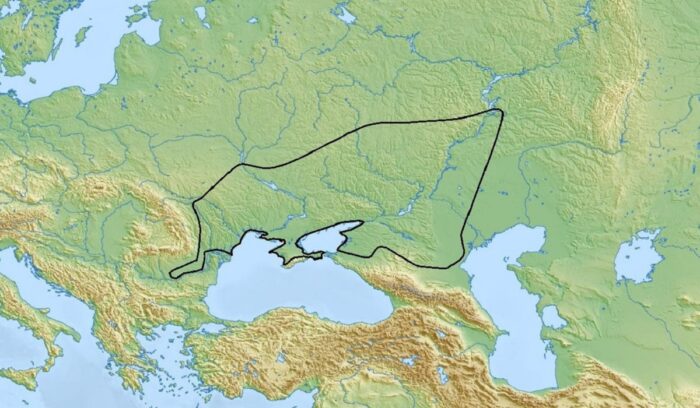
Around 2,500 B.C.E., a new way of life was taking shape across the vast grasslands north of the Black Sea. The people archaeologists call the Catacomb culture were burying their dead in a way no one on the steppe had done before — and in doing so, they left behind one of the most distinctive and far-reaching archaeological fingerprints of the early Bronze Age.
What the evidence shows
- Catacomb culture: Emerging around 2,500 B.C.E. from the earlier Yamnaya culture, the Catacomb culture spread across the Pontic steppe — the broad grassland corridor stretching through modern-day Ukraine and southern Russia — and persisted until roughly 1,950 B.C.E.
- Burial innovation: The culture takes its name from a distinctive grave form: a vertical shaft dug into the earth, with a side niche cut at its base to hold the body — an architectural leap beyond the simple pit graves of their predecessors.
- Steppe trade networks: Artifacts and stylistic similarities link the Catacomb people to cultures as distant as Mycenaean Greece, Italy, and Syria, suggesting active exchange across thousands of miles of ancient Eurasia.
A people on the move
The Pontic steppe is one of history’s great corridors. For thousands of years, it funneled people, animals, languages, and ideas between Europe and Central Asia. The Catacomb culture emerged within this corridor, growing out of the Yamnaya culture — the remarkable steppe society that had already spread wagon technology and possibly early Indo-European languages across a wide arc of Eurasia.
What made the Catacomb people distinct was a combination of innovation and synthesis. Their ceramics were more elaborate than anything the Yamnaya had produced. Their metalwork included knives with iron blades dating to around 2,500 B.C.E. — among the earliest documented uses of iron anywhere on Earth. Their composite bows and quivers for up to 20 arrows suggest a society that had invested deeply in both hunting and warfare.
They were also, in all likelihood, mobile. Most known Catacomb settlements are seasonal campsites near water sources. A few larger sites exist — including a stone-built fortress on an island in the Dnieper River — but the culture’s economy centered on herding cattle, sheep, goats, and horses, with only limited agriculture. Traces of einkorn and emmer wheat and wooden ploughs suggest farming wasn’t absent, just not central.
The catacomb grave and what it reveals
Burial archaeology tells us a great deal about how a society understood itself. Catacomb graves are unusually rich with meaning. The deceased were typically laid on their right side in a flexed position, accompanied by silver rings, stone and metal axes, daggers, maces, and arrows. Animal sacrifices — particularly the head and hooves of horses, cattle, goats, and sheep — appeared in about 16% of graves.
Some burials included wheeled vehicles, continuing a Yamnaya tradition that would later appear among the Scythians, the Celts, and the Italic peoples. Others were marked with carved stone stelae — upright monuments that stood on the open steppe as visible markers of memory and territory.
Perhaps the most striking practice of all was clay mask-making. In high-status burials, the faces of the dead — men, women, and children — were modeled in clay, with the mouth, ears, and nasal cavity filled and the surface features sculpted. Scholars have suggested these clay masks may have been prototypes for the famous gold masks later found at Mycenaean sites like Mycenae itself. The connection remains speculative, but the Mycenaean parallels — in burial customs, spearhead types, and horse cheekpieces — are striking enough that they continue to attract serious scholarly attention.
Connections across Eurasia
The Catacomb culture was not an island. It exchanged ideas and technologies with neighbors in every direction. To the east, it influenced the Poltavka culture, another Yamnaya descendant. Its metalwork appears to have shaped the later Sintashta culture, which would go on to produce some of the earliest known spoke-wheeled chariots. Its ceramics left traces in the Abashevo culture to the north.
The ancient DNA revolution has added a new layer to this picture. Genetic studies of Pontic steppe populations have confirmed deep continuities and migrations across this region, showing how people carried cultural practices, languages, and biological ancestry across enormous distances during the Bronze Age. The Catacomb people fit within a broader pattern of steppe mobility that reshaped much of Eurasia between roughly 3,500 and 1,500 B.C.E.
Linguists have speculated that Catacomb culture speakers may have spoken an early form of Tocharian — an Indo-European language later attested in texts from the Tarim Basin in western China, thousands of miles to the east. This remains contested, but it reflects the scale of movement and influence that steppe cultures of this era could sustain.
Craft, ritual, and everyday life
The Catacomb people were specialists as well as herders. Archaeological evidence points to weavers, bronze workers, and weapons manufacturers operating within the culture — a degree of craft specialization that implies trade, surplus, and some form of social organization beyond simple kinship bands.
Low-footed ceramic vessels found in female burials are thought to have been used in rituals involving hemp or other narcotic substances — a practice with parallels across the steppe world and echoed later in the writings of Herodotus, who described Scythian vapor baths using cannabis.
Cranial deformation appears in certain regional variants of the culture, particularly around the Donets River. About 9% of Catacomb skulls show drilled holes, interpreted as evidence of ritual or medical practice — one of the earlier documented instances of surgical intervention in the region.
Lasting impact
The Catacomb culture lasted for roughly 550 years before being succeeded by the Srubnaya culture, which itself became a major force on the steppe. But the Catacomb legacy did not disappear — it was absorbed, transmitted, and transformed by successor cultures across a vast arc from Central Europe to South Asia.
Its burial innovations echoed in Mycenaean Greece. Its metallurgical techniques fed into the Sintashta and Andronovo cultures that would shape the Bronze Age across much of Eurasia. Its composite bow technology left traces in the military traditions of cultures far to its east and west. And its ceramics influenced neighbors who carried those traditions forward for centuries.
More broadly, the Catacomb culture is a reminder that the steppe — often imagined as empty or peripheral — was in fact one of the most dynamic zones of human exchange in the ancient world. The people who lived and died there were not isolated. They were connected, inventive, and consequential.
Blindspots and limits
The Catacomb culture is known almost entirely from its graves. Settlements are sparse and poorly preserved, which means our picture of daily life, social structure, and belief is heavily skewed toward death rituals — the things that survive in the ground rather than those that defined living experience. The population of an estimated 50,000–60,000 individuals across a vast territory also hints at how much of this world remains undiscovered. Scholarly debate continues over how to classify the culture’s regional variants, and the linguistic associations with Tocharian or other Indo-European branches remain unresolved.
Read more
For more on this story, see: Wikipedia — Catacomb culture
For more from Good News for Humankind, see:
- Indigenous communities secure land rights for 160 million hectares
- Uganda reintroduces rhinos to Kidepo Valley
- The Good News for Humankind archive on prehistory
About this article
- 🤖 This article is AI-generated, based on a framework created by Peter Schulte.
- 🌍 It aims to be inspirational but clear-eyed, accurate, and evidence-based, and grounded in care for the Earth, peace and belonging for all, and human evolution.
- 💬 Leave your notes and suggestions in the comments below — I will do my best to review and implement where appropriate.
- ✉️ One verified piece of good news, one insight from Antihero Project, every weekday morning. Subscribe free.
More Good News
-

China plans to double its already massive clean energy supply by 2035
China’s new climate pledge to the United Nations sets a target of 3,600 gigawatts of wind and solar power by 2035 — more than the entire electricity-generating capacity of the United States today, and roughly double what China has already built. The commitment is woven into the country’s next Five-Year Plan, which directs state banks, provinces, and manufacturers to move in the same direction. Because China makes about 80% of the world’s solar panels, every factory it scales up makes clean energy cheaper for buyers in Africa, Southeast Asia, Latin America, and everywhere else. That ripple effect is what makes…
-

Doctors hail first breakthrough in asthma and COPD treatment in 50 years
Benralizumab, a single injection given during an asthma or COPD attack, outperformed the steroid pills that have been the only emergency option since the 1970s. In a King’s College London trial of 158 patients, those who got the shot had four times fewer treatment failures over 90 days, along with easier breathing and fewer follow-up visits. Because steroids carry real risks with repeated use — diabetes, osteoporosis, and more — a genuine alternative could change daily life for millions of people who live in fear of the next flare-up. After a half-century of stalled progress on diseases that claim 3.8…
-

Mexico launches universal healthcare for all 133 million citizens
Mexico universal healthcare is now officially a reality, with the country launching a system designed to cover all 133 million citizens through the restructured IMSS-Bienestar network. Before this reform, an estimated 50 million Mexicans had no formal health insurance, with rural and Indigenous communities bearing the heaviest burden of untreated illness and medical debt. The new system severs the long-standing tie between employment and healthcare access, providing free consultations, medicines, and hospital services regardless of income. If implemented effectively, Mexico’s move could serve as a powerful model for other middle-income nations still navigating fragmented, inequitable health systems.