
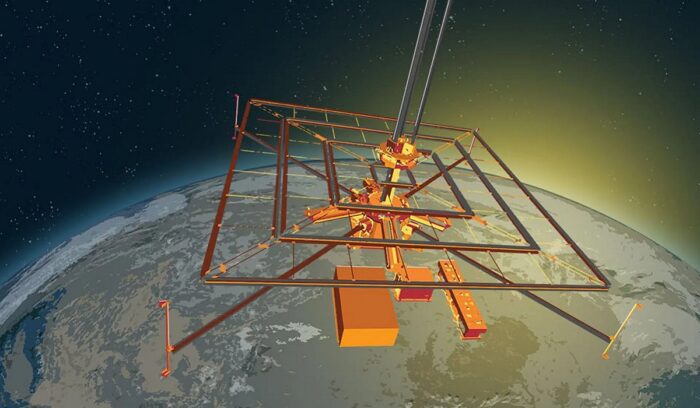
A team at the California Institute of Technology has achieved something engineers have theorized about for decades: sending solar energy collected in space back down to the surface of the Earth as a wireless power beam. The milestone, reached by the Space Solar Power Project (SSPP), marks the first time detectable power has been transmitted from orbit to a ground receiver — opening a new chapter in clean energy research.
At a glance
- Space solar power: The SSPD-1 demonstrator, launched January 3, 2023 C.E. aboard a SpaceX rocket, successfully beamed microwave energy from low Earth orbit to a receiver on the roof of a Caltech engineering building in Pasadena.
- Wireless energy transfer: The MAPLE module used phase manipulation and constructive/destructive interference — no moving parts — to steer the power beam precisely at its target, validating the core technology needed for a full-scale array.
- Flexible solar arrays: Unlike earlier rigid experimental structures, Caltech’s transmitter array is built on lightweight, flexible materials with custom integrated circuits, a design the team says has never before been used for wireless energy transfer in space.
The experiment was modest in scale — the power detected on the ground was not enough to run a household appliance — but the physics worked exactly as predicted. The beam arrived at the correct time, at the correct frequency, and with the frequency shift the team expected given the distance traveled. That precision matters enormously: in a commercial system, a transmitter array thousands of meters across would need to hit a receiver station on the ground with near-perfect accuracy, continuously, from orbit.
Why space solar matters
Solar panels in space have a fundamental advantage over those on the ground. They face no night, no clouds, and no atmosphere filtering the sun’s energy. According to the SSPP team, the solar potential in space is roughly eight times greater per square meter than a comparable panel on Earth’s surface.
That gap could matter a great deal as the world tries to shift away from fossil fuels. Ground-based renewables are growing fast — the International Energy Agency reported record renewable capacity additions in 2023 C.E. — but they still depend on local geography, weather, and a stable grid to deliver power where it is needed. Space solar sidesteps several of those constraints.
“In the same way that the internet democratized access to information, we hope that wireless energy transfer democratizes access to energy,” said Ali Hajimiri, Bren Professor of Electrical Engineering and Medical Engineering and co-director of the SSPP. “No energy transmission infrastructure will be needed on the ground to receive this power. That means we can send energy to remote regions and areas devastated by war or natural disaster.”
How the MAPLE experiment worked
The 50-kilogram Space Solar Power Demonstrator (SSPD-1) was launched into low Earth orbit on January 3, 2023 C.E., carried aboard a Momentus Vigoride spacecraft. It contained three separate experimental modules designed to test different aspects of the SSPP concept.
The MAPLE module — Microwave Array for Power-transfer Low-orbit Experiment — handled the power-beaming tests. It first ran a short-range validation inside the spacecraft, steering a microwave beam between a transmitter array and two small receiver arrays positioned roughly 30 centimeters away. The team was able to light LEDs on each receiver on demand, confirming that the beam-steering technology survived the radiation and temperature extremes of space.
Then came the Earth-pointing test. A small window in the MAPLE unit allowed the transmitter to aim its beam downward at the Caltech campus. The signal was detected at the ground station as expected. “To the best of our knowledge, no one has ever demonstrated wireless energy transfer in space even with expensive rigid structures,” Hajimiri said. “We are doing it with flexible lightweight structures and with our own integrated circuits. This is a first.”
The other two modules — DOLCE, testing the deployment mechanics of foldable structures, and ALBA, comparing different solar cell designs — were still in progress at the time of the announcement. The results of all three modules together are meant to inform the design of a much larger demonstration.
The road ahead is long
The SSPP vision calls for a commercially relevant orbital array spanning roughly 9 square kilometers, with matching receiver arrays on the ground. Caltech researchers estimate that building such a system could require as many as 39 separate rocket launches, even using the ultra-lightweight modular design the team is developing. Each module would pack into about one cubic meter at launch and unfurl into a flat square roughly 50 meters per side, with solar cells on one face and transmitters on the other.
The economics remain a serious challenge. The SSPP team has estimated a Levelized Cost of Energy for space solar in the range of $1 to $2 per kilowatt-hour — far above current retail electricity prices in the United States. The project has been funded by more than $100 million in donations from Donald Bren, chairman of the Irvine Company, but scaling to commercial viability will require cost breakthroughs that no one has yet mapped out.
“The flexible power transmission arrays are essential to the current design of Caltech’s vision for a constellation of sail-like solar panels that unfurl once they reach orbit,” said Sergio Pellegrino, Joyce and Kent Kresa Professor of Aerospace and Civil Engineering and co-director of SSPP.
Space agencies including the European Space Agency and the U.K. government have also been studying space solar power as a potential long-term contributor to net-zero targets, which suggests the Caltech result arrives in a policy environment that is at least paying attention. Whether any of that interest translates into the investment needed to move from a 50-kilogram demonstrator to a 9-square-kilometer array is the question the next decade of research will have to answer.
For now, the signal detected on a rooftop in Pasadena is a proof of concept, not a power source. But it is a proof of concept that, until this year, did not exist — and in the history of energy technology, those first confirmed steps have a way of compounding.
Read more
For more on this story, see: New Atlas — World-first space solar demonstration beams power from orbit to Earth
For more from Good News for Humankind, see:
- First ever space-to-Earth solar power mission succeeds
- Renewables hit 49% of global power capacity for the first time
- The Good News for Humankind archive on renewable energy
- In ‘world first’, ultra-cheap printable solar panels are launched in Australia
About this article
- 🤖 This article is AI-generated, based on a framework created by Peter Schulte.
- 🌍 It aims to be inspirational but clear-eyed, accurate, and evidence-based, and grounded in care for the Earth, peace and belonging for all, and human evolution.
- 💬 Leave your notes and suggestions in the comments below — I will do my best to review and implement where appropriate.
- ✉️ One verified piece of good news, one insight from Antihero Project, every weekday morning. Subscribe free.


