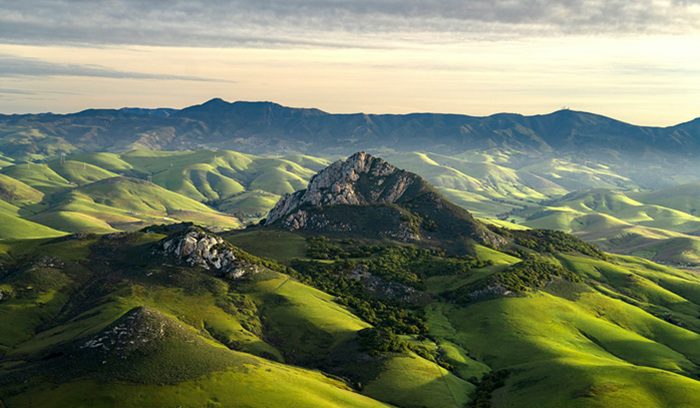
Three new state parks and expansions to several existing ones — California’s Earth Day announcement added hundreds of acres of protected land across the state, from the Central Valley to the redwood coast. It marks the largest growth of the California state park system in decades, bringing the total to 283 state parks.
At a glance
- San Joaquin River Parkway: Six riverfront properties totaling 874 acres near Fresno and Madera will become a new state park, securing public access that was at risk of expiring due to the San Joaquin River Conservancy’s limited funding.
- Dust Bowl Camp: A historic site near Bakersfield where Depression-era migrant farmworkers once lived — and which inspired John Steinbeck’s Pulitzer Prize-winning novel The Grapes of Wrath — will be preserved as a state park.
- Feather River Park: A 2,000-acre stretch of oak woodland along the Feather River north of Sacramento will become the first state park in Yuba County, a mostly rural region long overlooked by state investment.
Why the Central Valley win matters
For communities in and around Fresno, the San Joaquin River Parkway isn’t a distant destination — it’s within walking distance for some residents. Nesting bald eagles live along the river corridor. At night, the site becomes one of the darkest places in Fresno, offering a rare contrast to city lights.
The parkway’s six properties are currently managed by the San Joaquin River Conservancy, a small state agency with just six staff members. Its funding for operations and maintenance was set to expire next year. Transferring ownership to California State Parks solves that problem and guarantees long-term public access.
“We get forgotten about,” said Kari Daniska, CEO of the San Joaquin River Conservancy, “so for us to be in the spotlight feels really good.” The new park is part of a broader effort to protect 5,900 acres of open land along the San Joaquin River and build a 22-mile trail system.
History, access, and overlooked places
Dust Bowl Camp, near Bakersfield, carries a story many Californians know through literature but few have seen in person. The camp sheltered migrant workers who fled the Great Plains during the 1930s Dust Bowl — the people whose experience Steinbeck captured in one of American literature’s most enduring novels. Preserving the site as a state park honors that working-class history in a concrete and lasting way.
Yuba County’s Feather River Park fills a different kind of gap. The area’s oak woodlands drew heavy informal use for years, but also faced illegal dumping, trespassing, and off-road vehicle damage. Yuba County adopted a limited-use ordinance in 2024 C.E. that improved conditions, but state park resources will allow the land to reach its full potential. Gary Bradford, a Yuba County supervisor, called it “an amazing recreational asset.”
Paul Miller, president of the Sacramento chapter of the Audubon Society, uses a wheelchair and plans to advocate for accessible trails in the new park. The expansion of South Yuba River State Park in Nevada County — which will now encompass the full Independence Trail, the first wheelchair-accessible wilderness trail in the United States — shows what that kind of access can look like when it’s built in from the start.
Redwoods, bluffs, and existing parks grow too
Alongside the three new parks, California announced expansions to several existing ones. Save the Redwoods League donated 453 acres to Montgomery Woods State Natural Reserve in Mendocino County, adding second-growth forest and 1.25 miles of streams. In San Mateo County, 133 acres of coastal bluffs joined Pigeon Point Light Station State Historic Park, tripling its footprint.
South Yuba River State Park grew by 218 acres in Nevada County, absorbing the full length of the Independence Trail along a historic gold mining ditch — a route with both ecological and historical value.
The expansion is not complete in every sense. Many of these properties still need infrastructure investment — trails, facilities, and accessibility features take years and significant funding to build out. How equitably those resources flow to historically underfunded regions like the Central Valley and Yuba County will determine how much of this promise becomes real access for real people.
California State Parks Director Armando Quintero said the announcement sets the state “on a path to not just grow the State Park System but also provide more access and instill a greater connection and sense of pride for all Californians in their state parks.” With 283 parks now in the system, that path just got a little longer — in the best possible way.
Read more
For more on this story, see: SFGate
For more from Good News for Humankind, see:
- Indigenous land rights recognized across 160 million hectares at COP30
- Renewables now make up at least 49% of global power capacity
- The Good News for Humankind archive on the United States
About this article
- 🤖 This article is AI-generated, based on a framework created by Peter Schulte.
- 🌍 It aims to be inspirational but clear-eyed, accurate, and evidence-based, and grounded in care for the Earth, peace and belonging for all, and human evolution.
- 💬 Leave your notes and suggestions in the comments below — I will do my best to review and implement where appropriate.
- ✉️ One verified piece of good news, one insight from Antihero Project, every weekday morning. Subscribe free.
More Good News
-
Coho salmon returns surge 10x on California’s Mendocino Coast over last decade
Coho salmon are back on California’s Mendocino Coast in numbers no one alive expected to see: more than 30,000 endangered adults returned to spawn this past season, roughly ten times the count from a decade ago. Biologists who once walked miles of empty stream are now finding fish tucked under their boots and spawning in channels barely a foot and a half wide. The turnaround follows decades of patient work — over 100 restoration projects, removed culverts, and rebuilt floodplains — meeting a rare stretch of favorable ocean conditions. It’s a reminder that endangered species can come back when communities…
-
Botswana officially strikes anti-sodomy law from its national penal code
Botswana has officially erased its colonial-era anti-sodomy law from the national penal code in 2026, transforming a 2019 court victory into permanent written statute. The original provision, imported under British rule in the 19th century, had once threatened same-sex couples with up to seven years in prison. Striking the language itself matters because unconstitutional laws left on paper can still be used to harass and stigmatize, even when unenforceable. Botswana now joins a small group of African nations that have gone beyond court rulings to fully cleanse discriminatory language from their books. With more than 60 countries still criminalizing same-sex…
-

More than 10% of the world’s oceans now officially protected
Ocean protection just crossed a historic line: as of April 2026, 10.01% of the world’s seas are officially designated as protected, up from 8.6% just two years ago. That leap represents roughly 5 million square kilometers of newly safeguarded waters — an expanse larger than the entire European Union. The milestone fulfills a promise the world first made back in 2010, and it arrived thanks to thousands of small wins: national designations, community-led projects, and Indigenous stewardship of some of the most intact marine ecosystems on Earth. With the UN High Seas Treaty now in force, nations finally have a…