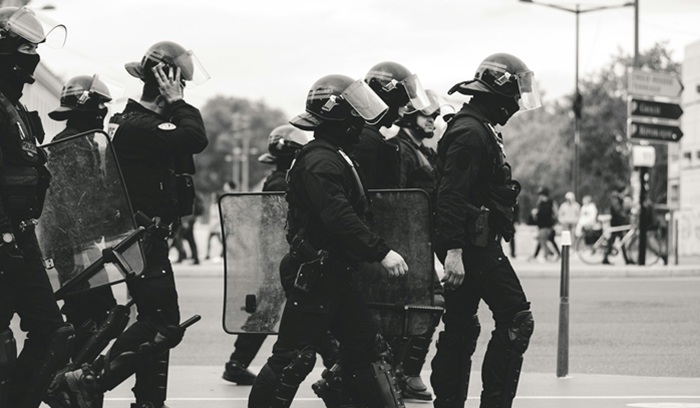
California has taken a historic step to increase transparency and public trust in law enforcement with the passage of the “No Secret Police Act.” This new law prohibits most law enforcement officers, including federal immigration agents, from wearing masks or other facial coverings while conducting official business. The legislation, signed by Governor Gavin Newsom, is the first of its kind in the United States. This action is a direct response to public concern over the use of face coverings during recent immigration raids in Los Angeles. This law is a progressive measure that aims to create a more accountable and transparent system of law enforcement.
A Stand Against Federal Overreach
The passage of this law is a powerful statement about a state’s right to push back against federal overreach. Governor Newsom and other proponents of the bill framed it as a defense of California’s diverse communities. The law is intended to prevent the use of tactics that critics have called “dystopian” and that have been a source of fear and confusion. The law specifically prohibits the use of masks, balaclavas, and neck gaiters, which can obscure an officer’s identity and prevent them from being held accountable for their actions. It is a bold move that has inspired similar proposals in other states.
Building a Safer and More Accountable Community
The new law is designed to have a direct, positive impact on public safety. By requiring officers to be clearly identifiable, it helps to build a sense of trust between law enforcement and the communities they serve. This is particularly important for immigrant communities, who have been the target of recent enforcement actions. The law also aims to prevent individuals from impersonating officers to commit crimes, a growing concern in some areas. While opponents of the law, including the Department of Homeland Security, have expressed concerns about officer safety and doxing, supporters argue that transparency and accountability are fundamental to a healthy democracy. Law enforcement agencies are required to adopt a policy governing the use of facial coverings by July 1, 2026. This will give departments time to adjust to the new rules while ensuring the law is implemented effectively.
A Blueprint for Future Reforms
The “No Secret Police Act” is a key piece of a larger legislative effort in California to reform the criminal justice system and protect the rights of its residents. The state has already passed other measures to protect immigrant families and provide legal aid to those facing deportation. This new law, which goes into effect on January 1, 2026, could serve as a blueprint for other states and cities looking to enact similar reforms. It shows that states are not powerless in the face of federal policy they disagree with and that they can take action to protect their own citizens. This move is a significant step toward a future where law enforcement is more transparent and accountable to the public it serves.
A Focus on Democratic Values
This law is ultimately about upholding democratic values. It affirms the principle that law enforcement should operate with transparency and accountability, and that individuals have the right to know who is enforcing the law. Governor Newsom and other supporters have stated that this legislation is a direct defense of the constitutional rights of all Californians. It is a declaration that the state will not tolerate tactics that erode public trust and create a climate of fear. This stand for basic freedoms is a hopeful sign for the future of civil liberties in the United States.
- For a deeper look at the importance of transparency in policing, the American Civil Liberties Union (ACLU) provides resources on the rights of protesters and the public.
- For more details on the law and its legal implications, you can read the bill’s official summary on the California State Legislature’s website.
- You can read more about the legal rationale for such laws from constitutional law experts at the University of California, Berkeley.
More Good News
-

Alzheimer’s risk cut in half by drug in landmark prevention trial
A clinical trial from Washington University in St. Louis and published in The Lancet Neurology found that long-term high-dose treatment with the antibody drug gantenerumab reduced Alzheimer’s risk by roughly 50% in people with dominantly inherited Alzheimer’s disease — a rare genetic form caused by mutations that make the disease near-certain. The results are statistically uncertain and apply to less than 1% of all Alzheimer’s cases, but they provide the first evidence that removing amyloid plaques before symptoms appear can meaningfully change the course of the disease.
-

Marie-Louise Eta becomes the first female head coach in men’s top-flight European football
Marie-Louise Eta, 34, was appointed head coach of Bundesliga side Union Berlin on April 12, 2026, becoming the first woman to hold the top coaching position at a men’s club in any of Europe’s Big Five leagues — the Premier League, La Liga, Serie A, Ligue 1, and Bundesliga. A Champions League winner as a player with Turbine Potsdam in 2010, Eta had already broken barriers as the first female assistant coach in the Bundesliga in 2023. She takes charge for the final five matches of the season as Union Berlin fights to secure top-flight survival, after which she was…
-

Renewables now make up at least 49% of global power capacity
Renewable energy reached 49.4% of total global installed power capacity by end of 2025, up from 46.3% in 2024, according to the International Renewable Energy Agency’s Renewable Capacity Statistics 2026. The world added 692 gigawatts of new renewable capacity last year — the largest annual addition ever recorded — with solar alone contributing 511 gigawatts. Africa recorded its highest renewable expansion on record, and the Middle East its fastest-ever growth. IRENA Director-General Francesco La Camera noted that countries investing in renewables are absorbing the current Middle East energy crisis with measurably less economic damage than fossil-fuel-dependent economies.