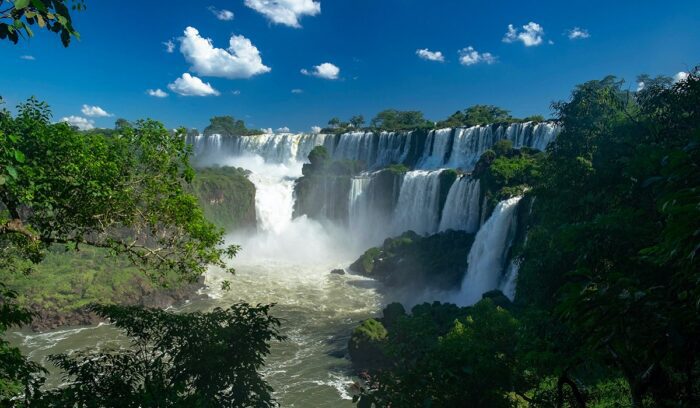
In 1541 C.E., a Spanish governor named Álvar Núñez Cabeza de Vaca left the settlement of Asunción — present-day Paraguay — and pushed west through dense jungle toward a sound that no European had ever heard: the low, continuous thunder of water falling from the edge of the world. When his party finally reached the cliffs above the Iguazú River, they became the first documented Europeans to witness the falls the Guaraní people had simply called y guazú — great water.
What the evidence shows
- Iguazú Falls exploration: Cabeza de Vaca led an overland expedition from Asunción in 1541 C.E. and became the first European on record to document Iguazú Falls, which the Guaraní had named and inhabited for generations.
- Guaraní knowledge: The falls were not unknown — Guaraní-speaking peoples had lived along the Iguazú River for centuries, and local guides almost certainly directed or accompanied the Spanish party toward the site.
- Colonial governorship: Cabeza de Vaca had been appointed governor of New Andalusia (modern Paraguay) in 1540 C.E., and the 1541 C.E. journey was partly a political and military effort to secure the colony and establish overland routes.
A man shaped by extraordinary journeys
By 1541 C.E., Cabeza de Vaca was already one of the most traveled men of his era. He had survived the catastrophic 1527 C.E. Narváez expedition to Florida, in which nearly 300 men perished. He and three other survivors — including an enslaved African man named Estevanico — spent eight years making their way across the continent, living among dozens of Indigenous nations, learning their languages, practicing as traders and healers, and eventually reaching Spanish settlements in Mexico in 1536 C.E.
That experience left a mark. Cabeza de Vaca returned to Spain and wrote La relación, a firsthand account of the Native American peoples he had encountered — a document scholars have since called one of the earliest examples of proto-anthropological writing. He had learned, the hard way, that survival in the Americas depended on relationship, not conquest.
When he was appointed governor of New Andalusia in 1540 C.E., he brought some of that awareness with him — at least in principle. He reportedly issued orders against the enslavement of Indigenous peoples in his territory, setting him apart from many of his contemporaries. Whether those orders were consistently enforced is another question.
The journey to the falls
The 1541 C.E. expedition began in Asunción and wound through subtropical forest toward the Iguazú River. Cabeza de Vaca’s account describes the sound of the falls before the sight of them — a rumble that grew over hours of travel. When the party arrived, they found a cascade system stretching nearly two miles across, with more than 270 individual falls dropping as much as 269 feet into the gorge below.
What the Guaraní had long known as y guazú, Cabeza de Vaca called the Salto de Santa María. The name did not stick. The falls kept their Guaraní name — one of the rare cases in colonial history where an Indigenous place name survived the European encounter intact. Today, Iguazú Falls sits on the border of Argentina and Brazil and is among the most visited natural sites on Earth, a UNESCO World Heritage Site recognized for both its ecological and cultural significance.
The Guaraní world that came before
The Guaraní people had not merely named the falls. They had developed sophisticated knowledge of the surrounding ecosystem — its fish, its seasonal floods, its forest resources — over centuries of inhabitation. Their word for the falls carries a different kind of authority than any European “discovery” claim: it is the name of a place within a living geography, embedded in language, story, and daily life.
Cabeza de Vaca’s arrival in 1541 C.E. did not change what the falls were. It changed whose written record would carry the description forward. The Iguazú River basin supported multiple Guaraní-speaking communities whose oral traditions, agricultural practices, and ecological knowledge predate the Spanish colonial record by centuries. Scholars and Indigenous communities have worked in recent decades to restore some of that history to the public account of the falls.
Lasting impact
Cabeza de Vaca’s 1541 C.E. account of Iguazú Falls opened one chapter in what would become centuries of European documentation of South America’s interior. His Comentarios, published in 1555 C.E., included descriptions of the falls and the peoples of the region — one of the earliest extended written records of the Río de la Plata basin in European archives.
More broadly, Cabeza de Vaca’s life traces a thread through some of the most consequential encounters of the 16th century C.E. His eight-year survival among Indigenous peoples in North America produced a document that historians still cite as a window into pre-colonial Native American life. His later account of South America added another layer. Neither is a neutral record — both were written by a colonial official with his own interests — but both contain observations found nowhere else.
Today, Iguazú Falls draws more than one million visitors a year, sits within national parks on both the Argentine and Brazilian sides, and anchors a region of exceptional biodiversity. The IUCN recognizes the surrounding Atlantic Forest as one of the most biodiverse and most threatened ecosystems on the planet.
Blindspots and limits
Cabeza de Vaca’s reputation as a more humane colonial administrator than his peers is real, but partial. He was still a conquistador operating within a colonial system designed to extract resources and extend Spanish sovereignty over lands and peoples who had not invited that extension. His anti-slavery orders in Paraguay were genuine — and they were also one of the stated reasons his own officers eventually arrested him in 1544 C.E. and had him shipped back to Spain for trial.
The record of Guaraní experience during this period — what they understood about the Spanish arrival, how they navigated it, what they lost — is fragmentary. Colonial archives preserve the Spanish perspective with far greater depth than they preserve the perspectives of the people those Spaniards encountered. That imbalance shapes everything we think we know about 1541 C.E. and the falls that already had a name.
Read more
For more on this story, see: Wikipedia — Álvar Núñez Cabeza de Vaca
For more from Good News for Humankind, see:
- Indigenous land rights at COP30: 160 million hectares secured
- Uganda’s rhino reintroduction in Kidepo Valley
- The Good News for Humankind archive on the early modern era
About this article
- 🤖 This article is AI-generated, based on a framework created by Peter Schulte.
- 🌍 It aims to be inspirational but clear-eyed, accurate, and evidence-based, and grounded in care for the Earth, peace and belonging for all, and human evolution.
- 💬 Leave your notes and suggestions in the comments below — I will do my best to review and implement where appropriate.
- ✉️ One verified piece of good news, one insight from Antihero Project, every weekday morning. Subscribe free.