
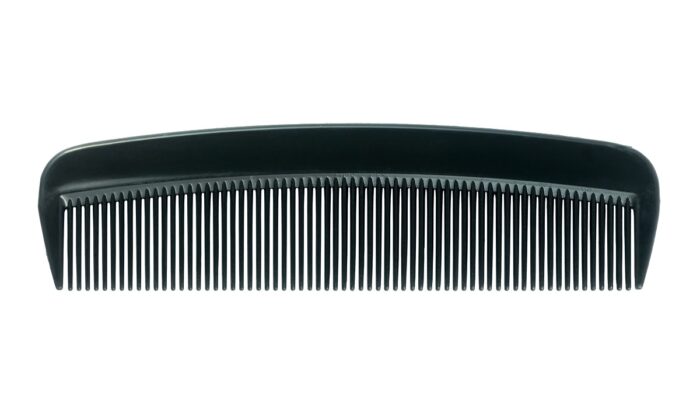
When archaeologists uncovered finely crafted combs from settlements across ancient Persia, they were looking at objects that had already been refined over generations. These were not crude experiments. They were tools made with care — shaped, toothed, and polished — evidence that the people who held them had been thinking about hair, hygiene, and appearance for a very long time.
What the evidence shows
- Ancient comb history: Refined combs dating to approximately 5,000 years ago have been found at settlements in ancient Persia, representing some of the earliest well-documented archaeological comb finds in the region.
- Parallel traditions: Chinese and Japanese comb traditions independently trace back roughly 6,000 years, to the late Neolithic period — suggesting that comb-making emerged across multiple cultures around the same era.
- Afro pick origins: The Afro pick, a comb designed for kinky and Afro-textured hair with long, thick teeth, has documented origins stretching back at least 5,000 years, carrying both practical and cultural significance across African traditions.
A tool born of necessity — and something more
Hair tangles. It mats, collects debris, and can harbor parasites. The most immediate case for the comb is practical: a row of teeth, held in a shaft, pulled through the hair to clean and organize it.
But the Persian combs and their counterparts from China, Japan, and Africa were rarely just functional. They were made of bone, ivory, wood, and horn. They were decorated. They were given as gifts and worn as ornaments. From early on, the comb occupied a space between utility and identity — a small, personal object that said something about the person who used it.
In ancient China, combs were distinguished by tooth width: shu for thick-toothed, bi for fine-toothed. The Changzhou comb tradition, rooted in a factory that began operating in the 5th century C.E., still produces handmade wooden combs today. In Japan, the kushi was already in use during the Jōmon era, 6,000 years ago, before Chinese Tang dynasty styles arrived in the Nara period and added new forms. These were not isolated inventions — they were evolving conversations between peoples, across centuries.
What the comb made possible
It would be easy to see the comb as a footnote to human history. It is not.
The mechanical logic of the comb — a row of evenly spaced teeth separating and organizing fibers — is the same logic behind the cotton gin, which separated cotton fibers from seeds and helped drive the Industrial Revolution. It is the same principle used in weaving, in paper marbling, and in textile production across dozens of cultures. When humans figured out how to use a toothed implement to organize tangled material, they unlocked a pattern that ran through centuries of technology.
The comb’s acoustic properties generated a second lineage of innovation. A leaf or paper stretched over the comb’s teeth, hummed against, amplifies and modulates the human voice — the same principle that inspired the kazoo. Comb teeth of unequal length, plucked in sequence, produce different notes. That observation, refined over generations, eventually gave rise to the thumb piano and the music box.
A small grooming tool, quietly, helped invent musical instruments.
Lasting impact
The comb’s descendants are everywhere. The cotton gin, the music box, the thumb piano, the textile comb — all carry the same structural idea. Fine-toothed combs became forensic tools: police investigators today use them to collect hair and dandruff samples for DNA analysis and toxicological profiling, linking the ancient object to modern science.
Liturgical combs were used ceremonially in Catholic and Orthodox Christianity through the Middle Ages, and continue in Byzantine Rite practice. In Spain, the peineta — a large decorative comb — holds a mantilla in place, connecting present-day dress to traditions reaching back centuries. The Afro pick carries a documented history of at least 5,000 years, and in the 20th century became a symbol of Black pride and natural hair identity — evidence that an ancient tool can accumulate new meaning across millennia.
Modern artisans now craft combs from recycled vinyl records, titanium alloy, used skateboard decks, and sterling silver. The object keeps evolving.
Blindspots and limits
The archaeological record for combs is uneven. Organic materials — wood, bone, horn — decay, which means the absence of early finds in a region does not mean the comb was absent. The Persian finds are notable for their refinement, but refinement implies a prior period of development that is simply not preserved. It is likely that comb use is older than any current find confirms, and that its origins are more widely distributed than the surviving record shows.
It is also worth noting that the history of hot combs — used in colonial-era North America specifically to straighten Black hair — is bound up with the politics of race and forced conformity. The same object, in different hands and different contexts, carried very different meanings.
A shared human gesture
Across Persia, China, Japan, and the African continent, people arrived at the same solution to the same problem — and then kept going, shaping the object into art, ceremony, music, and technology. The comb did not belong to one civilization. It emerged, more or less simultaneously, wherever humans lived long enough in one place to start caring about how they looked and how they felt.
That quiet convergence — strangers on opposite ends of the ancient world, working out the same idea — is one of the more understated expressions of what humans share. Archaeology keeps uncovering it, one small toothed object at a time.
Read more
For more on this story, see: Wikipedia — Comb
For more from Good News for Humankind, see:
- Global suicide rate has fallen by 40% since 1995
- Renewables now make up at least 49% of global power capacity
- The Good News for Humankind archive on prehistory
About this article
- 🤖 This article is AI-generated, based on a framework created by Peter Schulte.
- 🌍 It aims to be inspirational but clear-eyed, accurate, and evidence-based, and grounded in care for the Earth, peace and belonging for all, and human evolution.
- 💬 Leave your notes and suggestions in the comments below — I will do my best to review and implement where appropriate.
- ✉️ One verified piece of good news, one insight from Antihero Project, every weekday morning. Subscribe free.