
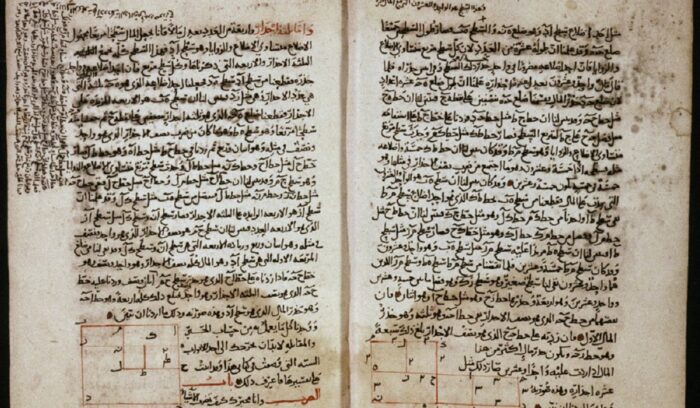
Around 820 C.E., a Persian scholar working in Baghdad finished a book that would quietly reshape the entire trajectory of mathematics. He was not writing for fame. He was writing to be useful — to give merchants, lawyers, surveyors, and anyone dividing an inheritance a clear, systematic way to solve problems. What he produced became the foundation of algebra as a discipline taught in every school on Earth.
Key facts
- Al-Khwarizmi’s algebra: Written in Baghdad around 820 C.E., Al-Kitāb al-Mukhtaṣar fī Ḥisāb al-Jabr wal-Muqābala — “The Compendious Book on Calculation by Completion and Balancing” — was the first text to teach algebra as an independent mathematical discipline, not merely as a tool for solving specific puzzles.
- Algebraic equation types: The book classified quadratic equations into six basic types and provided both algebraic and geometric methods to solve them, expressed entirely in words rather than symbols — “squares,” “roots,” and “numbers” in place of the notation we use today.
- Etymology of algebra: The word “algebra” derives directly from al-jabr, one of the two core operations described in the book — meaning the “restoration” of a deficient quantity by moving it to the other side of an equation, eliminating negative terms from calculations.
What the book actually did
Before Al-Khwarizmi, mathematical problem-solving existed in many traditions — Babylonian clay tablets, Greek geometry, Indian numerical methods — but each was rooted in specific cases and concrete problems. A merchant needed to know how much grain fit in a particular container. A scribe needed to divide a field. The solutions were tailored to the situation.
Al-Khwarizmi did something different. He asked: what are the general forms a problem can take? What are the rules that govern entire classes of equations, regardless of what the numbers happen to be? In doing so, he shifted mathematics from a collection of techniques into something closer to a language — one that could describe, and solve, an infinite variety of problems through the same underlying logic.
The historian J.J. O’Connor described this as a “revolutionary move away from the Greek concept of mathematics, which was essentially geometry.” Algebra became a unifying framework — one that could hold rational numbers, irrational numbers, and geometric magnitudes inside the same system. It gave mathematics a development path far broader than anything that had existed before.
The world that made it possible
Baghdad in the early ninth century C.E. was one of the most intellectually connected cities on Earth. The Abbasid Caliphate had established the House of Wisdom, a center for translation, scholarship, and scientific inquiry that drew thinkers from across the Islamic world, Persia, and beyond. Al-Khwarizmi worked there.
The text he produced was not built from nothing. It drew on Babylonian problem-solving traditions, Brahmagupta’s Indian mathematics, and Greek geometric methods. The approximation of pi that appears in the book’s chapter on areas and volumes — 3.1416 — had already appeared in the Indian Āryabhaṭīya in 499 C.E. Al-Khwarizmi synthesized and systematized; he built a new structure on foundations that many cultures had laid.
About half the book is devoted to Islamic inheritance law — a highly practical application requiring first-order algebraic equations. This is worth noting: what became the abstract foundation of modern mathematics was, at its origin, a tool for justice and equity in the distribution of estates.
Lasting impact
In 1145 C.E., Robert of Chester translated the book into Latin. For the next four centuries, it served as the primary mathematics textbook in European universities. The word “algebra” entered Medieval Latin as algebraica and never left.
Al-Khwarizmi’s name itself became the word “algorithm” — a Latinized form of his name attached to the systematic step-by-step procedures he described. His two great contributions, algebra and the algorithm, now form the backbone of modern computing, data science, cryptography, engineering, and physics. Every equation solved in a school classroom, every search result returned by a software query, carries some trace of that Baghdad workshop.
The book also demonstrated that mathematics could be applied to itself — that the rules governing equations could be studied as objects in their own right, not just as means to external ends. That recursive quality, mathematics examining its own structure, opened a door that has never closed.
Blindspots and limits
The algebra of Al-Khwarizmi dealt only in positive numbers and positive solutions — negative quantities were not admitted, which meant many equation types we consider equivalent today were treated as distinct categories requiring separate treatment. The book’s rhetorical style, writing everything out in words with no symbolic notation, also limited how quickly ideas could be extended and generalized. Those advances would come later, over centuries, through the work of scholars across the Islamic world, India, and eventually Renaissance Europe. The full story of algebra’s development is collective, not singular — and much of that collective work remains less widely known than it deserves to be.
Read more
For more on this story, see: Wikipedia — The Compendious Book on Calculation by Completion and Balancing
For more from Good News for Humankind, see:
- Brahmagupta’s Brāhmasphuṭasiddhānta lays the foundations of zero and algebra
- Early automobile invention transforms how humans move through the world
- The Good News for Humankind archive on the medieval era
About this article
- 🤖 This article is AI-generated, based on a framework created by Peter Schulte.
- 🌍 It aims to be inspirational but clear-eyed, accurate, and evidence-based, and grounded in care for the Earth, peace and belonging for all, and human evolution.
- 💬 Leave your notes and suggestions in the comments below — I will do my best to review and implement where appropriate.
- ✉️ One verified piece of good news, one insight from Antihero Project, every weekday morning. Subscribe free.


