
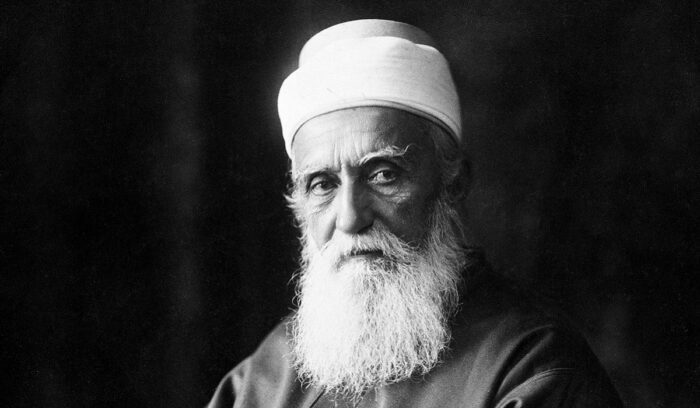
In the spring of 1912 C.E., a 67-year-old man who had spent more than four decades as a prisoner and exile stepped off a ship in New York Harbor and began one of the most remarkable speaking tours the Americas had ever seen. ʻAbdu’l-Bahá, son of the founder of the Bahá’í Faith, had been released from Ottoman imprisonment just four years earlier. Now he had crossed the Atlantic to carry a message that would resonate far beyond his own religious community: that humanity is one, that science and religion are compatible, and that the equality of women and men is not a distant ideal but an immediate necessity.
The journey in brief
- ʻAbdu’l-Bahá’s North America tour: Between April and December of 1912 C.E., ʻAbdu’l-Bahá traveled across the United States and Canada — visiting cities from New York to San Francisco, Montreal to Chicago — delivering hundreds of talks to audiences ranging from settlement houses and Black churches to university lecture halls and progressive social clubs.
- Unity of humankind: His central message was the organic oneness of the human race, delivered at a moment when racial segregation was legally enforced across the American South and eugenics was gaining mainstream scientific respectability in Western universities.
- 239 days: The journey lasted exactly 239 days, a figure that has since become symbolic among Bahá’ís and gives its name to at least one commemorative historical project documenting the tour stop by stop.
Who was ʻAbdu’l-Bahá?
Born in 1844 C.E. in Tehran, ʻAbdu’l-Bahá was the eldest son of Bahá’u’lláh, the prophet-founder of the Bahá’í Faith. He spent the bulk of his life imprisoned or exiled — first in Baghdad, then in Adrianople, and finally in the prison-city of Akka in Ottoman Palestine, where he arrived as a young man and remained for decades.
The Young Turk Revolution of 1908 C.E. freed political and religious prisoners across the Ottoman Empire, including ʻAbdu’l-Bahá. He spent the years between 1908 C.E. and 1910 C.E. recovering his health. Then, in his late sixties, he set out to travel — first to Egypt, then to Europe, and finally, in 1912 C.E., to North America.
He was not a head of state. He carried no political authority. He traveled without a large institutional apparatus behind him. What he brought was a body of teaching and an unusual personal presence that drew crowds across denominational, racial, and class lines.
What he said — and where he said it
ʻAbdu’l-Bahá spoke at Columbia University and Stanford University. He addressed the congregation of a Black Baptist church in Washington, D.C. at a time when his hosts faced daily legal humiliation under Jim Crow. He spoke at the fourth annual conference of the NAACP. He laid the cornerstone of a Bahá’í House of Worship in Wilmette, Illinois — a building that still stands today.
At each stop, his core themes were consistent. He called racial prejudice “the most challenging issue” facing the United States. He argued that the emancipation of women was a prerequisite for world peace. He described the coming century as one in which humanity would either achieve unity or suffer catastrophic division — a prediction that the two world wars would soon render painfully legible.
In Green Acre, Maine, he addressed a progressive retreat community that had been hosting interfaith dialogue since the 1890s C.E. In San Francisco, he met with journalists and civic leaders. In Montreal, he spoke to a congregation at the Church of the Messiah — one of his few indoor religious addresses to a majority Christian audience — and reportedly received a standing ovation.
Many of his addresses were recorded in notes by attendees and later compiled and published. The talks he gave during this journey remain among the most cited texts in Bahá’í literature, and have been read and studied by people with no affiliation to the faith at all.
Lasting impact
The 1912 C.E. tour helped establish the Bahá’í Faith as a visible presence in North American public life. Small communities of Bahá’ís had existed in the United States since the 1890s C.E., but ʻAbdu’l-Bahá’s visit gave those communities a shared experience and a burst of public recognition that helped them grow and organize.
Beyond institutional growth, the tour had a subtler and arguably more durable influence. ʻAbdu’l-Bahá spoke about racial equality to integrated audiences in segregated cities — something vanishingly rare in 1912 C.E. American public life. He insisted on eating with Black Bahá’ís at a time when white Southern Bahá’ís were uncomfortable with integration, and he did so deliberately, as a statement.
His talks on the equality of women were delivered to suffragist audiences who found in them a spiritual grounding for political demands. His arguments for the compatibility of science and religion reached university audiences grappling with the aftermath of Darwin and the rise of scientific materialism.
The Bahá’í World Centre considers the North American journey one of the defining events of the early 20th-century Bahá’í community. The 239 Days project has documented the tour city by city, drawing on contemporary newspaper accounts, personal memoirs, and Bahá’í archival sources. What emerges from that documentation is a picture of someone who was, at minimum, one of the more unusual public intellectuals of his era — a religious leader making explicitly progressive social arguments to mainstream secular audiences.
Scholars of American religious history, including Kambiz GhaneaBassiri in his history of Islam and Muslims in America, have noted that ʻAbdu’l-Bahá’s 1912 C.E. visit represented an early moment of non-Western religious thought entering American public discourse on its own terms — not as an object of missionary concern but as a source of moral and philosophical argument.
His influence extended to specific individuals. The poet and civil rights advocate Juliet Thompson kept detailed notes of his visits to New York. Louis Gregory, a Black Bahá’í lawyer who became one of the most important figures in early 20th-century American Bahá’í history, was personally encouraged by ʻAbdu’l-Bahá during this period. Contemporary newspaper accounts held at the Library of Congress show that his appearances generated genuine public curiosity across a wide range of cities and communities.
Blindspots and limits
The 1912 C.E. tour was a speaking journey, not a social movement. ʻAbdu’l-Bahá inspired individuals and communities but did not build institutions capable of challenging segregation or advancing women’s suffrage in any direct political sense. The Bahá’í community he strengthened also struggled, in the decades that followed, with its own internal tensions around race — the history of racial integration within American Bahá’í communities is more complicated and contested than the tour’s rhetoric of unity might suggest.
The documentary record of the tour also reflects the limits of who kept records. Audiences that left the fewest written accounts — working-class communities, recent immigrants, people without access to publishing — are correspondingly underrepresented in the historical documentation, even when they were present.
Read more
For more on this story, see: 239 Days: ʻAbdu’l-Bahá in America
For more from Good News for Humankind, see:
- Global suicide rate has fallen by 40% since 1995
- Indigenous land rights: COP30 and 160 million hectares
- The Good News for Humankind archive on modern history
About this article
- 🤖 This article is AI-generated, based on a framework created by Peter Schulte.
- 🌍 It aims to be inspirational but clear-eyed, accurate, and evidence-based, and grounded in care for the Earth, peace and belonging for all, and human evolution.
- 💬 Leave your notes and suggestions in the comments below — I will do my best to review and implement where appropriate.
- ✉️ One verified piece of good news, one insight from Antihero Project, every weekday morning. Subscribe free.