
Curated by Peter Schulte · Published 2026-08-05 · Last updated 2026-08-05
Racial justice progress is real, measurable, and accelerating — even as the work remains unfinished.
From Britain’s landmark 1807 ban on the Atlantic slave trade to Oman abolishing slavery in 1970, the arc of legal equality has bent — slowly but unmistakably — toward freedom. In the United States, that arc runs from the Emancipation Proclamation through Brown v. Board of Education to Barack Obama’s 2008 election and a 2023 Supreme Court ruling that saved Black voting rights in Alabama.
Globally, the pattern repeats: organized movements force legal change, legal change enables political power, and political power delivers concrete reforms.
The milestones collected here span abolition, civil rights, policing accountability, environmental justice, and reparative investment — a 200-year record showing that sustained pressure works.
Key takeaways
- Britain banned the Atlantic slave trade in 1807 after 20 years of campaigning — proving organized movements can end entrenched systems.
- South Africa’s 1994 all-race election and the U.S. election of Barack Obama in 2008 mark the two most watched democratic breakthroughs in racial justice history.
- The U.S. Supreme Court’s 2023 Alabama redistricting ruling upheld Section 2 of the Voting Rights Act, protecting Black political representation.
- Colombia elected its first Black woman vice president in 2022; Bloomberg’s 2024 $600 million gift to Black medical schools signals reparative investment at scale.
- Lead-pipe removal, Flint funding, and the prosecution of a racially profiling sheriff show environmental and policing justice advancing through federal action.
Recovery at a glance
| Subject | Recovery | Where |
|---|---|---|
| British Slave Trade Act | Atlantic slave trade banned after 20 years of campaigning | United Kingdom |
| Slavery Abolition Act | ~800,000 enslaved people freed across the British Empire | United Kingdom / Caribbean / South Africa |
| Emancipation Proclamation | 25,000–75,000 freed immediately; millions more as Union forces advanced | United States |
| Frederick Douglass memoir | 30,000 copies sold by 1860; galvanized abolition movement | United States |
| NAACP founding | Interracial coalition of 60+ activists launched on Lincoln's 100th birthday | United States |
| Brown v. Board of Education | Unanimous Supreme Court ruling overturned 60 years of 'separate but equal' | United States |
| Martin Luther King Jr. — 'I Have a Dream' | 250,000 gathered at Lincoln Memorial; speech reached global audience | United States |
| South Africa — end of apartheid | First fully democratic election after nearly 50 years of apartheid | South Africa |
| Barack Obama | First Black U.S. president elected; 134 million votes cast — highest turnout in generations | United States |
| Alabama redistricting ruling | Supreme Court 5-4 upheld Voting Rights Act Section 2 | United States |
| Francia Márquez | First Black woman vice president of Colombia | Colombia |
| Bloomberg HBCU gift | $600 million to four Black medical schools — more than doubling three endowments | United States |
| Flint water crisis funding | $270 million approved 95-3 by U.S. Senate for pipe replacement | United States |
| EPA lead-pipe rule | 10-year deadline to replace all lead pipes; $2.6 billion in funding | United States |
| Oman slavery abolition | One of the last countries to abolish slavery — 1970 decree | Oman |
| United Democratic Front | 575 organizations united against apartheid at 1983 launch | South Africa |
On this page
- Why this matters
- What’s driving the comeback
- Abolition: ending the legal foundation of racial slavery
- Movement-building: the organized foundations of racial justice
- Legal and political representation: firsts that shifted power
- Voting rights and policing accountability: justice in the system
- Reparative investment and environmental justice: resources to match rights
- The outlook
- Frequently asked questions
Why this matters
The story of racial justice is not a straight line — but it is, unmistakably, a story of progress.
Over two centuries, legal systems that once codified enslavement and apartheid have been dismantled, one statute and one court ruling at a time. Britain ended the slave trade in 1807 and freed 800,000 enslaved people by 1833. South Africa held its first democratic election in 1994. The United States elected its first Black president in 2008.
These are not just symbolic milestones. Each one shifted the material conditions of millions of lives — and each one was the product of organized, sustained, multigenerational pressure.
What makes this moment notable is the scale and speed of recent gains: a Supreme Court ruling protecting Black voting rights in 2023, a $600 million endowment gift to Black medical schools in 2024, and a federal mandate to remove every lead pipe in America within a decade.
By the numbers
- 800,000 enslaved people freed by Britain’s 1833 Slavery Abolition Act
- 283–16 was the final Commons vote to ban the Atlantic slave trade in 1807
- 30,000 copies of Frederick Douglass’s memoir sold by 1860
- 250,000 people gathered to hear King’s ‘I Have a Dream’ speech in 1963
- 134 million Americans voted in the 2008 election — highest turnout in generations
- $600 million donated to four Black medical schools in 2024, more than doubling three endowments
- $270 million approved 95-3 by the U.S. Senate for Flint water crisis recovery
What’s driving the comeback
The most consistent driver of racial justice progress is organized, coalition-based movement-building that forces legal change.
The 1807 slave trade ban came after 20 years of Quaker campaigning and the testimonies of formerly enslaved writers like Olaudah Equiano. The NAACP was founded in 1909 by an interracial coalition of over 60 activists responding to a race riot. South Africa’s United Democratic Front united 575 organizations — unions, churches, student groups — behind a single anti-apartheid banner in 1983.
Legal and political representation amplify those movements. Blaise Diagne’s 1914 election to France’s Chamber of Deputies, Robert Weaver’s 1966 cabinet confirmation, and Francia Márquez’s 2022 vice presidency all show how representation inside institutions creates leverage for structural change.
Reparative investment — money directed at communities harmed by structural racism — is emerging as a third driver. The $600 million Bloomberg gift to HBCU medical schools and the EPA’s $2.6 billion lead-pipe replacement program both reflect a shift from symbolic recognition toward concrete resource transfers.
Abolition: ending the legal foundation of racial slavery
The abolition of the transatlantic slave trade and then slavery itself required decades of organized pressure across multiple continents. What’s striking across these stories is how central Black writers, formerly enslaved people, and grassroots movements were to victories that are often credited solely to sympathetic legislators. Each abolition milestone built directly on the last.

Britain bans the Atlantic slave trade, 1807
After 20 years of failed attempts, the British Parliament passed the Slave Trade Act on March 25, 1807, with a final Commons vote of 283 to 16. The campaign was carried by Quakers and formerly enslaved writers like Olaudah Equiano alongside parliamentary allies. It was a foundational moment in the global fight against racial slavery.

The Slavery Abolition Act frees 800,000 across the British Empire, 1833
Britain’s Slavery Abolition Act became law on August 28, 1833, setting in motion the freedom of roughly 800,000 enslaved people across the Caribbean, South Africa, and Mauritius. It was the fruit of decades of campaigning by Black writers like Ignatius Sancho and the momentum of the 1831 Baptist War. The act marked the empire’s formal break with chattel slavery.

Frederick Douglass publishes his memoir, galvanizing abolition in the U.S., 1845
Frederick Douglass’s memoir appeared in American bookstores in 1845, just seven years after he had escaped slavery, and sold nearly 30,000 copies by 1860. His precise, literary voice carried the reality of slavery far beyond abolitionist circles. The book became one of the most powerful pieces of evidence in the U.S. abolition movement.

The Emancipation Proclamation reshapes the Civil War, 1863
Lincoln’s Emancipation Proclamation took effect on January 1, 1863, declaring enslaved people in rebelling Confederate states legally free and redefining the Civil War as a fight against slavery. It freed no one immediately by itself, but between 25,000 and 75,000 were liberated in Union-held areas, with millions more freed as federal forces advanced. The proclamation fundamentally shifted the war’s moral stakes.

Lincoln’s Emancipation Proclamation: immediate freedom for thousands, 1863
The same proclamation that redefined the war also produced immediate, measurable freedom: between 25,000 and 75,000 enslaved people were liberated in Union-held areas on the day it took effect. Millions more gained freedom as the Union army advanced through Confederate territory. The document marked the beginning of the legal end of American slavery.

Oman abolishes slavery — one of the last countries to do so, 1970
Oman’s abolition of slavery in 1970 came within weeks of Sultan Qaboos bin Said taking power, alongside sweeping modernization reforms. The decree marked a quiet close to one of the world’s last legal slave systems. It stands as a reminder that formal abolition was still incomplete less than 60 years ago.
Movement-building: the organized foundations of racial justice
Every major legal advance in racial justice history was preceded by organized, coalition-based movement-building. These stories reveal a recurring pattern: moments of racial violence or colonial oppression catalyze the formation of durable organizations and coalitions that outlast any single campaign, accumulating legal and political power across generations.

The NAACP founded by an interracial coalition, 1909
The NAACP was founded on February 12, 1909 — Lincoln’s 100th birthday — when more than 60 activists, journalists, and scholars gathered in New York following the Springfield race riot. Black leaders including W.E.B. Du Bois and Ida B. Wells joined white allies in an interracial coalition designed for the long fight ahead. It became the most consequential civil rights organization in American history.

South African leaders found the ANC to challenge colonial racial injustice, 1912
On January 8, 1912, lawyers, ministers, and editors gathered in Bloemfontein to form what would become the African National Congress, uniting Black South Africans across tribal lines against colonial rule. Founder Pixley ka Isaka Seme declared simply: ‘We are one people.’ The organization would spend the next eight decades fighting — and ultimately defeating — apartheid.
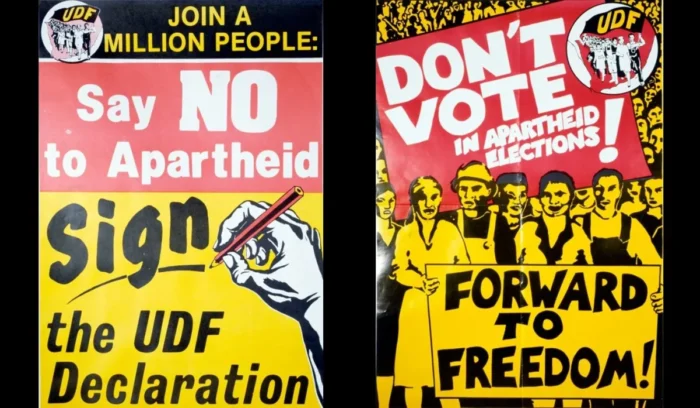
United Democratic Front unites 575 organizations against apartheid, 1983
The United Democratic Front launched on August 20, 1983, when roughly 10,000 people filled a community hall in Mitchell’s Plain, Cape Town, bringing together delegates from 575 organizations — unions, churches, student groups, and civic associations. Their unified slogan was ‘UDF Unites, Apartheid Divides.’ The UDF became one of the most powerful domestic forces in the ultimate dismantling of apartheid.

Martin Luther King Jr. delivers ‘I Have a Dream’ to 250,000, 1963
On August 28, 1963, Martin Luther King Jr. addressed more than 250,000 people from the steps of the Lincoln Memorial in the largest civil rights demonstration in American history. The speech’s most famous passage was improvised after gospel singer Mahalia Jackson called out to him during the delivery. Scholars rank it among the most significant speeches in modern history.
Legal and political representation: firsts that shifted power
Representation inside institutions — legislative, executive, judicial — has consistently proven to be more than symbolic. These stories show how firsts in political power created direct leverage for structural change: new laws passed, new departments created, new communities served. Each milestone also expanded the imaginable for the next generation.

Blaise Diagne elected first Black African in France’s Chamber of Deputies, 1914
On May 10, 1914, Blaise Diagne became the first person of full West African descent to win election to the French Chamber of Deputies, representing Senegal’s Four Communes. He later pushed through a 1916 law granting full French citizenship to residents of those communes. His election marked a breakthrough for Black political agency within a colonial empire.

Brown v. Board of Education: Supreme Court unanimously bans school segregation, 1954
On May 17, 1954, all nine U.S. Supreme Court justices ruled that racially segregated public schools were unconstitutional, overturning nearly 60 years of ‘separate but equal’ precedent. The decision did not end segregation overnight, but it stripped away the legal foundation that had sustained it. It also helped ignite the broader civil rights movement that followed over the next decade.

Robert C. Weaver becomes first Black U.S. cabinet member, 1966
Robert C. Weaver was confirmed by the U.S. Senate in January 1966 as the first African American to serve in a presidential cabinet, leading the newly created Department of Housing and Urban Development. He arrived with three Harvard degrees and more than 30 years of federal experience. His appointment represented both a personal milestone and a structural entry point for racial equity in housing policy.

South Africa ends apartheid with its first fully democratic election, 1994
On April 27, 1994, South Africans of all races voted together for the first time, ending nearly half a century of apartheid and electing Nelson Mandela as president. Voters lined up for hours — some for miles — to cast their first-ever ballot. The election remains one of the most watched democratic transformations of the modern era.

Barack Obama elected first Black U.S. president, 2008
On November 4, 2008, Barack Obama became the first African American elected to the U.S. presidency, drawing more than 134 million voters — the highest turnout in generations. He carried states Democrats hadn’t won in decades. For a country that had legalized segregation within living memory, the election was a rupture in what had seemed politically possible.

Colombia elects Francia Márquez, first Black woman vice president, 2022
On June 19, 2022, Francia Márquez was sworn in as Colombia’s first Black woman vice president, winning alongside Gustavo Petro with just over half the national vote. A former housekeeper and single mother from Cauca, one of Colombia’s poorest provinces, she rose to office through years of environmental and racial justice activism. Her election made her a landmark figure across Latin America.
Voting rights and policing accountability: justice in the system
Formal legal equality means little without enforcement — and these stories document the ongoing fight to hold institutions accountable when they discriminate. From a sheriff prosecuted for racial profiling to a Supreme Court ruling that protected Black voters’ maps, the through-line is the same: the law must be enforced, not just written.

Supreme Court upholds Black voters’ rights in Alabama redistricting, 2023
In 2023, the U.S. Supreme Court ruled 5-4 to uphold Section 2 of the Voting Rights Act, ordering Alabama to redraw congressional maps that had illegally diluted Black voters’ political power. The decision surprised observers who had expected a more conservative outcome from the current court. It reaffirmed that the Voting Rights Act retains enforceable teeth.

Arizona sheriff charged with criminal contempt for racial profiling, 2016
In 2016, federal prosecutors announced criminal contempt charges against Maricopa County Sheriff Joe Arpaio for defying a court order to stop immigration patrols ruled racially discriminatory against Latino drivers. By that point, taxpayers had already spent $48 million in related legal costs. The case became a national test of whether law enforcement officials could be held accountable for systematic racial discrimination.
Reparative investment and environmental justice: resources to match rights
The newest phase of racial justice progress moves beyond symbolic recognition toward concrete resource transfers — money, infrastructure, and institutional capacity directed at communities harmed by structural racism. These three stories, all from 2016 or later, represent a shift in the debate: not just whether discrimination occurred, but what repair looks like in practice.

U.S. Senate approves $270 million to help Flint recover from lead-poisoned water, 2016
On September 15, 2016, the U.S. Senate approved $270 million — by a 95-3 vote — to help Flint, Michigan recover from a water crisis that had poisoned children with lead through their own tap water. The funding covered pipe replacement and a national registry to track affected children. The Flint crisis exposed the intersection of race, poverty, and environmental harm in American infrastructure policy.

Bloomberg gives $600 million to four Black medical schools’ endowments, 2024
In 2024, Bloomberg Philanthropies announced a $600 million gift to Howard, Meharry, Morehouse, and Charles R. Drew universities — the four HBCU medical schools in the United States. The gift would more than double the endowments of three of the four schools, giving them the kind of financial stability long enjoyed by predominantly white institutions. It represents one of the largest single acts of reparative philanthropic investment in U.S. history.

EPA sets 10-year deadline to remove all lead pipes nationwide, 2024
In 2024, the EPA issued a new rule requiring every U.S. water utility to find and replace lead pipes within 10 years, backed by $2.6 billion in new funding. The rule marked a dramatic shift from previous timelines that had stretched 40 or more years. Because lead-pipe exposure falls disproportionately on low-income communities and communities of color, the mandate carries direct racial justice implications.
The outlook
The evidence from these 21 milestones is clear: sustained pressure over long time horizons produces irreversible legal change.
No single protest, speech, or lawsuit ended slavery, apartheid, or segregation. But the accumulation of Frederick Douglass’s memoir, the NAACP’s legal campaigns, King’s March on Washington, and decades of South African resistance did.
The current moment carries real momentum — federal voting rights protection reaffirmed, historic investments in Black institutions, environmental justice reaching communities like Flint. The open question is whether that momentum survives the political cycles that have historically rolled back civil rights gains.
History suggests the answer depends on the same factor it always has: whether organized movements sustain pressure long enough to make reversals politically costly.
Frequently asked questions
What are the biggest milestones in racial justice history?
Key milestones include Britain banning the Atlantic slave trade in 1807, the U.S. Emancipation Proclamation in 1863, the unanimous Supreme Court ruling against school segregation in 1954, South Africa’s first democratic election in 1994, Barack Obama’s election as the first Black U.S. president in 2008, and the 2023 Supreme Court ruling upholding Black voting rights in Alabama.
What year did Britain unite four colonies and create South Africa?
Britain united four colonies — the Cape Colony, Natal, Transvaal, and Orange River Colony — to create the Union of South Africa in 1910. The African National Congress was founded just two years later, in January 1912, explicitly to challenge the racial injustice built into that union from the start.
How has the Voting Rights Act been upheld in recent years?
In 2023, the U.S. Supreme Court ruled 5-4 in a case involving Alabama redistricting to uphold Section 2 of the Voting Rights Act, ordering the state to redraw congressional maps that had illegally diluted Black voters’ political power. The decision reaffirmed that the Act retains enforceable legal teeth despite expectations of a more restrictive ruling from the current court.
What is Francia Márquez known for?
Francia Márquez became Colombia’s first Black woman vice president on June 19, 2022, winning alongside president Gustavo Petro with just over half the national vote. A former housekeeper and single mother from the poor province of Cauca, she rose to office through years of environmental and racial justice activism, becoming a landmark figure across Latin America.
What is the significance of the Bloomberg $600 million gift to HBCU medical schools?
In 2024, Bloomberg Philanthropies gave $600 million to the four HBCU medical schools — Howard, Meharry, Morehouse, and Charles R. Drew — more than doubling the endowments of three of them. The gift addresses a long-standing resource gap between historically Black universities and predominantly white institutions, and represents one of the largest single acts of reparative philanthropic investment in U.S. history.
What did the Flint water crisis reveal about environmental racial justice?
The Flint water crisis exposed how race and poverty intersected with infrastructure neglect: children in a majority-Black city were poisoned by lead in their own tap water. In 2016, the U.S. Senate voted 95-3 to approve $270 million for pipe replacement and to track affected children. The crisis became a catalyst for the EPA’s 2024 nationwide rule requiring all lead pipes to be replaced within 10 years.
About this article
🤖 This article is AI-generated, based on a framework created by Peter Schulte.
🌍 It aims to be inspirational but clear-eyed, accurate, and evidence-based, and grounded in care for the Earth, peace and belonging for all, and human evolution.
💬 Leave your notes and suggestions in the comments below — I will do my best to review and implement where appropriate.
✉️ One verified piece of good news, one insight from Antihero Project, every weekday morning. Subscribe free.
