Post-modernity (1945 - 2016 C.E.)

Post-modernity spans 1945 to 2016 C.E., an era defined by rapid technological acceleration, decolonization, the rise of the internet, and expanding civil rights. This archive collects milestones in science, medicine, governance, and culture from those seven decades of sweeping human progress.

Brazilian flag, for article on Brazil's New Republic

Brazil’s New Republic begins as military hands power to civilians

Brazil’s return to civilian rule began on January 15, 1985, when an electoral college in Brasília chose Tancredo Neves as president, ending 21 years of military government. Neves fell ill before his inauguration and died that April, never taking office. Still, the opening he helped negotiate led to the 1988 “Citizen Constitution” — a framework that has now held for four decades.

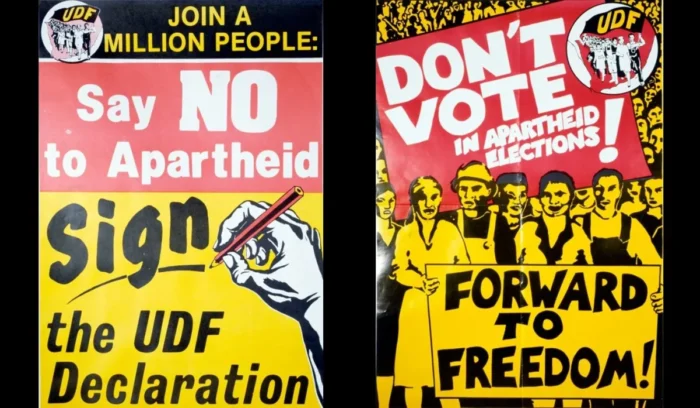
United Democratic Front flyer, for article on united democratic front south africa

United Democratic Front launches in South Africa, uniting 575 organizations against apartheid

The United Democratic Front launched on August 20, 1983, when roughly 10,000 people filled a community hall in Mitchell’s Plain near Cape Town. Delegates from 575 organizations — unions, churches, student groups, civic associations — united behind one slogan: “UDF Unites, Apartheid Divides.” It became one of the broadest nonracial coalitions in South Africa’s long struggle against apartheid.

Still front Michael Jackson's Thriller video, for article on Thriller album

Michael Jackson’s Thriller breaks racial barriers and rewrites pop music history

Thriller arrived on November 30, 1982, when a 24-year-old Michael Jackson released an album that refused to sit quietly inside the racial lines dividing American radio and MTV. Blending funk, pop, and rock across seven hit singles, it became one of the best-selling albums ever and helped open mainstream airwaves to Black artists long kept outside them.

Antigua and Barbuda flag, for article on Antigua and Barbuda independence

Antigua and Barbuda win full independence from Britain

Antigua and Barbuda became a fully sovereign nation on November 1, 1981, ending nearly 350 years of British colonial rule. The path ran through the cane fields: Vere Cornwall Bird, who led the trade union movement from 1943 onward, was sworn in as the country’s first prime minister. It was a quiet milestone in the Caribbean’s long arc toward self-rule.