
Scientists in South Africa discover a cure for the deadliest strain of tuberculosis
The new drug regimen tested has shown a 90% success rate against a deadly plague, extensively drug-resistant tuberculosis.
This archive collects solutions-journalism stories and progress milestones from South Africa, spanning health, environment, education, and civic life. Each entry highlights real developments — policies enacted, communities organized, problems solved — reported without hype.

The new drug regimen tested has shown a 90% success rate against a deadly plague, extensively drug-resistant tuberculosis.

South Africa’s parliament passed a national minimum wage bill by an overwhelming majority to tackle strikes and wage inequality.

Google is continuing in its aim to create 10 million African jobs in the next five years by training 100,000 software developers in Nigeria, Kenya and South Africa.

Nelson Mandela was sworn in as South Africa’s first Black president on May 10, 1994, at the Union Buildings in Pretoria, 27 years after being sentenced to life in prison. An estimated billion people watched worldwide. His inauguration offered a rare model of political transformation achieved through negotiation rather than retribution.

South Africa’s first fully democratic election, held on April 27, 1994, ended nearly half a century of apartheid and brought Nelson Mandela to the presidency. Voters of all races lined up for hours, some for miles, to cast their first-ever ballot. It remains one of the modern era’s most closely watched peaceful transitions from authoritarian rule.
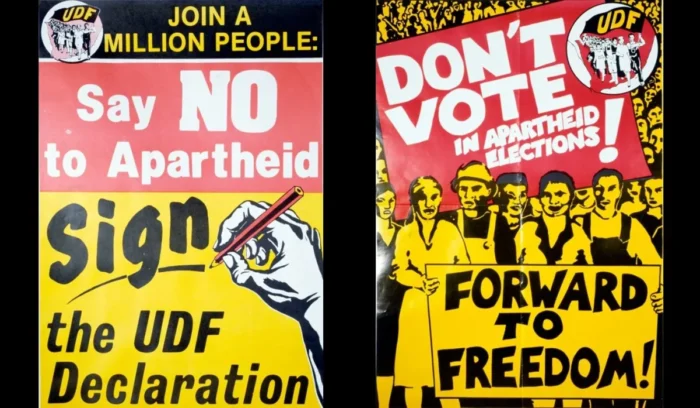
The United Democratic Front launched on August 20, 1983, when roughly 10,000 people filled a community hall in Mitchell’s Plain near Cape Town. Delegates from 575 organizations — unions, churches, student groups, civic associations — united behind one slogan: “UDF Unites, Apartheid Divides.” It became one of the broadest nonracial coalitions in South Africa’s long struggle against apartheid.

The African National Congress was born on January 8, 1912, when lawyers, ministers, and editors gathered in Bloemfontein to unite Black South Africans across tribal lines against colonial rule. Founder Pixley ka Isaka Seme told the room plainly: “We are one people.” The movement they began would outlast the empire that ignored it.

The Union of South Africa was born on 31 May 1910, stitching together four colonies — the Cape, Natal, Transvaal, and Orange River — under a single parliament. Louis Botha, a former Boer general who had fought the British less than a decade earlier, became its first prime minister. A fragile unification, built on exclusions that would shape the century ahead.

The Kingdom of Mapungubwe rose where the Shashe and Limpopo rivers meet, flourishing from around 1000 to 1300 C.E. as a hub linking southern Africa’s interior to Indian Ocean trade. At its peak, roughly 5,000 people lived at its capital, where rulers traded gold and ivory for glass beads and silk. It laid the groundwork for Great Zimbabwe.

San peoples had spread across southern Africa by around 10,000 B.C.E., reaching Cape Agulhas at the continent’s southern tip long before herder or farming cultures arrived. Their descendants still live across Botswana, Namibia, and neighboring countries today, carrying click-based languages and rock art traditions that trace one of the deepest-rooted branches of the human family tree.