China

This archive gathers solutions-journalism stories and milestones from China — covering advances in clean energy, public health, technology, conservation, and more. Each entry highlights progress worth knowing about.

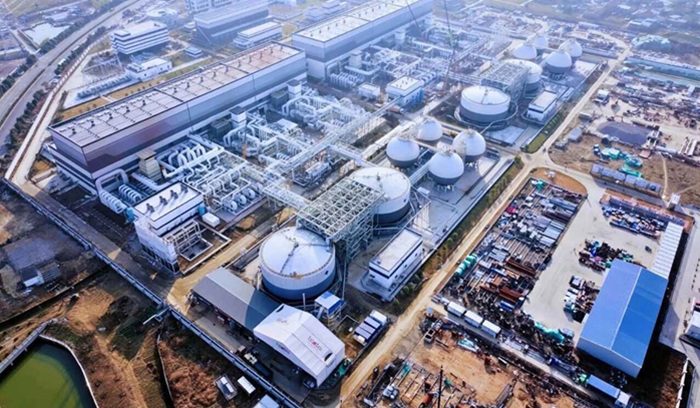
Industrial turbine machinery in a modern power facility for an article about supercritical CO2 power generation — 13 words.

China connects the world’s first commercial supercritical CO2 power generator to the grid

Supercritical CO2 power generation has reached a historic milestone as China’s Harbin Electric Corporation becomes the first in the world to operate a commercial-scale turbine using supercritical carbon dioxide — and connect it to a live national grid. The technology replaces conventional steam with pressurized CO2, achieving thermal efficiencies above 50% compared to roughly 40% for the best modern steam plants. Beyond efficiency, the turbines are dramatically more compact and work across multiple energy sources, including solar, nuclear, and industrial waste heat. China’s success gives the global engineering community proof that this long-pursued technology can actually work at scale, likely accelerating development timelines worldwide.

Milu deer standing in wetland marsh habitat for an article about milu deer recovery in China

China pulls milu deer back from extinction as population rebounds to 8,200 animals

Milu deer recovery has reached a remarkable milestone, with an estimated 8,200 Père David’s deer now living across protected reserves in China — a species that had completely vanished from the wild before 1895. The entire modern population descends from just 39 animals preserved on a private English estate, making this one of the most dramatic conservation rebounds ever recorded. A formal China-UK reintroduction program launched in the 1980s returned the deer to their ancestral wetlands, establishing a cooperative model now studied worldwide. The recovery demonstrates that sustained captive breeding, genetic stewardship, and international collaboration can bring a species back from the edge.

Aerial view of dense green forest canopy in China for an article about China reforestation

China has planted more than 170 million acres of new forest since 1990

China reforestation has reached a scale never seen before in human history, with more than 170 million acres of new tree cover added since 1990 — an area roughly the size of Texas and California combined. Driven by government programs like Grain for Green, which paid tens of millions of rural farmers to convert degraded cropland back to forest, the effort has transformed eroded hillsides into maturing woodland across the country. China’s forests now absorb an estimated 800 million tonnes of CO2 per year while also improving water quality, reducing flooding, and expanding habitat for endangered species. The achievement proves that large-scale ecological recovery is possible within a single human generation.

Colorized microscopy image of neurons and plaques for an article about Alzheimer's nanoparticle treatment

A single injection reversed Alzheimer’s symptoms in mice, and researchers say humans could be next

Alzheimer’s nanoparticle treatment developed by scientists in Spain and China reversed disease symptoms in mice with a single injection, according to a study published in Nature Nanotechnology. Rather than targeting amyloid-beta plaques directly, the engineered nanoparticles crossed the damaged blood-brain barrier and restored the brain’s own waste-clearance system. Within one hour, researchers recorded a sharp drop in toxic protein levels, with memory function fully restored and effects lasting the equivalent of decades in human terms. While mouse results don’t guarantee human outcomes, the mechanism targeting barrier function over individual markers may prove more durable than previous approaches.

Rows of solar panels stretching across a wide open landscape for an article about China CO2 emissions and clean energy growth

China’s CO2 emissions fall as clean energy outpaces fossil fuels for the first time

China’s carbon dioxide emissions are falling for the first time in its modern industrial history, driven by a clean energy buildout outpacing even rising electricity demand. In the first half of 2025, China’s CO2 emissions dropped 1% year-on-year, extending a decline that began in early 2024, while a record 212 gigawatts of solar capacity was installed in just six months. China also announced its first-ever absolute emissions reduction target, pledging a 7–10% cut below peak levels by 2035. The milestone matters globally because China’s manufacturing scale has slashed worldwide solar costs by over 90%, making clean energy more accessible everywhere.

Aerial view of a free-flowing river winding through green hills for an article about Yangtze River restoration

China tears out 300 dams on a Yangtze tributary to bring back endangered fish

Yangtze River restoration is advancing through one of the largest dam removal efforts in history, with China demolishing more than 300 dams and shutting down 342 small hydropower stations along the Chishui River. Critically endangered Yangtze sturgeon, a species that has survived for 140 million years, are already returning to previously blocked spawning grounds. Combined with a decade-long fishing ban imposed in 2020, the coordinated effort is producing measurable ecological recovery within years. The project adds significant momentum to a global dam removal movement and demonstrates that political will can reverse decades of river degradation at scale.

Alpine plants growing on a high-altitude mountain slope for an article about mercury emissions

Global mercury emissions have fallen 70% since the 1980s

Mercury pollution has dropped 70% since 1982, marking one of the most significant environmental reversals in recorded history. Researchers confirmed the decline by analyzing mercury levels trapped in alpine plant leaves collected from the Tibetan Plateau near Mount Everest, revealing a clear link to global policy action and the worldwide shift away from coal. The UN’s Minamata Convention, adopted in 2013, and stricter emissions standards — including US regulations that cut American power plant emissions by roughly 90% — drove much of the progress. The achievement demonstrates that sustained international cooperation can reverse even deeply entrenched industrial pollution.

Rows of solar panels extending across a vast installation for an article about China's 1 terawatt solar milestone

China becomes the first country to install 1 terawatt of solar power

China’s solar milestone reached one terawatt of installed photovoltaic capacity in 2025, making it the first nation in history to hit that mark, arriving ahead of schedule. The achievement is equivalent to 1.6 million utility-scale solar arrays running simultaneously and now represents half of all solar capacity installed worldwide as recently as 2024. Beyond climate goals, the buildout reflects a strategic push toward energy independence, reducing exposure to volatile fossil fuel markets. Most significantly, China’s manufacturing scale has driven global panel prices to historic lows, making clean energy newly affordable for developing nations that once had no realistic alternative.

Rows of solar panels under a blue sky for an article about China CO2 emissions and renewable energy growth, for article on China CO2 emissions

China’s CO2 emissions fall for the first time as renewables surge past coal

China’s carbon dioxide emissions declined in 2024 for the first time on record, marking a potential turning point in the global fight against climate change. Driven by an extraordinary surge in wind and solar power, clean energy now generates more electricity in China than coal and gas combined. China alone installed roughly 300 gigawatts of new solar capacity last year, more than the entire United States has ever built. Because China accounts for nearly 30 percent of global CO2 emissions, this shift could accelerate worldwide emissions reductions years ahead of previous projections.