Bolivia

Aerial view of dense Amazon rainforest canopy and winding river for an article about Amazon rainforest protection in Bolivia — 13 words

Bolivia protects over 2.4 million acres of Amazonian rainforest in Indigenous-led conservation win

Bolivia’s Amazon rainforest protection just reached a landmark milestone, with more than 2.4 million acres of Amazonian lowland forest placed under formal Indigenous-led stewardship. The newly protected territory, larger than Connecticut, shields critical habitat for jaguars, giant river otters, and thousands of plant species from logging, agribusiness, and extractive industries. What makes this action particularly significant is that Indigenous communities served as rights-holders and decision-makers throughout the process, not passive beneficiaries of outside policy. Research consistently shows that Indigenous-managed lands retain forest cover and biodiversity at higher rates than conventionally governed areas.

Dense Amazon rainforest canopy seen from above for an article about Bolivia's first Indigenous protected area

Bolivia’s first Indigenous protected area gives three Amazon peoples legal authority over their forests

Indigenous protected area victory: Three Indigenous peoples in the Bolivian Amazon have won legal management authority over Loma Santa, officially recognized as Bolivia’s first Indigenous protected area in the Amazon. The Moxeño Ignaciano, Yuracaré, and Tsimane communities spent decades defending their ancestral lands against illegal loggers, ranchers, and land grabbers. The designation matters because research consistently shows Indigenous-managed territories experience lower deforestation rates than other protected areas. This precedent demonstrates that when communities hold legal authority over lands they have stewarded for millennia, both justice and conservation win.

A young girl writing in a school notebook, for an article about Bolivia's child marriage ban

Bolivia bans child marriage with no exceptions, joining a growing regional movement

Child marriage ban advances in Bolivia as Law No. 1639 takes effect, setting 18 as the absolute minimum age for marriage and civil unions with no exceptions. The previous law had allowed marriage at 16 or 17 with parental or judicial approval, a loophole advocates say was routinely used to formalize pregnancies and conceal sexual violence against girls. More than 4,800 adolescent marriages were recorded in Bolivia between 2014 and 2024. The reform aligns Bolivia with over a dozen Latin American nations that have already eliminated similar exceptions, signaling that sustained, evidence-based advocacy can produce meaningful legal change.

Bolivian rainforest, for article on Amazon rainforest protection

Bolivian town Sena protects 1 million acres of Amazon rainforest

Amazon rainforest protection just got a remarkable boost from an unlikely source: a Bolivian town of 2,500 people passed a law safeguarding 1.1 million acres of intact forest. The new Gran Manupare reserve lifts conservation coverage in Bolivia’s Pando Department to 26% of its land, and locks in an estimated 9.2 million tons of irrecoverable carbon. It’s also a haven for giant river otters, jaguars, and big-leaf mahogany — and it works because standing forests pay, thanks to a Brazil nut economy that depends on healthy ecosystems. Piece by piece, Bolivian communities have now stitched together 10 million contiguous hectares of protected Amazon, proving that community-led conservation can match anything achieved by national decree.

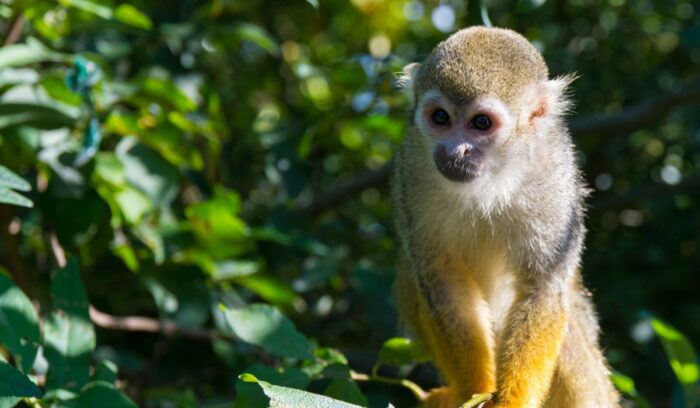
Squirrel monkey, for article on Indigenous-led land management

New fund supports Indigenous-led land management in biodiverse area of Bolivia

Indigenous communities in Bolivia’s Madidi Landscape just launched a dedicated conservation fund, opening with $650,000 from the Bezos Earth Fund to back work they’ve been doing for generations. Four nations — the Tacana, Lecos, T’simane Mosetene, and San José de Uchupiamonas — will direct the money themselves through an Indigenous-led board, finally putting resources behind territorial plans they first drafted twenty years ago. Madidi National Park is the most biodiverse protected area on land anywhere, home to more than 9,000 recorded species, from Andean condors to maned wolves. Globally, only a sliver of conservation funding reaches Indigenous hands directly, even though these communities steward most of the world’s remaining biodiversity. Funds like this one offer a hopeful blueprint for changing that.

River dolphin, for article on river dolphin declaration

11 countries sign global pact to protect endangered river dolphins

River dolphins just got their first global lifeline: 11 countries have signed the Global Declaration for River Dolphins, a pact aiming to double Asian populations and halt declines across South America by 2030. It’s a meaningful turn for a group of species that has lost nearly three-quarters of its numbers since the 1980s. The hope isn’t abstract — China’s Yangtze finless porpoise population grew 23% over five years under strict protections, and the Indus river dolphin has nearly doubled in two decades. Because dolphins signal the health of the rivers nearly a billion people depend on, their recovery points toward something larger: that coordinated, community-rooted conservation can still pull ecosystems back from the brink.