
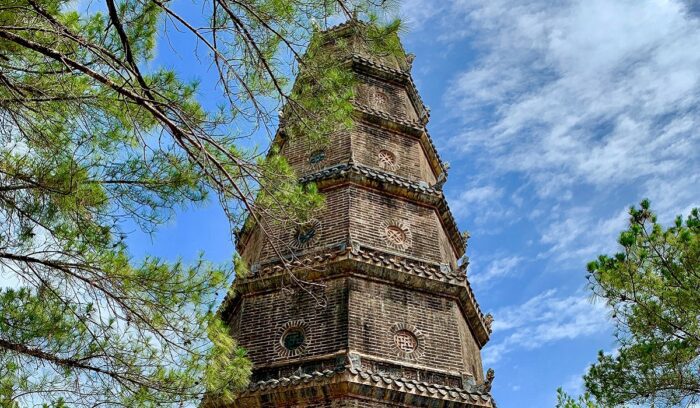
On a hill above the Perfume River, a legend gave birth to one of Vietnam’s most enduring sacred sites. A celestial old woman — Thiên Mụ, dressed in red and blue — was said to have appeared at Hà Khê hill, foretelling that a lord would come to build a temple there for the prosperity of the land. In 1601 C.E., Nguyễn Hoàng, governor of Thuận Hóa and the de facto ruler of central Vietnam, heard the prophecy and ordered construction to begin. The Thiên Mụ Pagoda has stood in some form ever since.
Key facts
- Thiên Mụ Pagoda: Founded in 1601 C.E. on Hà Khê hill on the northern bank of the Perfume River, roughly 5 kilometres from the Citadel of Huế, on the site of a pre-existing Cham shrine.
- Cham goddess: The celestial lady of the founding legend is understood by scholars to be an adaptation of Po Nagar, a pre-existing Cham goddess — evidence of the layered religious and cultural history of the region long before the Nguyễn lords arrived.
- Phước Duyên tower: The iconic seven-story octagonal brick pagoda that has become the unofficial symbol of Huế was not part of the original 1601 C.E. structure — it was erected in 1844 C.E. by Emperor Thiệu Trị, more than two centuries later.
A founding rooted in legend and politics
Nguyễn Hoàng was, in name, a loyal official of the ruling Lê dynasty based in Hanoi. In practice, he governed central Vietnam with considerable independence. His decision to build the pagoda was both a religious act and a political one — asserting the legitimacy and permanence of Nguyễn rule in a region the dynasty would govern for generations.
The site chosen for the pagoda was not an empty hill. The legend of Thiên Mụ herself appears to be rooted in earlier Cham spiritual traditions — specifically the goddess Po Nagar, who was venerated by the Cham people who had long inhabited central Vietnam before the southward expansion of Vietnamese settlement. The pagoda’s founding layered Vietnamese Buddhist practice over an existing sacred landscape, a pattern common across Southeast Asia and one that shaped the site’s ongoing spiritual character.
The original structure was relatively simple. Over the following century, it was expanded significantly. In 1665 C.E., Nguyễn Phúc Tần undertook major construction. In 1695 C.E., the Zen master Shi Da Shan arrived from China at the invitation of the Nguyễn lords, bringing with him the Caodong school of Chan Buddhism. He served as abbot and helped formalize Buddhist practice at the site before returning to China in 1696 C.E.
The bell, the tower, and the books
In 1710 C.E., a giant bell was cast under the patronage of Lord Nguyễn Phúc Chu. Weighing 3,285 kilograms, it was considered one of the most prized cultural objects in Vietnam — its sound said to carry 10 kilometres across the river valley. The bell became the subject of poems and folk songs, including verse by Emperor Thiệu Trị in the 1840s C.E.
In 1714 C.E., Chu oversaw the largest expansion in the pagoda’s history. Triple gates, dharma halls, sutra towers, bell and drum towers, meditation halls, and living quarters for the sangha were all added. He also organized an expedition to China to bring back more than a thousand volumes of the Tripiṭaka canon and Mahayana sutras, interring them at the pagoda. The site was becoming not just a place of worship but a center of Buddhist learning and scholarship in Vietnam.
Chu also established the vassana retreat tradition at the pagoda — an annual practice rooted in the time of Gautama Buddha in ancient India, during which monks remain in one place during the rainy season rather than traveling, to avoid inadvertently harming small creatures on flooded paths. That ancient Indian monastic rhythm was now embedded in the calendar of a hilltop in central Vietnam.
The nineteenth century and the symbol of Huế
When the Nguyễn dynasty formally unified Vietnam in 1802 C.E. under Emperor Gia Long, the pagoda gained new imperial patronage. Emperor Minh Mạng funded further renovation. His successor Thiệu Trị added the structure that has since defined the site’s silhouette: the Phước Duyên Pagoda, a 21-meter octagonal brick tower with seven stories, each dedicated to a different Buddha, completed in 1844 C.E.
That tower — overlooking the Perfume River, visible for kilometers — became the unofficial symbol of Huế. It is, strictly speaking, a 19th-century structure, though it stands on a site with more than two centuries of continuous sacred history behind it.
Lasting impact
The Thiên Mụ Pagoda became one of the most enduring cultural landmarks in Vietnamese history — referenced in folk rhymes, ca dao (Vietnamese folk poetry), and the national imagination. It anchored Buddhist institutional life in central Vietnam across multiple dynasties and political regimes.
In 1963 C.E., the pagoda became a center of the Buddhist crisis in South Vietnam. As the government of President Ngô Đình Diệm — a Catholic who showed systematic favoritism toward Catholics and discrimination against Buddhists in the military, public service, and aid distribution — faced mass protest, the Thiên Mụ Pagoda served as a major organizing point. Hunger strikes, barricades, and protests were held at the site. The pagoda also houses the Austin motor vehicle in which monk Thích Quảng Đức was driven to his self-immolation in Saigon — one of the most photographed acts of protest of the 20th century, which brought global attention to the treatment of Buddhists under Diệm.
The pagoda suffered severe damage in a cyclone in 1904 C.E. and was reconstructed beginning in 1907 C.E. under Emperor Thành Thái. In the 20th century, Hòa Thượng Thích Đôn Hậu served as abbot during the reconstruction era; a stupa erected in his honor now stands in the pine gardens of the complex.
Today the site remains an active place of Buddhist worship and a major destination for visitors to Huế, drawing from UNESCO’s recognition of Huế’s complex of monuments as a World Heritage Site.
Blindspots and limits
The founding narrative of Thiên Mụ Pagoda, as preserved in Vietnamese royal annals, centers on the Nguyễn lords and frames the site’s history through the lens of Vietnamese dynastic legitimacy. The earlier Cham spiritual traditions at the site — and the broader displacement of Cham people and culture through the southward expansion of Vietnamese settlement — receive little attention in that record. The pagoda’s history is well-documented in Vietnamese sources, but the voices of those whose sacred landscape it was built upon remain largely absent from the written archive. The 1904 C.E. cyclone damage also means that much of the pre-storm material fabric of the site is lost, and reconstructions from 1907 C.E. onward reflect early 20th-century interpretations of what the complex once was.
Read more
For more on this story, see: Wikipedia — Pagoda of the Celestial Lady
For more from Good News for Humankind, see:
- Indigenous land rights and the protection of sacred landscapes
- Uganda’s Kidepo Valley and the restoration of natural heritage
- The Good News for Humankind archive on Vietnam
About this article
- 🤖 This article is AI-generated, based on a framework created by Peter Schulte.
- 🌍 It aims to be inspirational but clear-eyed, accurate, and evidence-based, and grounded in care for the Earth, peace and belonging for all, and human evolution.
- 💬 Leave your notes and suggestions in the comments below — I will do my best to review and implement where appropriate.
- ✉️ One verified piece of good news, one insight from Antihero Project, every weekday morning. Subscribe free.