
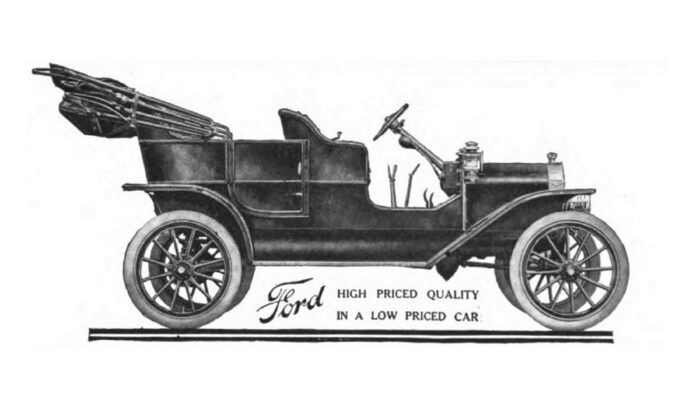
On October 1, 1908 C.E., a car rolled out of a small Detroit factory and quietly changed the shape of everyday life. It wasn’t the first automobile — that distinction belongs to Karl Benz, whose gasoline-powered vehicle debuted in Germany in 1885 C.E. But the Ford Model T was something the world hadn’t seen before: a car that a working family could actually afford to buy.
What the evidence shows
- Model T launch: Released on October 1, 1908 C.E., the Model T sold for $850 — high by wage standards of the day, but Ford’s explicit goal was to keep cutting that price until ownership became genuinely common.
- Assembly line innovation: By 1913 C.E., Ford’s Highland Park factory introduced the first moving assembly line, inspired by Chicago meatpacking plants, reducing build time from nearly ten hours to under six.
- Mass car ownership: Between 1913 C.E. and 1927 C.E., Ford factories produced more than 15 million Model Ts — enough that, at peak popularity, a majority of Americans owned one.
The road to the Model T
Henry Ford had been obsessing over engines long before the Model T existed. By day he ran operations at the Edison Illuminating Company of Detroit. By night he built things. On Christmas Eve, 1893 C.E., he tested a small gasoline engine on his kitchen counter with his wife Clara steadying the fuel supply. It ran for thirty seconds. That was enough.
He built a self-propelled vehicle called the Quadricycle in 1896 C.E., launched two companies that failed, and finally incorporated the Ford Motor Company on June 16, 1903 C.E. Eight experimental car models followed, each one teaching Ford’s team something new. Official development of the Model T began in January 1907 C.E., led by engineer Childe Harold Wills, machinist C.J. Smith, and draftsman Joseph Galamb.
The finished car was well-engineered for its moment. It featured a four-cylinder enclosed engine, a left-sided steering wheel for safety, and a vanadium alloy steel frame — light but strong. Its generous ground clearance was a deliberate choice, aimed at rural drivers navigating unpaved roads. At a time when most Americans lived outside cities and roads were often little more than dirt tracks, that feature mattered enormously.
Why the price kept falling
Ford’s $850 launch price was considered reasonable value, but it still exceeded the average American worker’s annual income. Ford’s answer was scale. Sell more cars, build more efficiently, lower the price. It worked.
The key was the moving assembly line, introduced at the Highland Park factory in 1913 C.E. Ford’s engineers divided manufacturing into hundreds of specialized steps. Workers stayed in place; the car came to them on a conveyor belt. The idea was borrowed in part from Chicago’s meatpacking industry, where carcasses moved down a line and workers each performed a single task. Applied to car-building, it cut assembly time nearly in half and made the Model T progressively cheaper year after year.
By 1924 C.E., a Model T cost just $260. That shift — from luxury item to something a factory worker could save up for — was genuinely new in the history of consumer goods.
What mass car ownership made possible
The Model T connected rural America to itself. Farmers could reach markets. Families could reach towns. The car created demand for better roads, which in turn led to the numbered U.S. highway system. Communities that had been isolated by distance became less so. That process of physical connection — of shrinking the gaps between people — continued for decades after the Model T’s last production run in May 1927 C.E.
The manufacturing methods Ford pioneered spread far beyond the auto industry. The moving assembly line became the template for mass production across the 20th century C.E. — consumer electronics, appliances, food processing. The idea that complex goods could be built quickly, cheaply, and at enormous scale owed a significant debt to what Ford’s engineers worked out on the factory floor in Highland Park.
Lasting impact
The Model T launched more than an affordable car. It launched a model of industrial production that shaped how goods are made to this day. Assembly line logic — breaking complex work into repeatable steps — underpins manufacturing across virtually every sector of the modern economy.
It also changed the physical geography of the United States. Car culture drove the expansion of suburbs, the construction of highways, and the decline of rail as the dominant mode of passenger travel. The Smithsonian has documented how the Model T effectively created the social conditions for the American middle class as the 20th century C.E. unfolded.
And the MIT Automotive Research Center has noted that Ford’s production breakthroughs set the terms of global manufacturing competition for generations — influencing Toyota’s later lean production methods, which themselves reshaped industry worldwide.
Blindspots and limits
The Model T’s story is not clean. Ford required dealers to bundle subscriptions to the Dearborn Independent with each car sale — a newspaper that actively spread anti-Semitic propaganda and reached circulation rivaling major national papers. Ford also used his industrial power to suppress labor unions, control immigrant workers, and resist workplace protections that his employees sought.
The mass car ownership the Model T enabled came with long-term costs that were not visible in 1908 C.E.: urban sprawl, dependence on fossil fuels, the erosion of public transit networks, and carbon emissions that would take more than a century to fully reckon with. The car that connected rural America also, eventually, helped disconnect it from the rail lines, town squares, and walkable communities that had shaped life before it.
Ford’s factories were also largely closed to Black workers in their early years, and the benefits of automobile ownership did not flow equally across racial lines — a fact the history of discriminatory road placement and access, documented by scholars for decades, makes plain.
The Model T ended production in 1927 C.E. after competition from General Motors made it look outdated. Ford reluctantly shut the line, scrapped 40,000 specialized tools, and introduced the Model A by December. The era of the single dominant car model — and the industrial monoculture it represented — was already giving way to a market of choices.
Still, what the Model T demonstrated — that ordinary people could own something once reserved for the wealthy, and that manufacturing could be reimagined to make it so — remains one of the more durable ideas in economic history. Henry Ford’s biography at History.com traces how that single idea shaped a century of industrial thinking. And the Library of Congress has documented how the automobile age reshaped not just transportation but American culture, music, and social life in ways still felt today.
Read more
For more on this story, see: History.com — The Model T
For more from Good News for Humankind, see:
- Ford’s moving assembly line slashes car production time by nearly 90%
- Thomas Davenport and his wife build the first U.S. electric motor vehicle
- The Good News for Humankind archive on the modern age
About this article
- 🤖 This article is AI-generated, based on a framework created by Peter Schulte.
- 🌍 It aims to be inspirational but clear-eyed, accurate, and evidence-based, and grounded in care for the Earth, peace and belonging for all, and human evolution.
- 💬 Leave your notes and suggestions in the comments below — I will do my best to review and implement where appropriate.
- ✉️ One verified piece of good news, one insight from Antihero Project, every weekday morning. Subscribe free.


