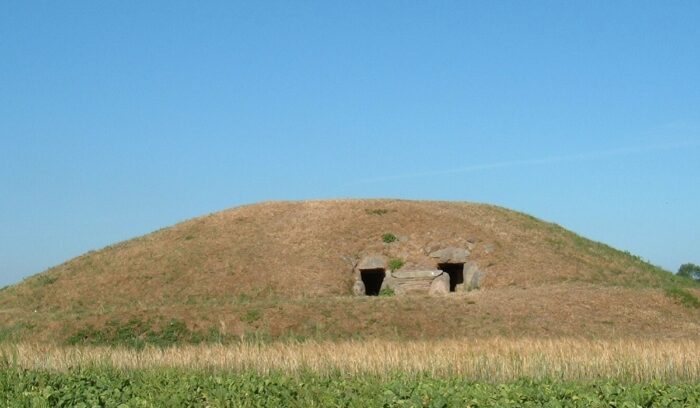
The Cairn of Barnenez – prehistoric mausoleum – is constructed in Brittany, France
The Cairn de Barnenez (known also as Barnenez Mound or Barnenez Tumulus) is one of the oldest structures in the world that is still standing.
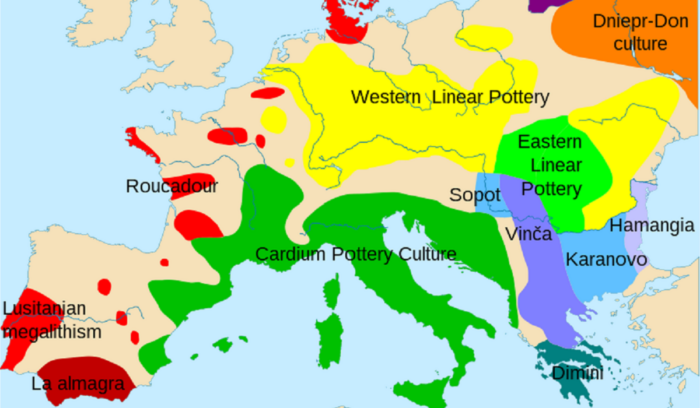
The first known permanent settlement of the area began with the Linear Pottery Culture, around 5000 B.C.E. in the Neolithic era. About 200 B.C.E., the Celtic Boii tribe founded the first significant settlement, a fortified town known as an oppidum.
The majority of Cucuteni–Trypillia settlements consisted of high-density, small settlements, concentrated mainly in the Siret, Prut and Dniester river valleys.
The aulos was a musical wind instrument played by the ancient Greeks. Made from cane, boxwood, bone, ivory, or occasionally metals the circular pipe (bombyke) was fitted with bulbous mouth pieces which gave the instrument a different pitch.
Pottery found by archaeologists at the Skorba Temples resembles that found in Italy, and suggests that the Maltese islands were first settled in 5200 B.C.E. mainly by Stone Age hunters or farmers who had arrived from the Italian island of Sicily, possibly the Sicani.
The Vinča symbols are a set of symbols found on Neolithic era artifacts from the Vinča culture of Southeastern Europe. The nature and purpose of the symbols is a mystery.
The Neolithic long house was a long, narrow timber dwelling built by the first farmers in Europe beginning at least as early as the period 5000 to 6000 B.C.E. They first appeared in central Europe in connection with the early Neolithic cultures such as the Linear Pottery culture or Cucuteni culture.
The Linear Pottery culture is a major archaeological horizon of the European Neolithic. It represents a major event in the initial spread of agriculture in Europe.
By the Iron Age, starting in the 7th century B.C.E., the Iberian Peninsula consisted of complex agrarian and urban civilizations, either Pre-Celtic or Celtic.
The trade route involved the seaborne movement of obsidian by an unknown Neolithic Europe seafaring people. The obsidian was mined from the volcanic island of Milos and then transported to various parts of the Balkans, Anatolia, and Cyprus, where they were refined into obsidian blades. However, the nature of the seafaring technologies involved has not been preserved.