
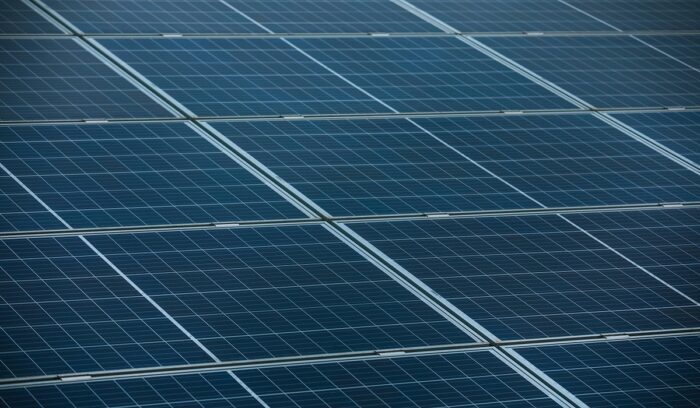
A physicist at the University of Newcastle has completed what may be the world’s first commercial installation of printed organic solar cells — a technology so cheap and fast to deploy that it could reshape how households and businesses access solar energy entirely.
At a glance
- Printable solar cells: The panels cost less than $10 per square meter to produce, are under one millimeter thick, and can be held in place with double-sided sticky tape.
- Commercial solar installation: A 200-square-meter pilot was completed in a single day by five workers — the first commercial application of organic printed solar technology in Australia and possibly anywhere in the world.
- Solar energy cost: Despite lower efficiency than silicon panels, the technology’s manufacturing and installation costs are so low that total energy cost at scale is expected to be competitive.
Professor Paul Dastoor has spent more than a decade developing organic printed solar cells at the University of Newcastle. In 2018 C.E., he moved from the lab into the real world with a 200-square-meter commercial pilot — a milestone he says demonstrates what happens when universities and industry stop waiting for government policy and simply act.
Paper-thin panels, serious potential
The panels look and feel like a potato chip packet. They are less than one millimeter thick and flexible enough to be produced in rolls by a lab-size printer capable of outputting hundreds of meters of material in a day. Installation requires no specialized crew or mounting hardware — just adhesive tape and a few hours of labor.
That simplicity is the point. Dastoor argues that the numbers most people reach for when evaluating solar — efficiency ratings and lifespan — are not the right measures for this technology.
“The question is how much does the energy cost?” he said. “These materials are so cheap to make, manufacture and install that when you calculate the total cost of energy when manufacturing at scale, it’s going to give you a competitive product.”
The tradeoff is real. Organic printed cells convert sunlight to electricity less efficiently than silicon panels, and they degrade more quickly. Dastoor is candid about both limitations. But he draws a comparison to early mobile phones — products that were initially limited and short-lived yet sparked an industry built on affordable plans, continuous upgrades, and mass accessibility.
An energy subscription model
Dastoor envisions a future in which companies sell solar energy the way carriers sell mobile data — as a subscription. Customers sign up, panels are installed quickly and cheaply, and when they degrade, they are replaced as part of the plan. The economics work precisely because the cost to manufacture and redeploy another set of cells is so low.
“I think over time our current picture of how we view solar energy and cells is going to fundamentally change,” he said.
This kind of thinking sits within a broader wave of clean energy milestones that are rewriting assumptions about who can access renewable power and how quickly it can be rolled out. From large utility-scale farms to rooftop arrays, the common thread is falling cost — and printed solar extends that logic further than almost any other format.
The 2018 C.E. pilot was Dastoor’s final proof-of-concept step before broader commercial availability. It followed a 2017 C.E. exhibition in Melbourne where organic printed cells powered screens and displays — an earlier public demonstration that the technology works outside the lab.
Industry and academia acting without waiting
Dastoor completed the commercial pilot against a backdrop of sustained gridlock in Australian energy policy. His framing of the moment was pointed: universities and industry partners were, in his words, “just getting on with things.” The 200-square-meter installation went up in a day, completed by five employees without specialized equipment.
The six-month pilot will generate real-world performance data under Australian conditions. Those results will shape how the technology is refined and how quickly it moves toward wider availability. Australia’s solar market is an apt testing ground — the country had already become one of the world’s leading adopters of rooftop solar per capita, driven by high electricity prices and strong sunlight.
Organic printed solar research has drawn attention from institutions including the U.S. National Renewable Energy Laboratory, which tracks the efficiency progress of emerging photovoltaic technologies. Printed organic cells remain at the lower end of the efficiency spectrum, but the gap with silicon has been narrowing as the chemistry improves. A 2022 C.E. review in Nature Energy noted that organic photovoltaics had crossed the 18% efficiency threshold in lab conditions — still below silicon’s commercial ceiling but a significant jump from where the field stood in 2018 C.E.
The technology is not yet a plug-and-play replacement for conventional panels. Durability under prolonged UV exposure, heat cycling, and moisture remains an active area of research, and no printed organic product has yet matched the 25-year warranties standard for silicon modules. Those are the honest constraints any commercial rollout will have to navigate.
But the direction of travel is clear. If the cost of entry drops far enough, solar stops being an infrastructure investment and becomes something closer to a utility service — accessible to renters, small businesses, and communities in the developing world that can’t afford conventional installations. That shift, more than any efficiency record, may be what Dastoor’s work ultimately represents.
Read more
For more on this story, see: The Guardian
For more from Good News for Humankind, see:
- India’s Gujarat solar park and the growth of utility-scale solar
- Australia’s rooftop solar record: 3.5 million panels in 2017
- The Good News for Humankind archive on solar energy
About this article
- 🤖 This article is AI-generated, based on a framework created by Peter Schulte.
- 🌍 It aims to be inspirational but clear-eyed, accurate, and evidence-based, and grounded in care for the Earth, peace and belonging for all, and human evolution.
- 💬 Leave your notes and suggestions in the comments below — I will do my best to review and implement where appropriate.
- ✉️ One verified piece of good news, one insight from Antihero Project, every weekday morning. Subscribe free.


