
Leonardo da Vinci paints the Mona Lisa
Mona Lisa, oil painting on a poplar wood panel by the Italian painter, draftsman, sculptor, architect, and engineer Leonardo da Vinci, is probably the world’s most-famous painting.

Mona Lisa, oil painting on a poplar wood panel by the Italian painter, draftsman, sculptor, architect, and engineer Leonardo da Vinci, is probably the world’s most-famous painting.

The frescoes, which take up the entirety of the vault, are among the most important paintings in the world.

The Garden of Earthly Delights is considered Bosch’s seminal masterpiece and the most successful and outstanding of his creations.

On 15 March 1503, Vasco da Gama, crossing from India to East Africa, sighted what was almost certainly Silhouette Island and the next day, Desroches Island. The granitic islands began to appear on Portuguese charts as the Seven Sisters.
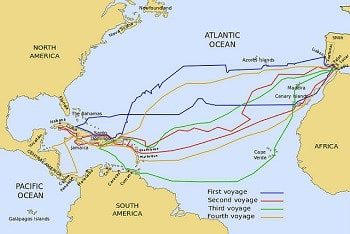
A year later Christopher Columbus on his fourth voyage, sailing south and eastward from upper Central America, explored Bocas del Toro, Veragua, the Chagres River and Portobelo (Beautiful Port) which he named.

Perhaps the first written record we have of a mother and baby surviving a cesarean section comes from Switzerland in 1500 when sow gelder, Jacob Nufer, performed the operation on his wife. The mother lived and subsequently gave birth normally to five children, including twins. The cesarean baby lived to be 77 years old.

Dating from 1493, when the Spanish settled on the island, and officially from 5 August 1498, Santo Domingo became the oldest European city in the Americas.

After sailing across the Atlantic Ocean, Italian explorer Christopher Columbus sights a Bahamian island, believing he has reached East Asia.

The A-Ma Temple is a temple to the Chinese sea-goddess Mazu located in São Lourenço, Macau, China. Built in 1488, the temple is one of the oldest in Macau and thought to be the settlement’s namesake.
Maravi was a kingdom which straddled the current borders of Malawi, Mozambique, and Zambia, in the 16th century. The present-day name ” is said to derive from the Chichewa word “malaŵÔ, which means “flames”.