Humans create art for the first time, possibly in Indonesia
The Griffith University professor Maxime Aubert and his team were able to determine that the Sulawesi paintings are, at minimum, 39,900 years old.
Archaeological evidence suggests that human beings arrived in Sarawak – overland – at least 40,000 years ago.
The oldest remains of modern humans in the islands, however, is the Tabon Man of Palawan, carbon-dated to 47,000 ± 11–10,000 years ago. The Tabon man is presumably a Negrito, who were among the archipelago’s earliest inhabitants, descendants of the first human migrations out of Africa.
According to the field of genetic genealogy, people first resided in Siberia by 45,000 B.C.E. and spread out east and west to populate Europe and the Americas.
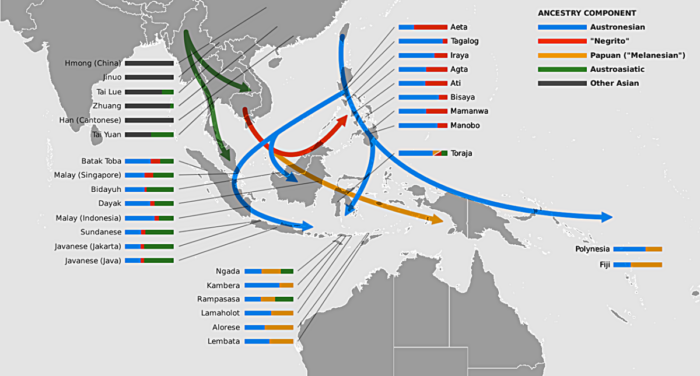
Early humans traveled by sea and spread from mainland Asia eastward to New Guinea and Australia. Homo sapiens reached the region by around 45,000 years ago.
The flutes, made from bird bone and mammoth ivory, come from a cave in southern Germany which contains early evidence for the occupation of Europe by modern humans – Homo sapiens.
They used carbon dating on nuggets of hearth charcoal and eggshells to discover that the shelter was first occupied about 50,000 years ago.
The profound cognitive shift known as behavioral modernity—the emergence of abstract thinking, deep planning, and symbolic— catalyzed the development of complex language development, artistic expression, and the establishment of long-distance trade networks and initiated an era of unprecedented ingenuity.
The emergence of ceremonial burial required profound human ingenuity: abstract thought, planning depth, and symbolic communication. This cognitive leap, evidenced by organized graves (like the 50,000-year-old Neanderthal burial at La Chapelle-aux-Saints) and symbolic grave goods, reinforced community bonds, empathy, and cultural memory.