
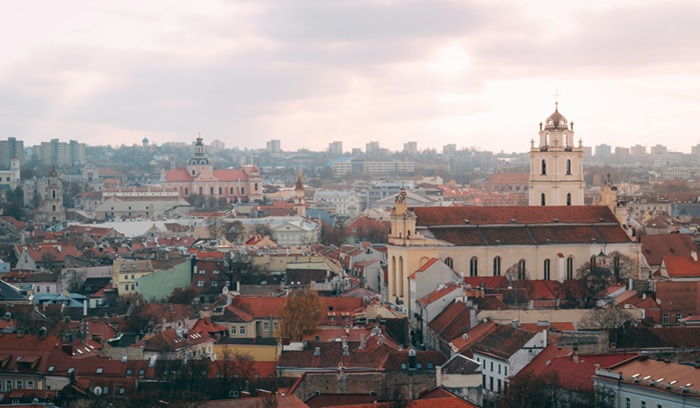
Lithuania has taken a historic step toward equality with a court ruling that granted state recognition to a same-sex couple. The Vilnius City District Court ruled in favor of two women who petitioned for recognition, affirming their right to be acknowledged as a legal family under the Lithuanian constitution (LGBTQ Nation).
This marks the first time in Lithuanian history that a same-sex couple has received such recognition, following the Constitutional Court’s April 2025 ruling that excluding same-sex couples from civil partnerships was unconstitutional.
Constitutional Foundations for Equality
The April 2025 Constitutional Court decision was groundbreaking, ruling that restricting civil partnerships to opposite-sex couples violated principles of equality, human dignity, and the right to family life (Wikipedia: Recognition of same-sex unions in Lithuania). The court also instructed the government to create a mechanism for registering same-sex partnerships until the Seimas, Lithuania’s parliament, passes formal legislation.
By granting recognition in this case, the Vilnius court effectively demonstrated how the constitutional ruling can now be applied in practice.
A Precedent-Setting Decision
The couple’s attorney, Aivaras Žilvinskas, stressed that the ruling illustrates how ordinary citizens can use the courts to defend their rights when lawmakers fail to act. The decision does not amount to full marriage equality, but it sets a precedent that other same-sex couples can follow through the judiciary (LGBTQ Nation).
Until the Seimas enacts comprehensive legislation on civil partnerships, the courts will remain a vital avenue for recognition and legal protection.
Lithuania’s Place in the European Context
Lithuania is one of the few European Union member states where same-sex marriage remains constitutionally banned and civil unions have not been legislated (Wikipedia: LGBTQ rights in Lithuania). Across Europe, however, recognition of same-sex unions is steadily expanding, with countries in Eastern Europe beginning to follow the path set by Western and Northern European nations (Wikipedia: Recognition of same-sex unions in Europe).
The Vilnius ruling therefore represents not only a breakthrough for Lithuanian citizens but also a broader signal that judicial activism may drive progress in regions where parliaments are slow to act.
Challenges and Public Opinion
Despite the legal progress, societal attitudes in Lithuania remain divided. Polling shows that urban and younger populations are more supportive of legal recognition for same-sex couples, while conservative values remain strong in rural areas and among older voters (Wikipedia: LGBTQ rights in Lithuania).
This tension has repeatedly stalled efforts to pass legislation in the Seimas, even though Lithuania is bound by EU principles to uphold human rights and equality.
Looking Forward
For the couple at the center of this case, the ruling means long-awaited recognition, dignity, and legal protections. For the wider LGBTQ+ community in Lithuania, it represents a new pathway to equality and a precedent that may inspire others to seek recognition through the courts.
The ruling also adds pressure on Lithuania’s lawmakers to fulfill the Constitutional Court’s mandate by drafting legislation for civil partnerships. Without such action, courts will continue to play a leading role in expanding rights case by case.
In sum, this decision demonstrates how constitutional principles can translate into lived rights. Lithuania has now taken a meaningful step toward justice, showing that even in environments resistant to change, the judiciary can be a powerful force for equality.
More Good News
-
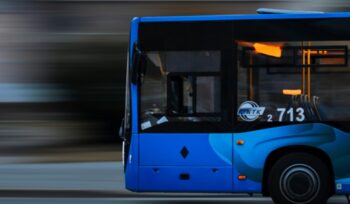
Senegal launches all-electric bus network powered by renewable energy
Senegal has successfully launched a transformative Bus Rapid Transit system in Dakar, featuring a fleet of 121 fully electric buses. As the first network in Sub-Saharan Africa to operate entirely on renewable energy, the initiative utilizes local solar power to transport up to 300,000 passengers daily. By utilizing dedicated lanes, the clean energy fleet cuts cross-city commute times in half while preventing nearly 60,000 tons of carbon dioxide emissions annually. This monumental project dramatically improves urban air quality and establishes Senegal as a pioneering leader in sustainable, green public infrastructure.
-

Yangtze River showing remarkable ecological recovery following fishing ban
China’s Yangtze River is experiencing a remarkable ecological revival five years into a sweeping ten-year commercial fishing ban. Recent surveys reveal significant increases in overall fish biomass and the heartening return of critically endangered species in the world’s fifth largest river. Furthermore, thousands of former commercial fishers have been successfully transitioned into new roles as official river guardians. This massive conservation effort offers a hopeful, replicable model for global freshwater restoration.
-

Rob Jetten becomes The Netherland’s first openly gay prime minister
In a historic victory for representation and progressive politics, Rob Jetten has been sworn in as the first openly gay Prime Minister of the Netherlands. At 38 years old, the centrist Democrats 66 leader is also the youngest head of government in Dutch history. Jetten successfully formed a minority coalition government following a tense election that defeated far-right populist opponents. His platform prioritizes climate investment, economic fairness, and strong international collaboration. Jetten’s premiership powerfully reaffirms the Netherlands’ global legacy as a pioneer of LGBTQ+ equality and inclusive, cooperative democratic leadership.
-

Millions of New York City workers gain additional time off through new law
Millions of workers in New York City are benefiting from a major expansion of the Protected Time Off Law, which officially took effect in late February 2026. The progressive legislation grants employees an additional 32 hours of unpaid, protected leave that is available immediately upon hire or at the start of the calendar year. This ensures workers do not have to wait to accrue hours before addressing sudden medical emergencies or family crises. The law also vastly expands permitted uses to include mental health care, public disaster recovery, and caring for disabled loved ones.
-

Malaysia bans electronic waste imports to protect the environment and public health
In a monumental victory for public health and environmental justice, Malaysia has enacted an immediate and absolute ban on the importation of electronic waste. By removing regulatory loopholes and launching a strict enforcement campaign, the nation is successfully preventing toxic heavy metals from polluting its soil and waterways. Authorities have already intercepted hundreds of thousands of kilograms of illegal e-waste at major ports, vowing to return the hazardous materials to their countries of origin. This decisive action establishes Malaysia as a leading force in Southeast Asia’s growing movement to reject global waste and prioritize ecological sustainability.