
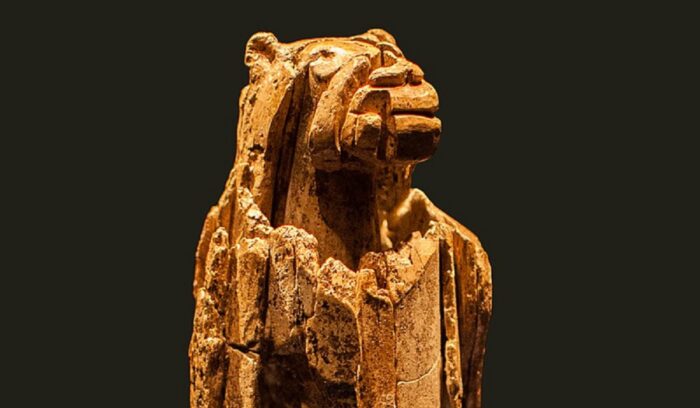
IOn August 25, 1939, just days before the outbreak of World War II, a team of excavators made a discovery in the Hohlenstein-Stadel cave that would eventually rewrite art history. Working in the Swabian Jura of southern Germany, anatomist Robert Wetzel and geologist Otto Völzing unearthed hundreds of fragmented mammoth ivory pieces. Due to the impending mobilization of the German army, the excavation was abruptly halted, and the shards were packed into a box and stored at the Museum of Ulm. It would take another thirty years for researchers to realize that these fragments formed a singular, cohesive figure: the “Lion-man.”
The Aurignacian Masterpiece
The people who created this figure belonged to the Aurignacian culture, the first anatomically modern humans to settle in Europe roughly 43,000 to 35,000 years ago. This specific statue dates to approximately 40,000 years ago, placing it at the very dawn of figurative art. Standing 31.1 centimeters (12.2 inches) tall, it is carved from the tusk of a woolly mammoth using flint tools. The wear on the body suggests it was passed around and rubbed by many hands, indicating it was a cherished object used in social or religious rituals for generations. Read about the Aurignacian culture and their art.
The Engineering of Imagination
Creating the Lion-man required an immense investment of time and resources that speaks to the sophistication of Aurignacian society. Experimental archaeology using authentic stone tools estimates that the figure took over 400 hours to carve. This means the artist spent months focused solely on this task, supported by a community that provided food and clothing in exchange for their spiritual labor.
The artist also demonstrated profound technical skill, splitting the curved tusk and utilizing the natural pulp cavity to form the space between the legs. This structural ingenuity prevented the ivory from shattering during the delicate carving process. Learn more about the experimental reconstruction.
The Dawn of Abstract Thought?
The Lion-man represents a cognitive leap known as “behavioral modernity,” marking the moment humans began to create images of things that do not exist in the physical world. Unlike earlier markings or simple depictions of animals, this figure is zoomorphic, blending the body of a human with the head of a cave lion. This synthesis of two distinct biological categories—human and apex predator—suggests the development of complex mythology or religious belief.
It implies that these early humans were capable of abstract thought, imagining supernatural beings that possessed the strength of a lion and the agency of a person. This ability to construct and share imaginary worlds is a defining characteristic of the human experience. Explore the cognitive significance of the Lion-man.
A Legacy of Resilience
The survival of the Lion-man through the Ice Age and its rediscovery during the chaos of the 20th century serves as a powerful symbol of human resilience. The figure was found in a layer of the cave associated with hearths and occupation, suggesting it was part of daily life rather than a hidden treasure. Its presence likely strengthened social bonds, acting as a “social glue” that helped the group navigate the harsh Pleistocene environment.
Today, the Lion-man stands as the oldest uncontested example of figurative art in the world, a silent witness to the birth of the human imagination. It reminds us that the drive to create meaning and beauty is as fundamental to our species as the need for shelter or food. View the Ulm Museum collection details.