
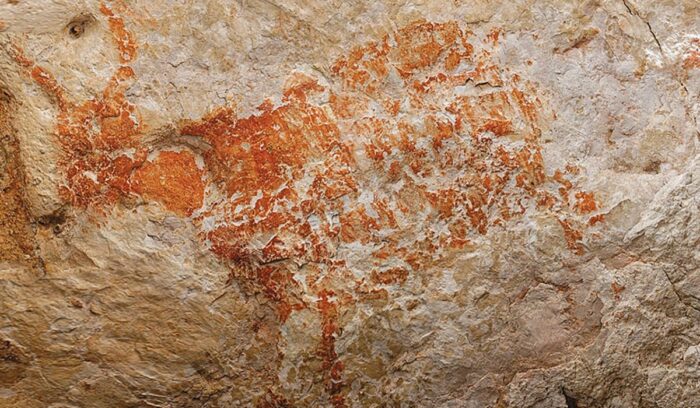
Deep in the limestone karst caves of Sulawesi, Indonesia, a profound shift in human expression occurred tens of thousands of years ago. Ancient inhabitants ventured into these subterranean chambers to leave enduring marks of their existence on the cave walls. The discovery of these artworks reshaped our understanding of where and when human creativity first blossomed.
For decades, the prevailing scientific narrative suggested that complex artistic expression originated exclusively in Western Europe. However, researchers applying uranium-series dating to the mineral crusts covering the Indonesian paintings revealed a very different timeline. The results showed that these Southeast Asian artworks were created at least 39,900 years ago, placing them on par with European examples.
The Ingenuity of the Stencil
Among the most striking discoveries in the Maros caves are the hand stencils created by early humans. To produce these images, individuals pressed their hands against the rock surface and blew a mixture of red ochre and liquid from their mouths. This early airbrushing technique demonstrates a remarkable level of technical ingenuity and forward planning.
Creating these stencils required artists to understand how to process mineral pigments into a workable paint. They had to gather iron oxide, grind it into a fine powder, and mix it with a binding agent such as water or animal fat. This chemical knowledge highlights the resourcefulness of these ancient populations. Read about the earliest spray-painted art
These handprints are more than mere aesthetic exercises; they represent a deliberate externalization of human identity. By leaving a permanent physical record of their presence, these individuals were declaring their existence to future generations. This act of marking territory and self is a fundamental milestone in the evolution of human consciousness.
Depicting the Natural World
Alongside the hand stencils, the caves feature intricate paintings of local wildlife, including the babirusa, a unique species of pig-deer endemic to the island. One specific painting of a babirusa was dated to a minimum of 35,400 years ago, making it one of the oldest known figurative depictions in the world. The attention to detail in the animal’s physical form suggests a deep familiarity with the natural environment.
The ability to observe an animal in the wild and later reproduce its likeness from memory is a significant cognitive achievement. It requires abstract thinking and the capacity to translate a three-dimensional living creature into a two-dimensional image. This artistic endeavor likely played a vital role in sharing knowledge about local fauna within the community. Explore the significance of the Sulawesi cave paintings
Researchers suggest these animal paintings may have been related to storytelling traditions or imparting survival knowledge. By rendering the animals on the cave walls, the artists created visual aids that could pass ecological information to younger members of the group. Regardless of the exact motivation, the art served as a powerful tool for community cohesion and cultural transmission.
A Global Heritage of Creativity
The realization that art was being created simultaneously in both Europe and Southeast Asia roughly 40,000 years ago carries profound implications. It suggests that the cognitive capacity for symbolic art was already fully developed in early modern humans before they migrated out of Africa. Alternatively, it indicates that the drive to create art arose independently in different populations facing similar environmental and social landscapes.
This shared heritage of creativity emphasizes that the desire to produce art is a universal human trait rather than an isolated cultural phenomenon. The ancient artists of Sulawesi used their ingenuity to transform dark cave walls into vibrant canvases of communication. Their work continues to inspire awe and provides a tangible connection to the minds of our distant ancestors. Learn more about the dating of these ancient artworks
The preservation of these sites is crucial for understanding the complete narrative of human evolution and artistic development. However, environmental changes and industrial activity pose significant threats to the delicate limestone caves and their precious contents. Safeguarding this global heritage requires international cooperation and a commitment to protecting the physical records of our shared past. Discover the efforts to preserve Southeast Asian rock art
More from the Archive of Human Genius
-

31 countries sign the Vienna Convention on Road Signs and Signals
In 1968, the United Nations adopted the Vienna Convention on Road Signs and Signals, marking a historic moment in international road safety. The treaty was designed to harmonize traffic signs, […]
-
Humans create art for the first time, possibly in Indonesia
Deep in the limestone caves of Sulawesi, Indonesia, early humans created some of the world’s oldest art 39,900 years ago. By processing red ochre and blowing it over their hands to form stencils, they proved complex artistic expression wasn’t exclusive to Europe, representing a universal milestone in human consciousness.
-

Humans, perhaps in East Timor, begin fishing in the open sea
The discovery of 42,000-year-old shell hooks in East Timor provides the first definitive proof that early humans had mastered deep-sea fishing. By targeting open-ocean species like tuna, these ancient mariners demonstrated a level of technological ingenuity and planning depth that transformed the ocean from a barrier into a vital highway for global expansion.
-
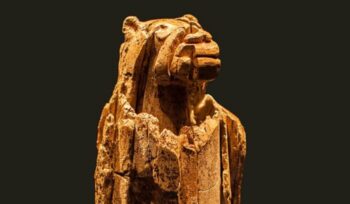
Lion-man of the Hohlenstein-Stadel, the first known example of figurative art, is made
Discovered in 1939 at the Hohlenstein-Stadel cave in Germany, the 40,000-year-old “Lion-man” is the Aurignacian culture’s masterpiece. This ivory figure, requiring 400 hours to carve, proves early humans possessed the abstract imagination to create supernatural beings, marking the dawn of complex symbolism and mythology.
-

Ritual cremation practiced for first time, perhaps in modern-day Australia
The 42,000-year-old cremation of “Mungo Lady” at Lake Mungo, Australia, marks a pivotal moment in human history. As the world’s oldest known ritual cremation, it provides powerful evidence that early humans possessed complex spiritual beliefs and abstract thought, transforming death from a biological event into a profound cultural rite.