
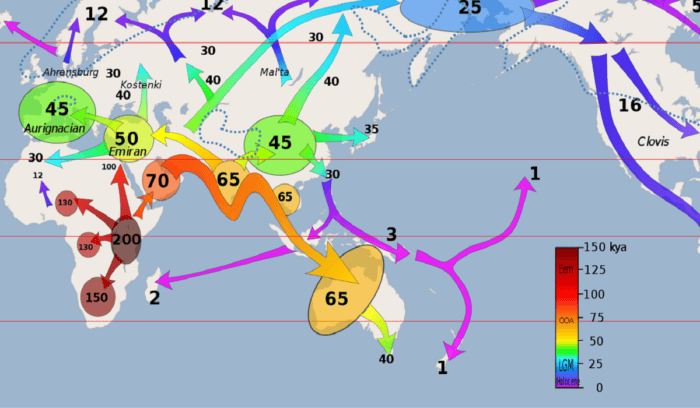
Long before the pyramids, before writing, before the wheel, a population of early Homo sapiens made Southern Africa their home — and stayed. Their descendants, the ancestors of today’s Khoisan peoples, would become one of the oldest continuous human lineages on Earth, carrying within them a genetic record that still tells part of the story of all of us.
What the evidence shows
- Southern Africa settlement: Homo sapiens reached what is now South Africa before 130,000 years ago C.E., and possibly as early as 260,000 years ago C.E., making this one of the earliest known regions of sustained human habitation.
- Khoisan ancestry: The populations ancestral to today’s Khoisan peoples are thought to have represented the largest human population for much of the anatomically modern human timeline — from their early separation before 150,000 years ago C.E. until the peopling of Eurasia around 70,000 years ago C.E.
- Blombos Cave artifacts: Archaeological sites including Blombos Cave preserve personal ornaments, ochre-based pigment kits, and bone tools from this period — among the earliest evidence of symbolic thinking and artistic production anywhere in the world.
A population at the center of human origins
Modern humans evolved in Africa. But Africa is vast, and the story of where early Homo sapiens put down roots — and why — is still being pieced together. Southern Africa, with its rich coastlines, diverse ecosystems, and deep cave systems, appears to have been one of the most significant of those early homelands.
The populations who settled here were not a brief wave passing through. They persisted. Over tens of thousands of years, they adapted to dramatic climate shifts — cycles of glacial cold, coastal flooding, and expanding grasslands — developing technologies and strategies that allowed them to survive where others could not.
Genetic research confirms their deep antiquity. The Khoisan lineage separated from all other human populations earlier than any other living group. In a very real sense, studying the genetic heritage of Khoisan communities today offers a partial window into what all of humanity once looked like — before the migrations, before the mixing, before the dispersal out of Africa roughly 70,000 years ago C.E.
What they built and left behind
The archaeological record from this period is remarkable. Blombos Cave, on South Africa’s southern coast, has yielded ochre engraved with geometric patterns — among the earliest known examples of abstract symbolic expression. Nearby sites at Still Bay and Howieson’s Poort reveal sophisticated, variable tool technologies — blades, points, and implements that show planning, craft knowledge, and adaptation.
These weren’t scattered campsites left by people passing through. They were places returned to, modified, and used across generations. The evidence points to communities with knowledge systems, social structures, and creative lives.
There is also evidence of movement. Between 120,000 and 75,000 years ago C.E., some populations moved back northward toward East Africa, tracing routes that may have contributed — indirectly — to the later dispersal of humans out of Africa entirely. Southern Africa was not a dead end. It was a hub.
The Khoisan as living continuity
What makes this milestone unusual in human prehistory is that it has a living legacy. The San and Khoikhoi peoples — grouped together under the term Khoisan — are the modern descendants of these early Southern African populations. Their languages, among the most phonetically complex on Earth and featuring the distinctive click consonants found nowhere else, carry forward tens of thousands of years of continuous cultural evolution.
Genetic studies, including landmark research published in the journal Cell, have confirmed that the Khoisan carry the deepest-rooting branches of the human family tree. Their existence is not a footnote to human history. It is one of its longest chapters.
Around 20,000 years ago C.E., a further expansion of Khoisan-ancestral populations spread click consonant sounds across a wider region of Eastern Africa — a linguistic echo of demographic movement that researchers can still trace in languages like Hadza today.
Lasting impact
The settlement of Southern Africa before 150,000 years ago C.E. helped establish one of humanity’s most genetically and culturally significant populations. The symbolic technologies developed here — engraving, ochre use, personal ornamentation — represent early expressions of the cognitive capacities that would eventually give rise to art, language, and complex society everywhere.
Southern Africa’s role as a refuge during harsh climate periods may have been critical to human survival. When glacial cycles contracted habitable land across the continent, coastal and riverine zones in the south offered food, shelter, and stability. The people who endured here didn’t just survive — they innovated.
Their genetic legacy flows, in measurable ways, into the broader human family. Research into ancient DNA and population genetics has repeatedly returned to Southern Africa as a key node in understanding how all modern humans are related.
Blindspots and limits
The date range for first settlement — somewhere between 130,000 and 260,000 years ago C.E. — is genuinely uncertain, and the year used here (approximately 150,000 B.C.E.) is an estimate within that range, not a confirmed figure. Much of the physical evidence has not survived: organic materials decompose, sea levels have risen and shifted coastlines, and only a small fraction of archaeological sites have been excavated. The record we have is fragmentary.
It is also worth stating plainly that the Khoisan peoples, whose ancestry stretches back to this period, have faced severe displacement, violence, and marginalization in more recent centuries — a history that sits in sharp contrast to the deep time significance of their lineage.
Read more
For more on this story, see: Early history of South Africa — Wikipedia
For more from Good News for Humankind, see:
- Ancient bone harpoons show humans were fishing 90,000 years ago
- Early humans occupy Ksar Akil, leaving some of the oldest personal ornaments in Western Eurasia
- The Good News for Humankind archive on prehistory
About this article
- 🤖 This article is AI-generated, based on a framework created by Peter Schulte.
- 🌍 It aims to be inspirational but clear-eyed, accurate, and evidence-based, and grounded in care for the Earth, peace and belonging for all, and human evolution.
- 💬 Leave your notes and suggestions in the comments below — I will do my best to review and implement where appropriate.
- ✉️ One verified piece of good news, one insight from Antihero Project, every weekday morning. Subscribe free.


