
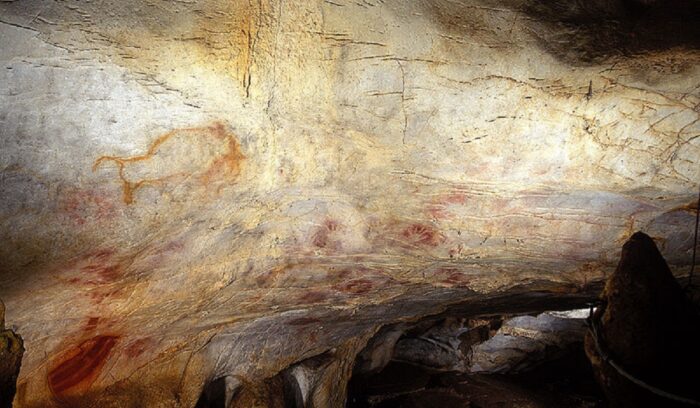
Deep within the limestone cavern of El Castillo in Cantabria, Spain, a pivotal moment in the history of consciousness took place more than 40,800 years ago. In the flickering light of torches, an ancient hand pressed against the cold rock wall. Red pigment, carefully prepared and held in the mouth, was blown over the hand, leaving a negative stencil that would endure for millennia. This act was not merely graffiti; it was a deliberate assertion of existence and the earliest known example of cave art in Europe.
The Science of Stone and Time
For decades, the true age of these paintings remained a mystery, as traditional radiocarbon dating could not be used on pigments lacking organic matter. The breakthrough came when researchers applied Uranium-Thorium dating to the tiny calcite crusts that had formed naturally on top of the art. By measuring the radioactive decay of uranium into thorium within these mineral deposits, scientists could determine a minimum age for the paintings beneath.
The results were shattering. The red disk at El Castillo was found to be at least 40,800 years old, while a nearby hand stencil dated to at least 37,300 years ago. This pushed the timeline of European cave art back by nearly 10,000 years, challenging previous assumptions that complex artistic expression began only with the Chauvet paintings in France. This scientific ingenuity allowed us to peer further back into the human mind than ever before. Read about the dating breakthrough.
A Shared Legacy of Creativity
The extreme age of these paintings raises a profound question: who were the artists? The date of 40,800 years ago sits right at the intersection of Neanderthal decline and the arrival of anatomically modern humans (Homo sapiens) in Europe. This suggests two fascinating possibilities: either modern humans arrived in Europe already possessing a fully developed artistic culture, or these works were created by Neanderthals.
Later discoveries at caves like Maltravieso and Ardales have pushed dates even further back to over 64,000 years ago, strongly implying that Neanderthals were indeed the continent’s first artists. This realization redefines our understanding of “human” behavior. It suggests that the capacity for symbolic thought—the ability to let one thing (a mark on a wall) represent another (an idea or identity)—is a shared trait of the human genus, not exclusive to our specific species. Explore the Neanderthal art debate.
The Ingenuity of the First Masters
Creating these images required far more than a sudden creative impulse; it demanded complex planning and technical skill. The artists had to venture deep into the earth, necessitating the invention of reliable lighting systems, such as animal-fat lamps, to navigate the pitch-black corridors. They also had to locate and process mineral pigments, specifically iron oxide (ochre), grinding it into a powder and mixing it with a binder to ensure it would adhere to the damp walls.
The “spitting” or blowing technique used for the hand stencils reveals a sophisticated understanding of fluid dynamics and tool use. The artist likely used two hollow bones or simply their mouth to atomize the liquid pigment, creating a spray-paint effect. This early airbrushing technique allowed them to record their physical presence, leaving a signature that says, “I was here, I am real.” Learn about the techniques of cave art.
Positive Contributions to Human Identity
The emergence of cave art marked the beginning of externalized memory. For the first time, humans were not just surviving in their environment but actively interpreting and marking it. These decorated caves likely served as social hubs, places for ritual, storytelling, and the transmission of cultural knowledge across generations.
This “symbolic revolution” fostered stronger social bonds and cooperation, essential traits for survival in the harsh Ice Age environment. The art at El Castillo stands as a monument to the human need for connection and meaning. It reminds us that creativity is not a luxury of civilization but a fundamental instinct that helped us—and our ancient cousins—become truly human. View the UNESCO significance of Northern Spanish caves.