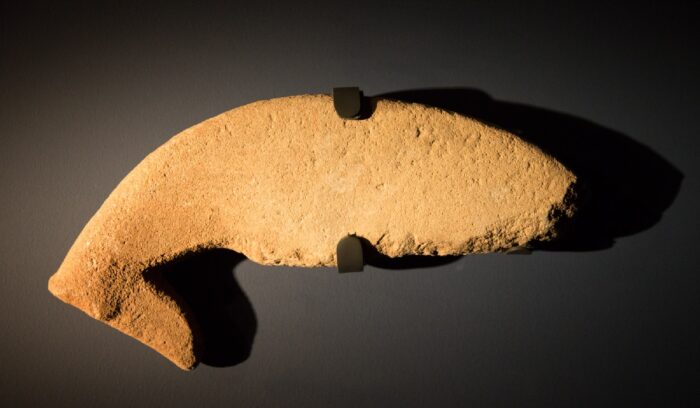
Humans begin cultivating yams in West Africa
People started to cultivate yams, rather than digging up wild ones, as long as 10,000 years ago in both Africa and Asia, and some time later in the New World.
The earliest pottery ever found in the Western Hemisphere, radiocarbon-dated 8,000 years old, has been excavated in the Amazon basin of Brazil, near Santarém, providing evidence to overturn the assumption that the tropical forest region was too poor in resources to have supported a complex prehistoric culture.
The Capsian culture was a Mesolithic and Neolithic culture centered in the Maghreb that lasted from about 8,000 to 2,700 B.C.E.
Archaeologists have long debated what caused the Neolithic Revolution, when prehistoric human beings gave up the nomadic life, founded villages and began to farm the land.
The oldest known fishing net is the net of Antrea, found with other fishing equipment in the Karelian town of Antrea, Finland, in 1913. The net was made from willow, and dates back to 8300 B.C.E.
Fully-developed village farming emerged at various Zagros sites such as Jarmo, Sarāb, upper Ali Kosh, and upper Gūrān.
Al-Magar was a prehistoric culture of the Neolithic whose epicenter lied in modern-day southwestern Najd in Saudi Arabia. Al-Magar is possibly one of the first cultures in the world where widespread domestication of animals occurred.
We know that humans have lived with cats for at least 10,000 years –there’s a 9,500-year-old grave in Cyprus with a cat buried alongside its human, and ancient Egyptian art has a popular motif showing house cats eating fish under chairs.
Cinnamon is native to Sri Lanka and has been found in Ancient Egypt as early as 1500 B.C.E., suggesting early trade between Egypt and the island’s inhabitants.
Maize, also known as corn, is a cereal grain first domesticated by indigenous peoples in southern Mexico about 10,000 years ago. Maize has become a staple food in many parts of the world, with total production surpassing that of wheat or rice.