
Johannes Kepler publishes his three laws of planetary motion
Kepler’s work improved the heliocentric theory of Nicolaus Copernicus, explaining how the planets’ speeds varied, and using elliptical orbits rather than circular orbits with epicycles.

Kepler’s work improved the heliocentric theory of Nicolaus Copernicus, explaining how the planets’ speeds varied, and using elliptical orbits rather than circular orbits with epicycles.

His machine was composed of two sets of technologies: an abacus made of Napier’s bones and a dialed pedometer to perform additions and subtractions.

The first depiction of Terra Australis on a globe was probably on Johannes Schöner’s lost 1523 globe on which Oronce Fine is thought to have based his 1531 map of the world.

A printing press is a device for applying pressure to an inked surface resting upon a print medium (such as paper or cloth), thereby transferring the ink. This was a dramatic improvement on earlier printing methods.
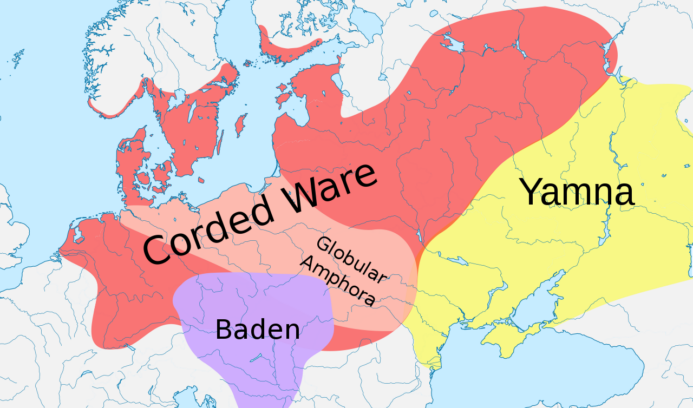
Corded Ware culture encompassed a vast area, from the contact zone between the Yamnaya culture and the Corded Ware culture in south Central Europe, to the Rhine on the west and the Volga in the east, occupying parts of Northern Europe, Central Europe and Eastern Europe.
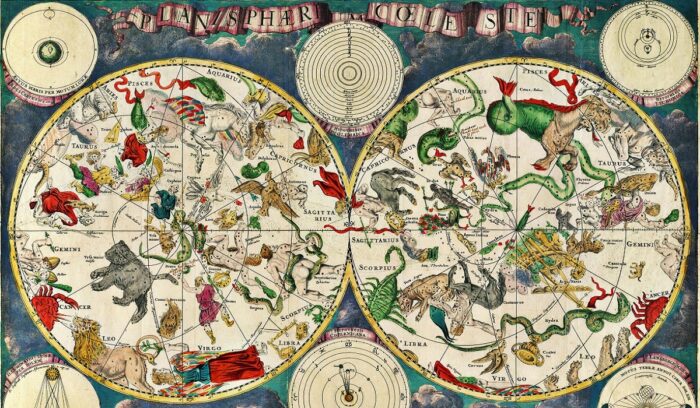
The oldest known star chart may be a carved ivory Mammoth tusk that was discovered in Germany in 1979. This artifact is 32,500 years old and has a carving that resembles the constellation Orion.

Discovered in 1939 at the Hohlenstein-Stadel cave in Germany, the 40,000-year-old “Lion-man” is the Aurignacian culture’s masterpiece. This ivory figure, requiring 400 hours to carve, proves early humans possessed the abstract imagination to create supernatural beings, marking the dawn of complex symbolism and mythology.